Writing about music is like dancing about architecture
Showing posts with label library. Show all posts

Friday, 9 September 2011

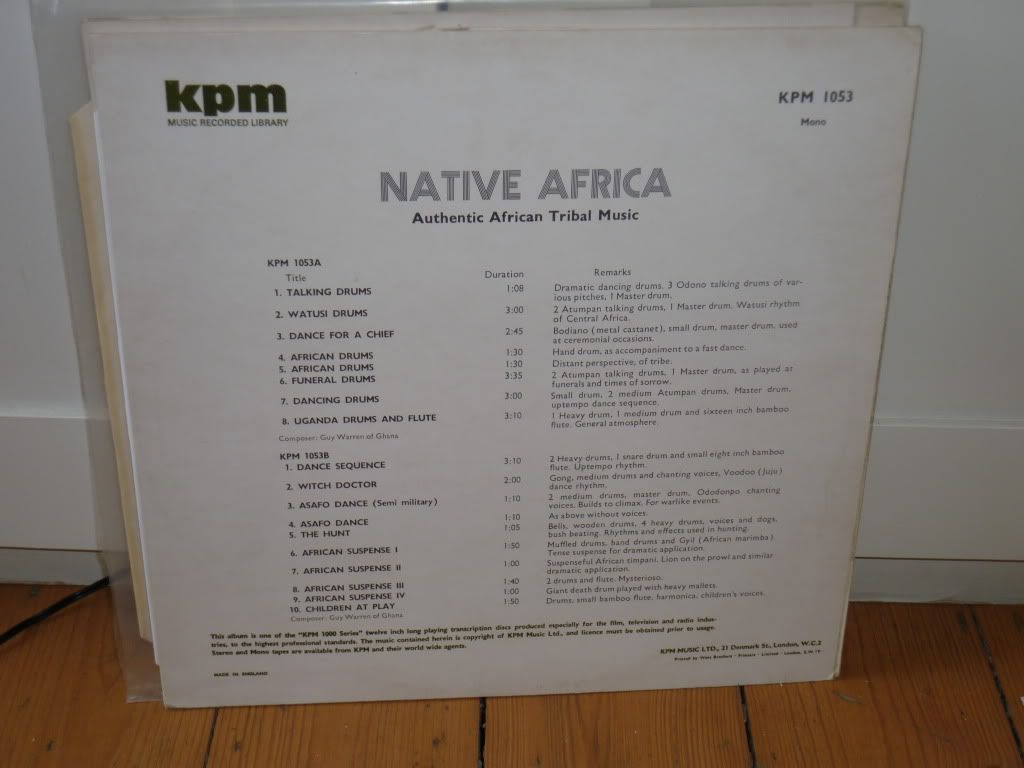
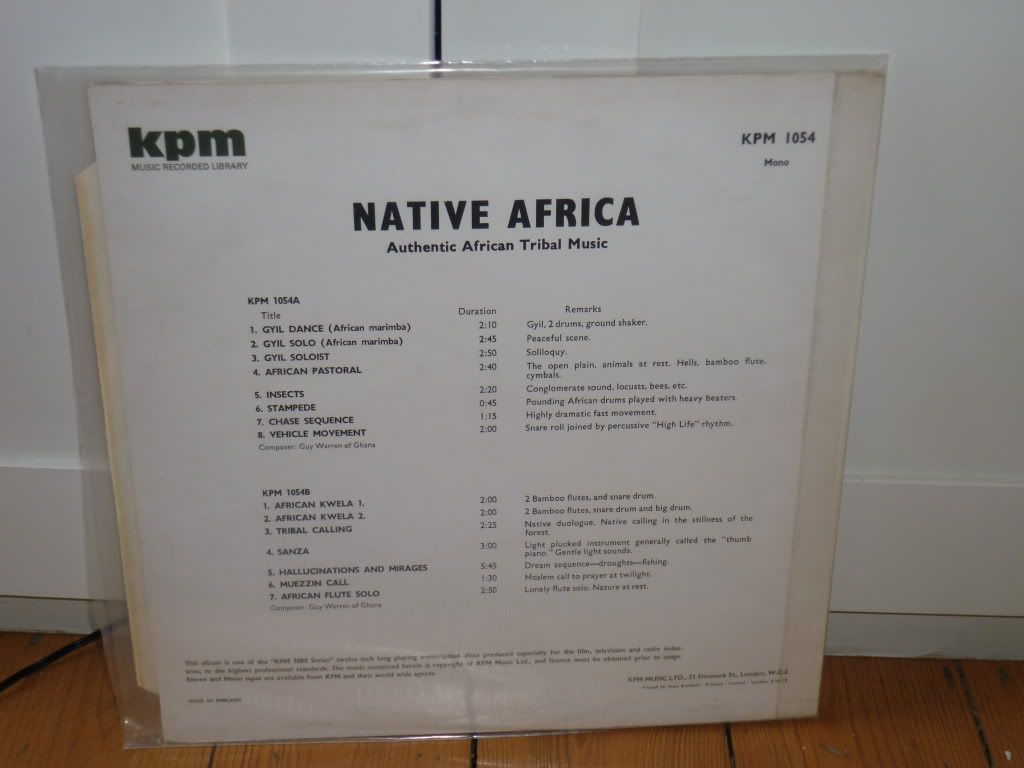
GUY WARREN - NATIVE AFRICA - KPM 1053 and 1054

Did I ever mention that I am obsessed with Guy Warren of Ghana?
Maybe at least once!
Anyway, here are a couple of records he did for KPM in 1968.
In 1968 he was in London (of course) and had just recorded Afro Jazz with Don Rendell, Ian Carr and Amancio D'Silva.
He would team up with D'Silva again for The African Soundz which you can read about here.
The money from KPM must have been good to persuade Guy to make these two records. Why else take time from your career to record two albums worth of material? The suspicion, before you've even put the needle on the record, is that he was going through the motions. A chance to earn some money and just exploit the situation.
But of course when you listen to the music and hear the quality of the songs, it is clear that this was not the case.
I must admit that when I first heard these records I was reminded of lots of very worthy 'in the field' recordings of African musicians. You know the stuff - field recordings of so-called 'ethnic' musicians, which come in worthy sleeves with lots of footnotes about the collator of the music, but little about the people who made it or how it fits into local culture.
By 1968 Guy Warren had moved beyond all of that easily categorizeable stuff.
Having played in London with Kenny Graham (another obsession of mine) and in the US with some of the legends of bebop, Warren was international. He had even been a DJ for the BBC World Service for God's sake!
Nevertheless these are his least jazz-influenced recordings. The usual KPM descriptions (click on the pictures to get a larger image) reference, Watusi (or as we say now Tutsi), Uganda, Asafo and Muslim music. They also talk about natives, lions, insects, tribes and witch doctors. I guess the best you can say is that it was 1968!
You can imagine the kind of programme that these tracks were intended to soundtrack. A white man, perhaps in khaki shorts and with a neat beard, drives a beaten up Land Rover across the veld. Perhaps he is accompanied by a faithful retainer, dressed in a mix of Western and local clothes. As they drive along, the camera pans back to show giraffe or elephants. You can hear drum-based music in the background to show that we really are in the deep heart of Africa!

Listening to these records make me wonder about Warren's relationship to Europe and America. Like many African artists he had left Africa to pursue his musical aspirations. How, did he have to compromise to achieve his aims? Did he relish the opportunity of recording these tracks for KPM or was is a distraction from his more jazz-related work? Did he find it easy to be a Ghanaian in London?

As with all things related to Guy Warren of Ghana it is best to let the music do the talking. I have taken my favourite tracks from each record. Apologies if you favourite isn't here.

01. Talking Drums - Dramatic dancing drums. 3 Odono talking drums of various pitches, 1 Master drum
02. Dancing Drums - Small drum, 2 medium Atumpan drums, Master drum, uptempo dance sequence
03. Uganda Drums and Flute - 1 Heavy drum, 1 medium drum and sixteen inch bamboo flute. General atmosphere
04. Witch Doctor - Gong, medium drums and chanting voices, Voodoo (Juju) dance rhythm
05. Asafo Dance (Semi Military) - 2 medium drums, master drum, Ododonpo chanting voices. Builds to climaz. For warlike events
06. African Suspense III - 2 drums and flute. Mysterioso
07. Children At Play - Drums, small bamboo flute, harmonica, children's voices
08. Gyil Dance (African marimba) - Gyil, 2 drums, ground shaker
09. Gyil Solo (African marimba) - Peaceful scene
10. African Pastoral - The open plain, animals at rest. Hells (sic), bamboo flute, cymbals
11. Vehicle Movement - Snare roll joined by precussice "High Life" rhythm
12. African Kwela I - 2 Bamboo flutes, and snare drum
13. Tribal Calling - Native duologue. Native calling in the stillness of the forest
14. Sanza - Light plucked instrument generally called the "thumb piano". Gentle light sounds
15. Hullcinations and Mirages - Dream sequence - droughts - fishing
16. African Flute Solo - Lonely flute solo. Nature at rest

Native Africa - click here

Wednesday, 7 September 2011

PAT PRILLY - MOOG SUONO DEL DOMANI - CANOPO 12

During a recent trip to Paris I found this in a dodgy shop on Montmatre. Amidst scratched Blue Notes and overpriceds 80s 'wave', nestled this record.
It had to be mine!
As we all know Pat Prilly was a pseudonym for Jean Jacques Perry.
This music is the sound of the future - or at least the future from the perspective of 1972.
For some reason it reminds me of Zardoz, the film with Sean Connery wearing strange pants. I don't know why, as none of the music was used in the film, but that's just the weird way my mind works.


Here is the track list - and mouthwatering it it too:

Side A
1. Treno Sperimentale
2. Canali Di Marte
3. Misteri Del Cosmo
4. Irrealta
5. Musica Dell'Infinito
6. Vibrazioni Magnetiche
7. Viaggio Nell'Incoscio
8. Cardifonia

Side B
1. Uomo 2000
2. Il Nulla
3. Altitudine
4. Frontiere Dello Sconosciuto
5. Elettrosintesi
6. Mondo Del Futuro
7. Psycho

As the notes on "Questo disco che vi proponiamo non contiene alcuna musica tradizionale ed e stato interamente realizzato con sonorita di orgine elettronica utilzzando uno strumento rivoluzionario: il sintetizzatore Moog."

Listen for yourselves here

Apologies for the odd pops  - but that's what you get with vinyl!

Monday, 16 May 2011

MUSIC OF THE DEAD - SOUNDTRACKS TO ROMERO'S ZOMBIE MOVIES

From the title of this blog you could probably guess I was a Romero fan. I've loved his Zombie movies ever since I caught Day of the Dead on late night TV when I was far too young to be allowed to watch it. Which made it all the more thrilling!
I had never seen anything like it. The gore and blood were good, although I don't remember being too grossed out by them - perhaps it was a cut version. But it was the political message of the film that got me. Even as a small kid I could tell that this was an attack on consumer society - or shopping as I called it in those days. I can barely go to a shopping mall today without looking at all of the shopping zombies around me. I am, of course, not like them!
When I discovered that there were more films by the same director I was thrilled. What I didn't realise is that they were all so different. Of course, being different they also have very different soundtracks.
The soundtrack to 1968's Night of the Living Dead wasn't released until 1982. In part that was because the 'soundtrack' consisted of library cuts chosen by Romero from the Capitol Hi-Q Library.
When choosing the music he wanted, Romero made a deliberate effort to select music that he thought evoked earlier horror films. Whether deliberately or accidentally he chose tracks that had been previously used in The Hideous Sun Creature, Teenagers from Outer Space and Terror from the Year 5,000 (none of which I've seen!).
The use of library music, although undoubtedly financially motivated, unintentionally adds to the tension and in some places horror of the film. The music is 'familiar', it instantly evokes the kind of emotions that are expected. We have all heard this 'kind' of music before and, even if we don't consciously hear it our emotions are directed by it.
String driven and melodramatic, these tracks have, for me, moved beyond mere background music and now remind me of each scene. However, without the images of the zombies the music can in places be quite beautiful. I particularly like First Advance by Ib Glindemann for its imaginative use of heavy percussion and strings.
If you haven't seen the film, shame on you. And now is your chance to see it:-


Night of the Living Dead was such a success that it was inevitable that Romero should make a sequel, although he tried not to and made the not very successful romantic comedy There's Always Vanilla, the unsatisfactory Season of the Witch, the creepy Crazies and the even more creepy Martin before returning to the undead.
The story of the production of Dawn of the Dead is convoluted. You can read about it here.
One of the results of Romero's partnership with Italian film-maker Dario Argento was the use of the Italian prog rock band Goblin on the soundtrack. Goblin's first film score had been for the European cut of Romero's Martin.
Needless to say the music is much more modern than the 1950s cuts in the previous film. But then Dawn is also a more sophisticated film. Shot in colour, with a bigger budget and superior special effects the synthesisers and metronomic beat of the Goblin score provides the perfect accompaniment.
I love the space that each track has and the way that they develop slowly. The build of tense is achieved in much the same fashion as the earlier library tracks, but this time it is a synthesiser rather than a string section that produces the creepy effect.
Claudio Simonetti, keyboardist for Goblin went on to write disco and I think you can hear it in some of the funkier passages of the record.
Although, for me, the highlights are the electronic pieces there are also some, very strange, violin tracks which sound very unconvincing.
Just as there are many versions of the film there are many versions of the soundtrack, even a Japan only 45!
I am afraid to say that mine is the Dagored 2000 release.
In the end the Goblin music was only used in the Italian/ European release (which was cut in a different way too).
However, my version of the extended cut includes the Goblin music as well as the music used on the American release.
Again if you haven't seen the film then there must be something wrong with you:
Here it is:

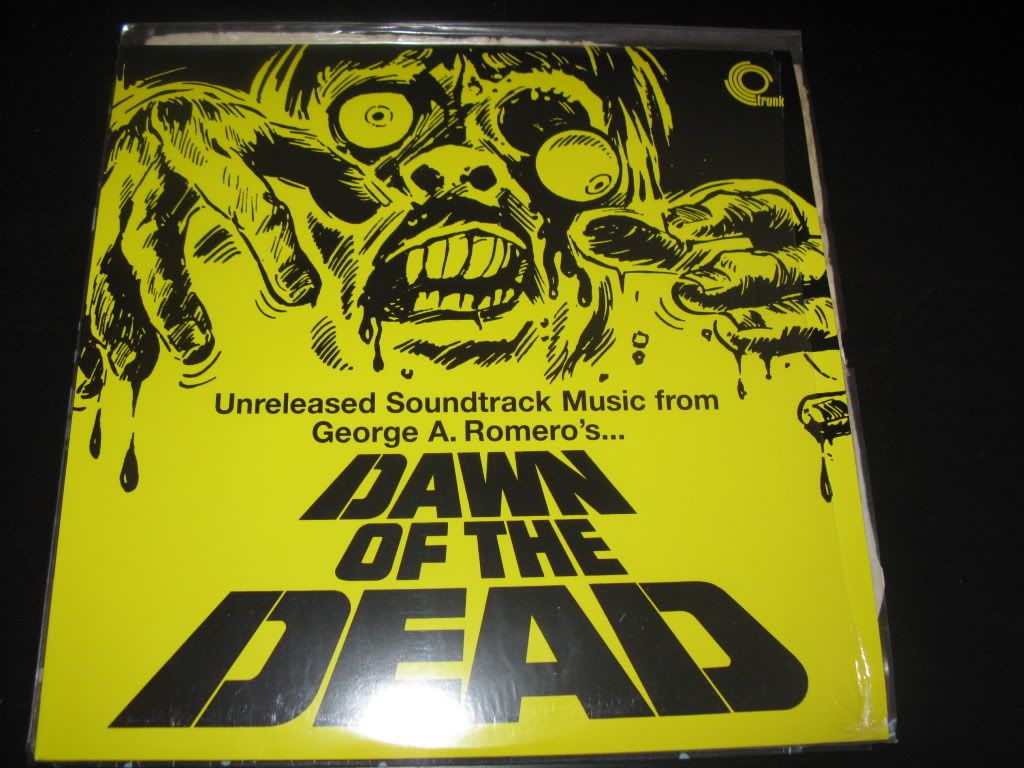
The Goblin music was only part of the Dawn of the Dead soundtrack but until the nice people at  Trunk Records it was unavailable.

Terrible sleeve mind you. Doesn't it look slightly like Phil Seaman? Check for yourself here.

Just as he had done for Night of the Living Dead, Romero used library recording for his soundtrack to Dawn of the Dead. Using the De Wolfe Library this time Romero brought together a group of song with a completely different feel.
Gone are the 50s B-Movie horror strings and in their place is a mix of menacing synthesisers, some very avant garde sounding works and even some Radiophonics.
I tracks such as Cosmology Part 1 by Pierre Lemel are almost too difficult for me to listen to - although just for the sake of this blog I have done!
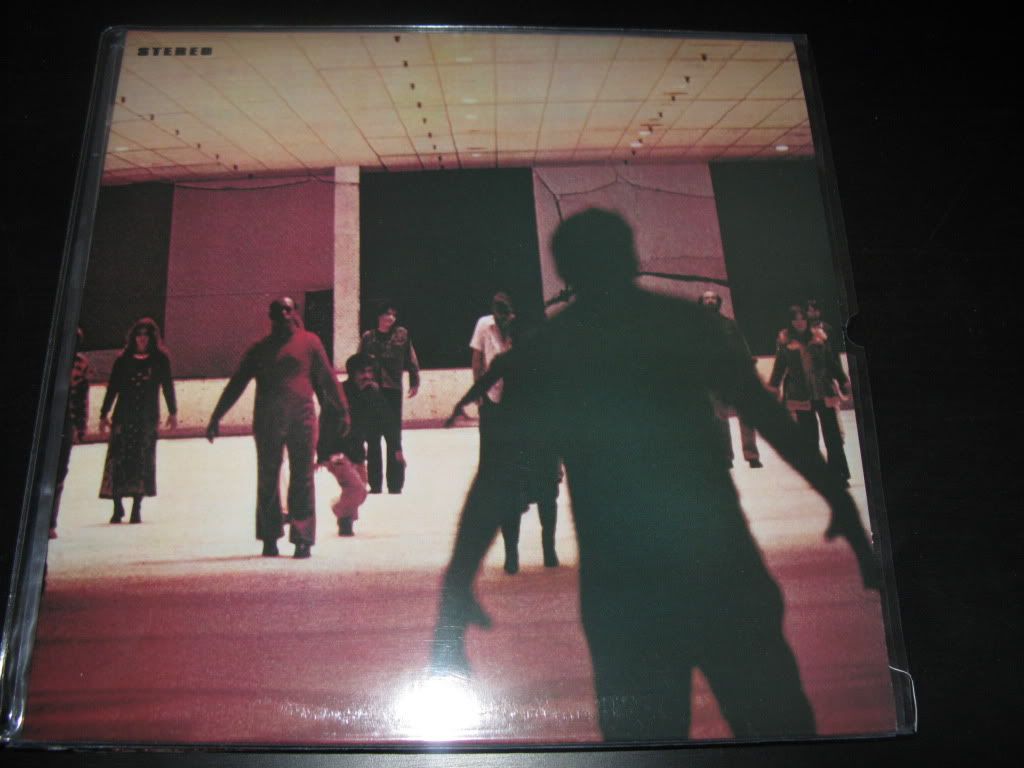
One of the 'highlights' of the record is The Gonk by Herbert Chappell. It appears at the end of the film as the zombies take over the mall and in particular as they walk across the ice skating rink. Personally I've never really liked it but others do.....
Figment by Simon Park on the other hand is a great bit of uptempo action music, not really horror more cop music.
Hats off once more to Romero for finding these perfect tracks.


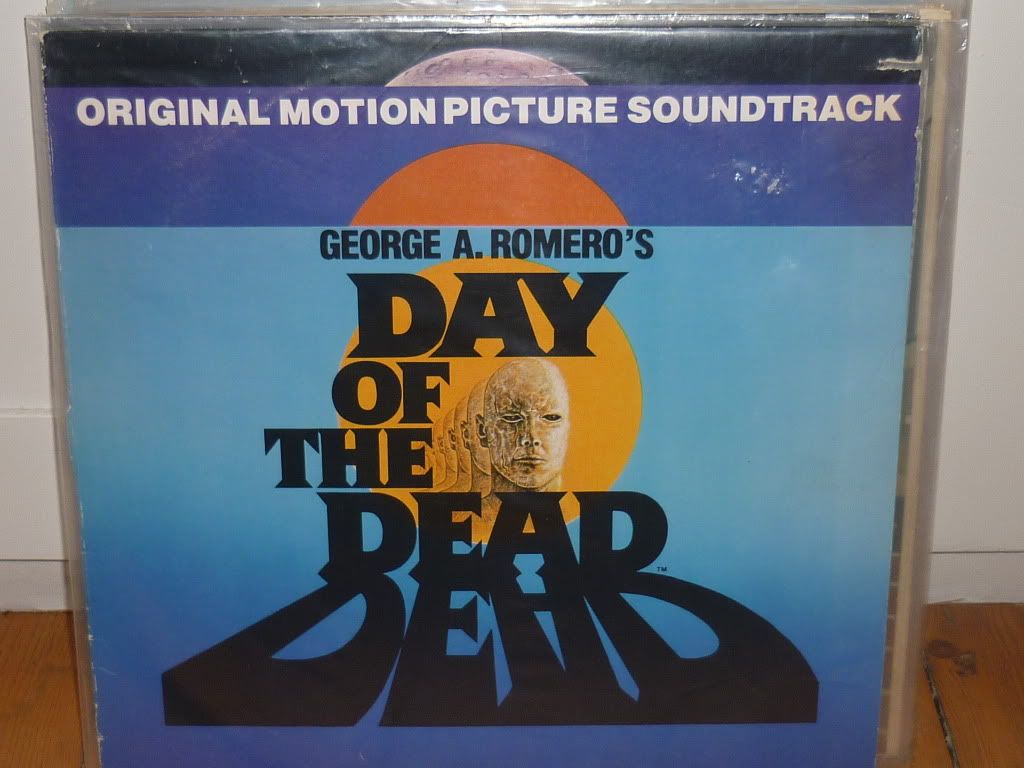
Perhaps the experience of having Goblin score Dawn of the Dead influenced Romero but I suspect that the decision to involve John Harrison in the soundtrack was an attempt by t the studio to produce a marketable product. Some of the quirkiness of the library tracks has gone unfortunately.
That said I like this soundtrack very much indeed. The opening track The Dead Walk is almost disco. In a way this record reminds me of the music of John Carpenter, particularly his score for Assault on Precinct 13, particularly Breakdown which is fantastic.
The vocal numbers If Tomorrow Comes and The World Inside You Eyes, could, perhaps, have been left of the record but you can't have everything.
I was playing the side long The Dead Suite recently and my daughter asked me to take it off. "Its very scary music daddy," she said. And that is all you need to know about it.
If you've read down to here you have surely seen the film but if not here it is:

Monday, 21 February 2011

BERNARD LUBAT AND HIS MAD DUCKS

What is the sound of library music? Indeed can you even say that there is a 'library sound' given that library music covers just about every conceivable style of music?
Nevertheless there is something, some indefinable element that sets it apart from commercially available recordings.
Bernard Lubat's work can be found largely on French library recordings and is inventive and interesting.
How he came to make a record for the hip boutique record label Les Disques Pierre Cardin I am not sure. No doubt couturier Cardin thought it would be a shrewd move to branch out into music and he must have had some adventurous A&R men as, in his label's short life, it released some marvelous, albeit not terribly commercial stuff. As you would imagine each release was thoughtfully packaged and this is no different.
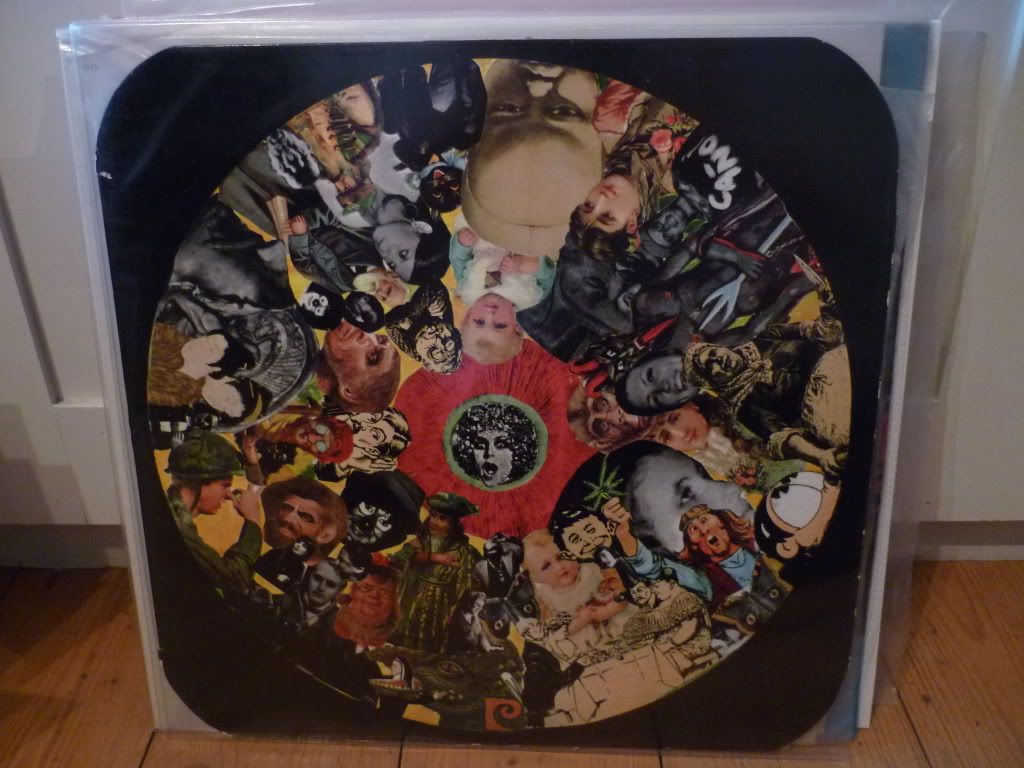
Enlarge the image and have a long look at it. Designed by Emmanuel 'Pinpin' Sciot, I think its a rather beautiful collage that hints at all manner of pop cultural and avant garde interests. And is the face at the centre of the eye happy or shocked, is she laughing at us, or with us, or is she amazed to be seeing us at all?
You probably can't see but the corners of the sleeve have been 'curved' which is a lovely touch for a record cover.
Altogether a very thoughtful piece of design.
The record kicks of with some quacking a la Donald Duck, presumably from some of Lubat's Mad Ducks. However, if I am honest, the quacking doesn't remind me so much of Donald Duck but of the protagonist in The New York Ripper. Another movie/library connection although the film came out in 1982 and the record came out in 1974. Lubat did compose for film and TV as well as for library records, but not I am afraid to say for Fulci's misogynistic effort.
The first track however, is pure gold. Pappy Thomas, largely led by Claude Engel's fuzzy guitar but ably supported by Eddy Louiss on the organ, is a funky slow burning groover that just doesn't seem to stop. If it were in a movie it would be played during the scene where the male lead sees the female lead for the first time dancing in a mod-ish basement nightclub with 'psychedelic' lights playing across her beautiful form. Engel's guitar gets so heated that at one point I wonder if he's actually still playing the same song and hasn't wondered off onto some kind of Hendrix exploitation record. Wigged out man!
After the funky nightclub scene our two heroes have met. To the strains of the next song, To Yashima they drift around swinging London, looking into each other's eyes and making sweet love. The music is light and airy, the wordless vocals drift smoothly moving ever upwards. Eddy Louiss takes his organ work into the swirling, twisting song and also moves ever upwards. Amidst all of this calmness check out the drums - played by Monsieur Lubat the drums are skittish and driving, perhaps pulling away for the wonderful vocal harmonies but nevertheless underpinning the whole. Music for love's young dream.
After the dreamy interlude our boy and girl get back to the important business of solving the crime (whatever it might be) but now they are being chased. Vendredi Chez Astrid Trassoundaine (Friday at Astrid Troussoundaine's) sounds from the title as though it should be another dreamy track. Instead we get funky drumming and more fuzzy guitar attack. Whatever is happening at Astrid's its active stuff. This time Francois Gimenez does the guitar honours and he delivers the goods - as long as what you want are distorted guitar solos. The whole track collapses under the weight of its own freaky fuzzness before, just about, finding its feet with a lovely vibes solo as it fades away into the night.
Side two starts with some more off-putting duck impersonations before heading off into the beautiful Shouara. If our boy and girl want something to listen to while they are having meaningful sex this is the one for them. Again it feature the wordless singing of Annie Vassiliu, Daniele Bartoletti, Christian Padovan, Henry Tallourd and Michel Pellay. Soft guitar and piano accompany our young lovers as they gently celebrate their youth and beauty until some busy drums bring them to a climax.
Just as well they've finished because Au Bon Livre (Ode to Malcom Lowry) is very busy stuff. Malcolm Lowry wrote, amongst other things, Under the Volcano which is without doubt one of the most gut-wrenching depictions of a man's life destroyed by drink. He was also a favourite author of the OuLiPo group of writers and I wonder if that was an influence on Lubat? Au Bon Livre has some fantastic percussion, again courtesy of Lubat which may be an attempt to recreate the Latin-American setting of Lowry's book. There are moments during the song where I think that its one of those 'freak-out' tracks that you usually get on biker soundtracks. But then the inventive percussion comes through, as does the vibes and piano and you realise what an inventive piece of music it is. The piano refrain gets into my brain and is very hard to shift.
Finally, after their drink/drug freak-out our heroes get to the end of the movie. With another shot of mad duck noise Mickey Schroeder's Dreams contains only some clear, aching piano played by Lubat. Whatever Mickey is dreaming about it is a happy dream.
But perhaps not, as the very last sound on the record is a door being slammed. The end.

Monday, 13 December 2010

ROGER ROGER/ NINO NARDINI - ANIMALS' CHRISTMAS

It's nearly Christmas so I thought I'd add a Christmas record.
Having said that I'm not really sure how Christmas-y this record it. Despite the title there is nothing really very Christmas-like about this library record.
If you are looking for strange electronic noises that are made to approximate the sounds of animals this is the record for you. If, on the other hand, you want something that sounds like carols then look elsewhere.
Roger Roger and Nino Nardini were electronic pioneers and in much the same way as Jean Jacques Perrey and Gershon Kingsley they found it difficult to find a wide audience. In fact most of their recorded output, together or seperately, is on library records.
Think Radiophonic Workshop but on the farm rather than in space and you have an idea of the kind of sounds that these guys are making here.
I am always amazed at the breadth of music that appeared on library records. What film or TV programme would need an electronic horse noise or a song using bleeting bionic sheep noises?  Maybe they appeared on French children's programmes? Or maybe they were used as cues for some kind of space-age Animal Farm? Or maybe not.
The propensity for early electronic music to be used in a funny setting meant that lots of early moog, electronic or radiophonic tracks have a kind of cartoon quality to them. You can see that they would make very good background to Tom and Jerry comedy violence. An early JJ Perrey track was even picked up by Disney and used at Disneyland. Perhaps it still is.
I found this languishing in the Christmas section of Oxfam and would have flicked past it had I not been intrigued by the children's writting on the front and the back. I am not sure who Sophie and Cathy were but I like to think they were the daughters of either Mr Roger or Mr Nardini. "This album is dedicated to all my little friends, the animals of the world" it says on the back.
A slightly daft record all in all but you would have to be a very hard hearted person not to find it funny. See if you can find it in amongst the Christmas records.