Writing about music is like dancing about architecture
Showing posts with label post punk. Show all posts

Friday, 27 April 2012

Thomas Leer and Robert Rental - The Bridge

The classic theme of the story of electronic music in Britain is told is one of an amazing synchronicity. In different cities, different people, with different influences, were playing with machines that could make music.
Bravely, these pioneers were turning their backs on the macho posturing of guitars and drums, and were diving headfirst into the world of noises that owed nothing to the acoustic world.
Taking the DIY aesthetics of punk, so the story goes, and melding it to avant garde machines, these trail blazers took their strange noises and made them public and accessible. It was, so it seemed, only a hop skip and a jump from The Normal's Warm Leatherette to The Eurythmics, Sweet Dreams.
Maybe.
Of course, in any history, there are always more continuities than clean breaks. Things always, whether you want them to or not, have antecedents, influences, forebears. Punk didn't rid the world of pompous rock stars, and it certainly didn't invent rebellion or independence. It just seemed like it.
This wonderful, emotive and captivating record has elements of Brian Eno and Bowie, of the electronic side of Krautrock such as Tangerine Dream or Manuel Gottsching, of the Radiophonic Workshop but also of early PiL, of the dark brooding proto-goth of early Bauhaus and of course of Throbbing Gristle. It an amazing concoction.
Thomas Leer and Robert Rental were both from Edinburgh and came down to London to pursue their musical ambitions.
Releasing Private Plane (Leer's first single) and Paralysis (Rental's first single) on their own labels they found that they were in the company of other electronic musicians such as Cabaret Voltaire, the Human League and Daniel Miller's The Normal. Listen to some of them here.

 Leer would go on to attack the pop world, producing some lovely, but largely overlooked music. Rental, unfortunately died in 2000 having only released two singles, a one sided live album recorded with Daniel Miller and this collaboration.

On one level it is possible to enjoy this record simply for the variety of unusual sounds and noises it contains. Although synthesisers played a pivotal role in the music, they were much less sophisticated than current ones. Sounds were harder to produce and harder to reproduce. To my ears, these limitations can be heard on The Bridge, as can the efforts of Rental and Leer to overcome them. The first track on side 2, Interferon, starts with a noise that sounds like the wind whipping against a tall tower block, or an electronic machine gone wrong, or the half-heard noise of a massive city. I find that very exciting.

Added to these electronically produced noises, the pair provided pecussion by hitting objects to produce drum sounds they liked, and, as the sleeve notes say, "All blips, clicks & unseemly noises were generated by refrigerators & other domestic appliances & are intrinsic to the music". This was the soundscape of Eno's Ambient records taken to its logical conclusion. Not only were 'normal' objects used to make music but 'normal' noises became music. Leer and Renal were acting as 'the bridge' between the sounds of the everyday and the sounds of music. In effect making the everyday into the unusual.

Unlike many of Eno's ambient records of this period, the everyday sounds used by Leer and Rental were defiantly urban sounds. They aren't pretty or sweet but are hard edged and utilitarian. One might say they are industrial, although that might make you think that the music is hard and abrasive and meant to shock in the way of label mates (and the people who lent them the equipment) Throbbing Gristle. Although, at times, The Bridge does feel as though it might be a Chris and Cosey record there is something defiantly different in its sound and approach.

The use of strange noises, and of found sounds, has some pretty clear antecedents in the world of pop. The 1950's particularly saw the exploration of the boundaries of sound as musicians used everyday tools to create sounds, such as on Jack Fascinato's Music From A Surplus Store, which uses only builders tools to create a 'now sound' record, or Joe Meek's famous studio trickery, heard to the best effect in his I Hear A New World (which is just a crazy, crazy record and I can't recommend it enough to people who like strange sounds).

What makes this record different, and indeed, The Normal and Throbbing Gristle,
is that they are very serious. There are no frivolous or throw-away aspects to The Bridge. To me, this record reflects a very monochrome, hard, decaying, faded, city, not a New World, or even an amusing way to reconfigure the existing world, It is a reflection of the realities of the urban experience. Unlike music made with the traditional guitar, bass, drums, singer configuration, Rental and Leer, were able to conjure up not just the emotions that they felt through being in the city but the very sounds of the city itself.

The cover shows a dark brooding picture of the Thames looking from Chelsea across to Battersea. Battersea Bridge, a late Victorian structure that looks as through it was designed by a cake maker, is lit up giving it a further unreal quality. Ironically, it was designed by Sir  Joseph Bazalgette who also created London's sewerage network - a case of both low and high architecture!

Indeed the record itself is split, with Side 1 being more song-based, with guitars and vocals, and Side 2 being more filmic, with washes of sounds, atmospheric pauses, tension and drama. I can't help thinking that in its construction it is very like Bowie's Low in this regard - and Heroes as well in its use of noise and sound.

The whole record needs to be listened to in one sitting, rather than taken as individual tracks. Only in this way can the full emotional impact of the music properly be felt. I'm not sure if listening to it on CD would be the same experience. For me, getting up and turning the record over, perfectly marks the two sides, the dichotomy, the duality of the music. Two sides that are spanned by a bridge.

Thursday, 11 August 2011

McCARTHY - I AM A WALLET

With economic downturn, rising unemployment, riots in the streets and a royal wedding  I feel we've gone back through some sort of space/time anomaly and ended up back in the eighties.
However, one thing that we don't seem to have now but we did have in the eighties was political pop music. Not just music that was about bringing down the system or about loving everyone but music that was avowedly political and made statements about issues larger than not getting laid.
I grew up on a steady diet of left-wing, anti-fascist, feminist and anti-racist music and music writing and I have to admit that my current political views are very much formed by those early exposures.
I was encouraged to read books because I heard them mentioned in song lyrics, encouraged to seek out works by artists because they were on record sleeves and listen to older music that was reference by reviewers.
No doubt there are kids today who are being influenced in just the same way, although I doubt they are listening to jingly jangly guitar rock.
Looking around now it seems that perhaps politics has become as important to kids now as it was to kids in the late eighties. Riots and looting recently and violent politically motives demonstrations earlier in the year seem to me to be signs that young people are thinking about their world and are not very happy about what they see.
Of course in 1987 when I Am A Wallet was released the charts were as untroubled by political songs as they are now. Once in a while someone like The Style Council, or Billy Bragg or the Redskins would sneak a song through the pap but it was a rarity.
If McCarthy are remembered at all its probably because their lead guitarist Tim Gane went on to form Stereolab.
His playing in this record is superb in a very Byrd's influenced way. It reminds me somewhat of Primal Scream's Sonic Flower Groove but better. I also hear moments that remind me of Johnny Marr, particularly on The Way of the World. Overall the sound owes a lot to early Orange Juice and Malcolm Eden's singing always makes me think of Paul Haig in Josef K.
After all these years I have to admit that musically, McCarthy are definitely very twee.
But it is the lyrics that prompted me to pull the record off of the shelves.
Complex and rarely rhyming, Malcolm Eden's strident left wing political views are manifest on I Am A Wallet. Cloaked in pretty guitar and propulsive drums, Eden sets about attacking the pillars of the day, MPs, Prince Charles, Fleet Street, religion, the response to AIDS and on almost every song capitalism. The horrors and inequalities of the capitalist system are laid bare for all the see. The system which enables some to get rich at the expense of others is reviled and attacked. In much the same way as George Grosz (whose Funeral Procession is on the front cover) Eden caricatures figures such as politicians, journalists and bankers, creating grotesque parodies in order to highlight their crimes.
Here are some tracks from the record. Listen to the lovely guitar work and pay attention to the lyrics. Sadly they are as relevant in 2011 as they were in 1987.


Wednesday, 23 March 2011

MINNY POPS - DRASTIC MEASURES, DRASTIC MOVEMENT

"Take that racket off! Its even worse than jazz!"
This was my wife's reaction to the Minny Pops' LP.
Indeed its hard to reply to this kind of response when the first track on the LP, Springtime I, consists of little more than repetitive electronic beats and sounds a little like a broken heart monitor.

In terms of user friendliness things do improve. However, the Minny Pops make no concessions to popular music or to an easy listening experience. Which is why you should search out this record as soon as possible.
Recoded in 1979 Drastic Measures, seems, to my ears, to be the work of people who wanted to push to the boundaries the simple electronic music devices that they had. Thus we get simple sounds, repeated or looped, discordant squalls of sound, odd noises and sudden moments of clarity. Great stuff! However, I would hesitate to put Minny Pops into the Industrial category. Although their music is at time abrasive there is much humour and many silly moments.
For Minny Pops, the second track there is a recognisable tune and a guitar. The vocals repeat the phrase "I can feel a machine, I can feel a Minny Pop/ He wants to be a machine, he wants to be a Minny Pop". No, I don't know what it means either. However, it is clearly their manifesto and the merger of man and machine is evident throughout the record.
Hologram could be a transmission from another planet. A transmission that is breaking up or being jammed by hostile forces. Or, as my daughter thought, it sounds like Donald Duck talking on a broken mobile. You decide! I think it sounds like the kind of thing that you would make if you have access to synthesizers and a sense of humour.
Total Confusion is underpinned by some electronic percussion sounds which remind me of the tennis game that you used to get for your TV. Over the tennis-like sounds are swirling electronic noises, the occasional murky vocal and some tinny keyboard.

For me the standout track is Dolphin's Spurt. As with all of the other songs here I have no idea what, if anything the lyrics are about. Delivered in a cold manner, very much in the way of a lot of electronic music, stabbing jerky guitar repeats itself while the keyboards make whistling sounds (perhaps a Dolphin's Spurt) and the precise electronic drums act as a metronome throughout. You could dance to this in the slightly spasmodic way that people danced in the post-punk era. And then suddenly its all over.

Motor City could almost be something from Sonic Youth. Clashing discordant guitars vie with the dry emotionless singer in a squealing fight to the death. Or something.
Over on side two we start with Springtime II which again is largely the broken heart monitor but this time with added stylophone.
According to Monica "Living in Bolivia Ain't So Pretty". The pounding bass pushes Monica along, giving it a dark menace. Velvet's like guitars add to the claustrophobic feel as the song drills down into your head. With the robotic vocals, bass and drums there are clear krautrock influences but the shear tightness of the song seems to turn it away from anything 'hippy'.

Flash Goes the Eye features a sound that is part creaking door hinge, part violin bowed a la John Cale, and part kazoo. Yips and howls abound. Its a children's party gone horribly wrong!
I've always thought that MD Mania, the next track, is a song from the Silicon Teens album that has somehow escaped. Upbeat and perky with the kind of bossa drumming that only early synths could produce, its fun and happy until you listen to the lyrics.
RU21 predates the Mary Chain by a good six years and, although it doesn't have the bubble-gum influences of the Reid brothers, it channels the drones of the Velvets and marries it to some 'young love' lyrics. Although in this case there is something not quite right about the attention the singer is paying to the girl. Hypnotic like a road crash. 

Mono continues the tightly wound, choppy guitars, precise drumming theme but adds some arrhythmic hand claps and some dense and almost choking swampy sounds. I'd hate to hear what Stereo sounds like!

The record ends on New Muzak which sounds like a snippet from a Brian Eno ambient LP. If that's the new Muzak I'm going to spend more time in lifts.

Saturday, 29 January 2011

WRITZ - WRITZ

Can pop music be too clever?
Well in 1979, when this record was released, there were a lot of clever people making clever records. People like Elvis Costello and Joe Jackson, people like Talking Heads and Television, Brian Eno and John Lydon - all of them in their own ways being clever on record.
What about humour in pop?
Again, in 1979 there seemed to be a lot of that around too. The Cramps and the Rezillos with their pop trash aesthetic, XTC and Squeeze with their wry English-ness, Devo from outer space and the Damned from the Beano.
So you might think that a clever and funny record would fit in perfectly. Punk and New Wave were opening doors for all sorts of clever, clever and funny funny people. Unfortunately for Writz it seems that no one in 1979 was listening to them.
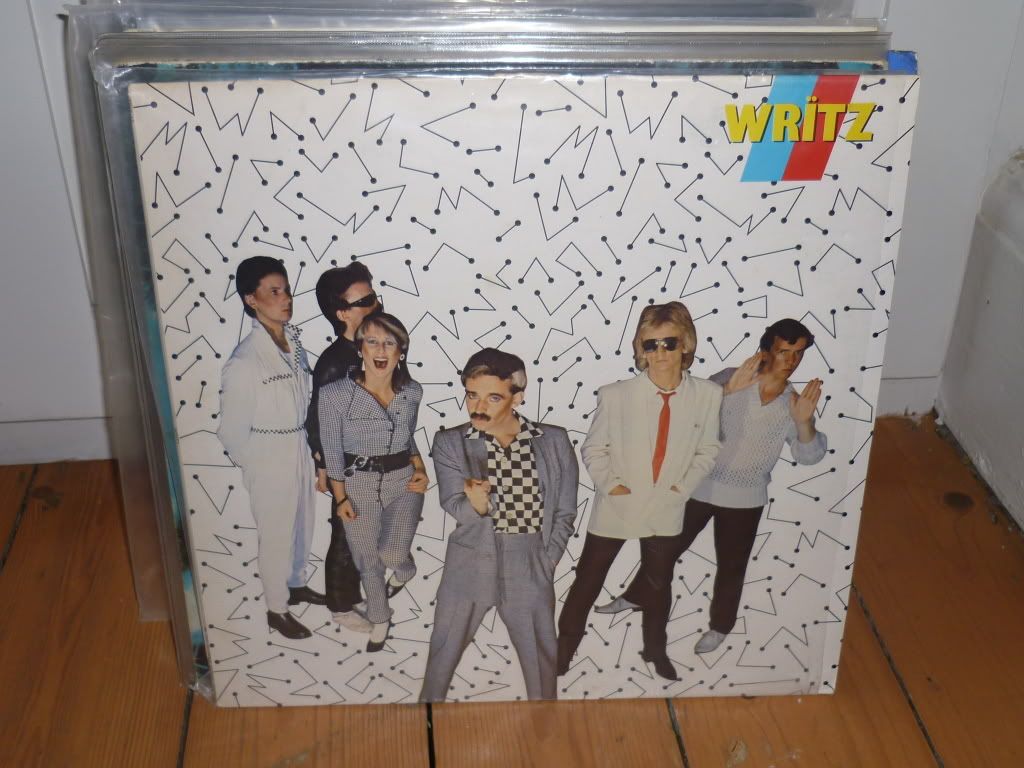
Writz was the brainchild of Steve Farnie, the dapper man with the Chaplin moustache and the terrible suit and shirt in the centre of the record sleeve, Steve Rowles, the guy in the red tie and mullet and Bev Sage, the lady in the rather dated one-piece Prince-of-Wales check button-down jump suit. People just don't dress like that anymore. Click on the photo and revel in the styles. I particularly like the guy behind Bev. If you can see he is wearing white sandals and socks under his leather trousers. Pretty way out!
But it's not fair to laugh at out-of-date fashion - I'm certainly not showing you photos of what I was wearing then!
But the visuals were important to Writz. They were as keen to have a striking and different visual presentation as they were to keep the music fresh. All three of the main protagonists had been to art or music college (a not uncommon story for bands). Farnie, particularly was certain that a merging of image and sounds would produce superior rock and roll.
So on to the music then.
Writz were greatly helped by having no only some very good musicians but some very experienced ones. Jules Hardwick on lead guitar was a session musician, Nick Battle the bassist had played with After the Fire while drummer Arry Axel seems to have been something of an enigma.
As I said earlier Writz are both clever and funny. Nowhere more so than on album opener and single Night Nurse.
From the opening klaxon call the song grabs your attention as Bev intones 'Night Nurse' in a chilling but sexy way. Then Rowles comes in singing about.... What? Its not really a song about a budding Florence Nightingale but perhaps more accurately about someone who might have worked for Cynthia Payne. For a band that liked to dress up, it's great that they should be singing about a woman who is also dressing up. Fading out with a rather sad trumpet line you are left wondering whether the Night Nurse is enjoying her nocturnal activities or whether they are really something she would prefer to avoid.
See it here
The record is very much of its time. This is not a criticism. After all you wouldn't expect a Hendrix record to sound as though it were recorded in the 50s or the 80s for that matter. It is, however, an attempt to fix the feel and texture of the music.
Other highlights are Luxury with a fantastic disco funk bass line, Private Lives and Muscle Culture.


Muscle Culture is a song about dictatorships and the use of the media and charismatic people to induce conformity. The live version on Youtube is better than the album version.

I was thinking about Muscle Culture the last time I went to the gym - body fascism? You can see from the clip how into image and fashion the band were. You can also hardly fail to notice the chemistry between Farnie and Sage. It would have been great if they had been given an opportunity to make some music videos but they were just slightly too early for the boom in videos.
The band's career can't have been helped when they were forced to change their name or face being sued by an American band who had the same name. Can anyone remember them?
As Famous Names they released Holiday Romance which is Blur's Girls and Boys avant la lettre. Another song brimming with ideas and wit it too failed to make a dent on the charts.

Effectively that was the end for Writz. Farnie and Sage reinvented themselves as the Techno Twins and released the charming Falling in Love Again which was a chart success. However, for some reason it was never followed up with greater success.


For all that they sound of their time I'd recommend you go out and track down the Writz album. No one can have too many clever and funny records in their collections.
For everything you ever wanted to know about the band go here

Friday, 21 January 2011

GIRLS AT OUR BEST! - PLEASURE

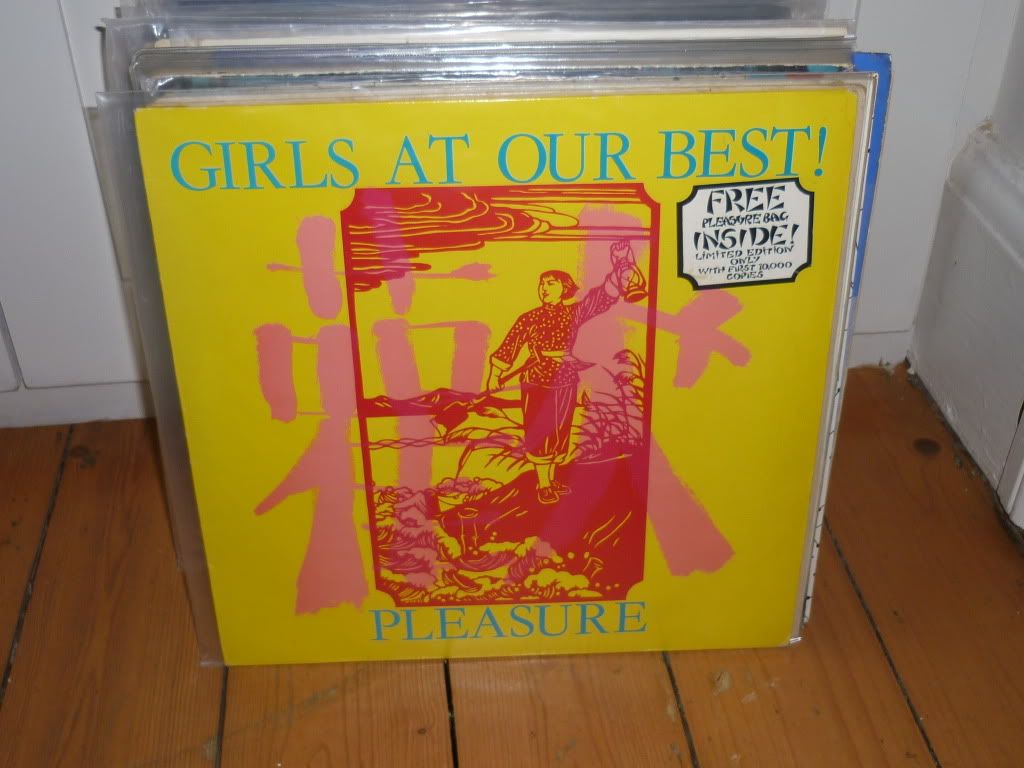
There are some records that are just fun. The music is upbeat, simple, catchy, the vocals are cool and perfectly delivered, the lyrics are amusing with the right mixture of real-world observation and political intent. This is one of those records.
Girls at Our Best! also have one of the best names in British rock. Which makes it rather a shame that only one band member, the lead vocalist Judy Evans, was a woman.
Unfortunately Pleasure is their only LP, but like so many groups in the post-punk era they left an enduring, if small legacy.If you are so inclined I would very much recommend you track down their earlier singles, Going Nowhere Fast (later covered by the Wedding Present) which also has one of the most amusing single picture sleeves, Going for Gold and Politics. Strangely the lyrics for all these song can be found on the lyric sheet that comes with the LP.
I love bands with a female lead vocalist, from the Slits, to Prag Vac, to the Au Pairs, to Girls at Our Best! to the Shop Assistants,to the Primitives, to the Sundays. Its partly the challenge to male rock values, partly the great lyrics and partly the pleasure of hearing a beautiful voice rather than a gruff growl, wedded to great rock songs.
Pleasure - the title of this record. The music is a pleasure. Buoyant and upbeat it is music for dancing around to like a loon. Perhaps in a dark room with your friends. Perhaps after a few drinks. Perhaps with someone you fancy. I don't think it takes anything away from the music to say that its very straight forward and simple. There's no post-punk stuttering drums or disco bass-lines or choppy guitars. Instead we get music that reminds me of the Mekons at their best. Even the clarinet solo on Fun City Teenagers is charming. Thomas Dolby also makes an early appearance on synthesisers. And for all you beat hunters out there the runout groove one side 1 has a repeated drum break.
The  lyrics also deal with Pleasure in one form or another, not in a simple hedonistic way, but in a questioning, ironic and slightly wry manner. The main theme of the lyrics is that although the modern world is full of ways to get your pleasure we should be careful as many of these seemingly pleasurable pursuits are in reality ways to dull us, to silence us and prevent us from questioning the world around us. Everyone becomes nothing more than pawns in the system if you only take the pleasures that are offered to you. How much better would it be for us to get our kicks by being different and not conforming? Maybe I'm reading too much into it - what do you think?
Unlike a lot of female fronted C86 bands Girls At Our Best's Judy Evans seems to me to meeting attitude to women head on. There is a political aspect to the lyrics that, while not party political, challenges the status quo.
I was just about to select some songs as highlights but then I realised that I can't - each song is wonderful. A beautiful gem of a record and worth tracking down.
If you want to find out more about them the I reckon this is the place: http://www.girlsatourbest.com/

Tuesday, 7 December 2010

DALEK i - COMPASS KUM'PAS

Every so often I stumble across a record that makes me think "Why hasn't anyone told me about this before?".
In this case no has told me about this before because it seems that no one has heard it or if they have then they don't hear in it what I hear.
Now, I don't mind having strange tastes, after all that's to be expected if you like vinyl in a download age, but the silence over dalek i's Compass, Kum'pas just seems weird to me.
People rave over far lesser 80s post punk bands but despite the current attention to so-called cold wave bands there seems to be no room for dalek i.
In some ways, however, its very refreshing to be able to make your own mind up without being influenced by anyone else.
And my mind is telling me that this in an unjustly forgotten piece of plastic that deserves more attention. So, if after reading this you are intrigued go onto a well known auction website and get a copy. They are really cheap and fairly easy to come by.
Hailing from Liverpool and, like most Liverpool bands, at one point having a future member of Big In Japan in their ranks (Dave Balfe if you are interested) they were obsessed with using electronic means to make music. Needless to say Kraftwerk and Suicide were an influence. Although there are real instruments, such as the tradional guitar, bass and drums they are usually only used to assist the synths.
The most complete history of the band, side-projects and further adventures can be found here: http://robinparmar.com/dalek-i-love-you.html
The LP kicks off with their second single The World. I find this a haunting and dark song. With a very flat vocal Alan Gil sings about the unpleasantness of the world - this is the 'real world'! There is a great bit of one fingered synth work about half way throught that is worthy of the Human League and suddenly the whole thing shudders to a close with what could be a laugh, a cough or a death rattle.
The rest of the record doesn't get very much warmer. 8 Track wonderfully utilises tape manipulation to slow down parts of the song, which together with the sawing guitar, some off key piano work and wordless voical give a woozy, drunken feel.
Next is Destiny (Dalek I Love You) which is the song that got me into Dalek i in the first place. Cold, spacey and slightly anguished I love this song. It is exactly the sort of music that Dr Who should be listening to. "What would I gain to sell my brain to a machine" goes the chorus. As dystopian a pronouncement as you are likely to hear.
Other key tracks are Freedom Fighters, the cover of You Really Got Me and We're All Actors. Freedom Fighters has some bouncy organ work and choppy guitar licks and on first listen seems to be one of the happiest songs on the record. Closer attention to the lyrics soon dispels that idea as it become clear that the song is about someone being attacked by a mob, possibly of fascist skinheads, for no reason.The Kinks, You Really Got Me is stripped down to the drum machine beat and an insistant bass overlaid with some electronic work. Under this onslaught it ceases to be about unrequited love and takes on a rather dictatorial quality. We're All Actors has a slightly ska-ish bass line over short organ stabs. From the sounds of it, being an actor is not all its cracked up to be.
The more I listen the more inventive this LP becomes. Is it too much to compare it to the Beta Bands EP's album? Well, there are, obviously, none of the sampledelica and hip hop influences. But none-the-less there is a similar playfullness and willingness to chuck anything in that will produce the right (wrong) results. The restrainted slightly muted vocals, the slow drum machine beats, the loving synth work and the rare appearance of the guitar combine to make this a rare pleasure.
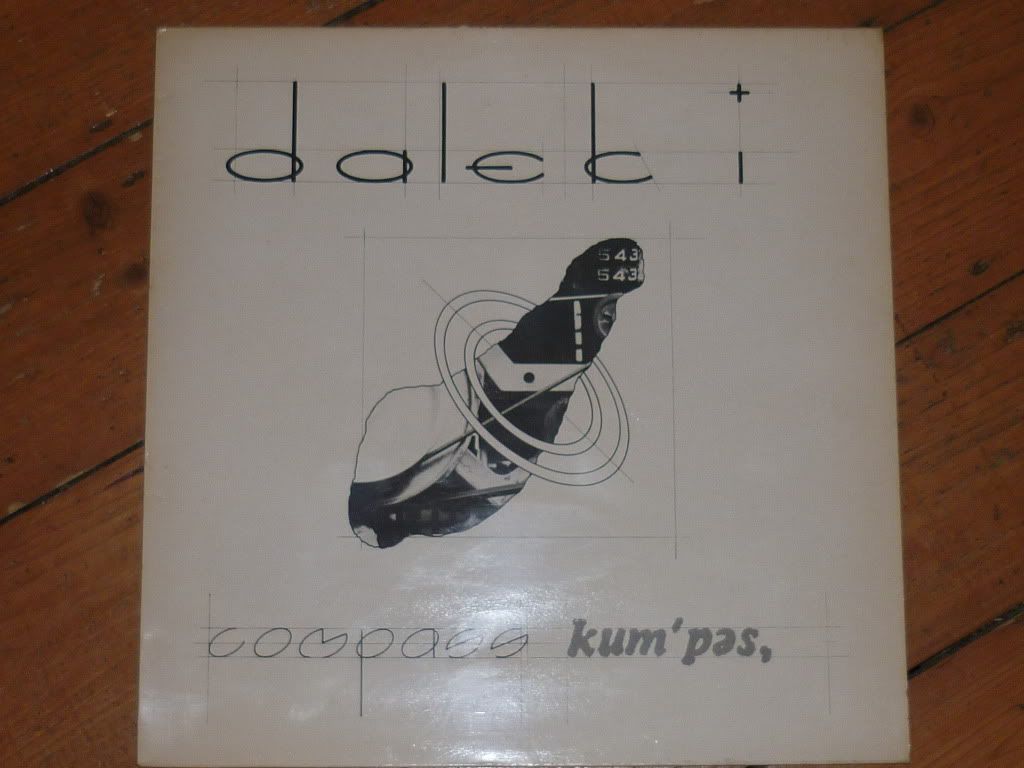
The cover artwork is also worthy of note. Designed by Chris Hughes of the band the front has a shape that may or may not be meant to represent Japan and this shape appears in reverse on the back of the sleeve. The carefully designed calligraphy lends an almost architectural quality. On the reverse the tracks are listed against a timeline to give an idea of how long they last. A great idea that I've never seen anywhere else.