Writing about music is like dancing about architecture

Friday, 27 April 2012

Thomas Leer and Robert Rental - The Bridge

The classic theme of the story of electronic music in Britain is told is one of an amazing synchronicity. In different cities, different people, with different influences, were playing with machines that could make music.
Bravely, these pioneers were turning their backs on the macho posturing of guitars and drums, and were diving headfirst into the world of noises that owed nothing to the acoustic world.
Taking the DIY aesthetics of punk, so the story goes, and melding it to avant garde machines, these trail blazers took their strange noises and made them public and accessible. It was, so it seemed, only a hop skip and a jump from The Normal's Warm Leatherette to The Eurythmics, Sweet Dreams.
Maybe.
Of course, in any history, there are always more continuities than clean breaks. Things always, whether you want them to or not, have antecedents, influences, forebears. Punk didn't rid the world of pompous rock stars, and it certainly didn't invent rebellion or independence. It just seemed like it.
This wonderful, emotive and captivating record has elements of Brian Eno and Bowie, of the electronic side of Krautrock such as Tangerine Dream or Manuel Gottsching, of the Radiophonic Workshop but also of early PiL, of the dark brooding proto-goth of early Bauhaus and of course of Throbbing Gristle. It an amazing concoction.
Thomas Leer and Robert Rental were both from Edinburgh and came down to London to pursue their musical ambitions.
Releasing Private Plane (Leer's first single) and Paralysis (Rental's first single) on their own labels they found that they were in the company of other electronic musicians such as Cabaret Voltaire, the Human League and Daniel Miller's The Normal. Listen to some of them here.

 Leer would go on to attack the pop world, producing some lovely, but largely overlooked music. Rental, unfortunately died in 2000 having only released two singles, a one sided live album recorded with Daniel Miller and this collaboration.

On one level it is possible to enjoy this record simply for the variety of unusual sounds and noises it contains. Although synthesisers played a pivotal role in the music, they were much less sophisticated than current ones. Sounds were harder to produce and harder to reproduce. To my ears, these limitations can be heard on The Bridge, as can the efforts of Rental and Leer to overcome them. The first track on side 2, Interferon, starts with a noise that sounds like the wind whipping against a tall tower block, or an electronic machine gone wrong, or the half-heard noise of a massive city. I find that very exciting.

Added to these electronically produced noises, the pair provided pecussion by hitting objects to produce drum sounds they liked, and, as the sleeve notes say, "All blips, clicks & unseemly noises were generated by refrigerators & other domestic appliances & are intrinsic to the music". This was the soundscape of Eno's Ambient records taken to its logical conclusion. Not only were 'normal' objects used to make music but 'normal' noises became music. Leer and Renal were acting as 'the bridge' between the sounds of the everyday and the sounds of music. In effect making the everyday into the unusual.

Unlike many of Eno's ambient records of this period, the everyday sounds used by Leer and Rental were defiantly urban sounds. They aren't pretty or sweet but are hard edged and utilitarian. One might say they are industrial, although that might make you think that the music is hard and abrasive and meant to shock in the way of label mates (and the people who lent them the equipment) Throbbing Gristle. Although, at times, The Bridge does feel as though it might be a Chris and Cosey record there is something defiantly different in its sound and approach.

The use of strange noises, and of found sounds, has some pretty clear antecedents in the world of pop. The 1950's particularly saw the exploration of the boundaries of sound as musicians used everyday tools to create sounds, such as on Jack Fascinato's Music From A Surplus Store, which uses only builders tools to create a 'now sound' record, or Joe Meek's famous studio trickery, heard to the best effect in his I Hear A New World (which is just a crazy, crazy record and I can't recommend it enough to people who like strange sounds).

What makes this record different, and indeed, The Normal and Throbbing Gristle,
is that they are very serious. There are no frivolous or throw-away aspects to The Bridge. To me, this record reflects a very monochrome, hard, decaying, faded, city, not a New World, or even an amusing way to reconfigure the existing world, It is a reflection of the realities of the urban experience. Unlike music made with the traditional guitar, bass, drums, singer configuration, Rental and Leer, were able to conjure up not just the emotions that they felt through being in the city but the very sounds of the city itself.

The cover shows a dark brooding picture of the Thames looking from Chelsea across to Battersea. Battersea Bridge, a late Victorian structure that looks as through it was designed by a cake maker, is lit up giving it a further unreal quality. Ironically, it was designed by Sir  Joseph Bazalgette who also created London's sewerage network - a case of both low and high architecture!

Indeed the record itself is split, with Side 1 being more song-based, with guitars and vocals, and Side 2 being more filmic, with washes of sounds, atmospheric pauses, tension and drama. I can't help thinking that in its construction it is very like Bowie's Low in this regard - and Heroes as well in its use of noise and sound.

The whole record needs to be listened to in one sitting, rather than taken as individual tracks. Only in this way can the full emotional impact of the music properly be felt. I'm not sure if listening to it on CD would be the same experience. For me, getting up and turning the record over, perfectly marks the two sides, the dichotomy, the duality of the music. Two sides that are spanned by a bridge.

Monday, 2 April 2012

GUY WARREN - THEMES FOR AFRICAN DRUMS & AFRICAN RHYTHMS


Guy Warren, in the late 1950s, was on a mission in the US to show the jazz world, and the rest of the musical community, the importance of drumming. Not only that but he was determined to show people that the drums of Africa were as expressive and versatile as any other instrument in America. For Warren, drums were not just for providing a steady background beat while other instruments took the lead. For him the drums were the centre stage instrument.
Not only that, for Warren jazz was all about the drums, and African drums at that. The music, its development, its history, was for Warren inextricably linked to African music, specifically music from West African, the part of Africa that provided many, but not all, of the people who would become slaves in the US.
Warren had played jazz in the UK with Kenny Graham's Afro Cubists and in the US with established jazz musicians such as Charlie Parker and Thelonious Monk, to whom he dedicates one of the tracks on this album. He had also played highlife in Ghana as a member of the Tempos along with ET Mensah and Joe Kelly. By 1958, when this record was released, he was an experienced, sophisticated musician with a vision for his music. "This is the album I wanted to make ... This is MY album" he proclaims in the linear notes.
His jazz credentials are for all to see in the linear notes. He thanks critics Nat Henthoff and Lee Shapiro. His band mates include James Hawthorne (Chief) Bey (who would play on Art Blakey's African Beat - here), he mentions Monk, he uses jazz terms such as free-form and jazz slang such as 'laid it down'. How can this be anything other than a jazz record?
That is, unless you ignore the truly obscene cover. From the cover you would think that this record was firmly in the exotica genre.


What is the crazed man in front of a fire supposed to represent? Is it a reference to voodoo, or just a blanket heart of darkness reference? I think it is tragic that a man so proud of his country and the contribution that it had made to world culture should find that his first solo record, the "album I wanted to make", should be packaged in such a crude and insensitive way. I have included a few other exotica sleeves to show that this sort of thing was not uncommon. But it also shows how Themes for African Drums suffered. The record sleeve made it seem as though the music was not authentic, that the music was neither genuine African music nor genuine jazz. On the evidence of the sleeve you might have thought that Warren's music was on a par with Thurston Knudson or maybe Augie Colon.
In fact it is fascinating and amazing music. If you've read any of my other Warren posts you will probably know I am fascinated by him and his music.

Warren, however, was a somewhat confusing proposition to the record buying public of America. For a start, although he is pictured on the reverse in Ghanaian clothes, his music was not a strict 'ethonographic' reproduction of Ghanaian or African music.
The complexities of music from Africa, the enormous range of  external influences, from Europe in the form of church choirs or military marching bands, from Cuba in the form of a wave of Latin records that swept over the continent after the second world war, from the West Indies in the form of calypsos and from the US in the form of jazz, was never acknowledged in European imaginations. Instead, as can be seen from the cover, music from Africa was assumed to be from a place untouched by the influences of the outside world. Wild, primal, sexualised (as can be seen from the cover above) and 'savage' drumming was the music that most Westerners expected from Africa. Jazz, particularly sophisticated fusions of the jazz idiom and African traditional idioms, was not expected. Few Americans were familiar with highlife or any of the other forms of modern music being created in Africa.
Furthermore, Warren's pride in his Ghanaian roots, pride in his country and Continent, proved problematic at a time when many African countries were gaining their independence. The response of jazz musicians was to pen tracks whose names recognised new nations, or the creators of new nations. The response of jazz critics and white audiences was either to ignore this or to label this as some form of racism. Where within this dichotomy could an African jazz musician and his music find a home? Warrren was, I suspect, too proud to accept any easy assimilation into American cultural imperialism.
I would guess that Warren was very influenced by the writings of Ghana's first president, Kwame Nkrumah. Nkrumah explored ideas about cultural transformation through the traditional culture of his country. He took popular artists such as EK Nyame and the Uhuru Dance Band with him on his trips outside Ghana and he encouraged musicians to use traditional instruments and rhythms and wear national costume. As the cover of Themes for African Drums shows, this could only be interpretedin America through a lens of colonialism and Western superiority, rather than as an equivalent and valid cultural statement. Jazz was American and even if many of its practitioners were not white Americans, for white record company executives and the white record buying public the concept that an African could explore new areas of jazz was just too incredible a proposition in 1958.
Themes for African Drums contains the amazing, Love, the Mystery Of, later covered by Art Blakey on his The African Beat LP only four years later in 1962. It also contains the incredible My Story which, if anyone's autobiography can be written using drums, then this must be it. 


Warren maintained the same musical path for his next record, that is a mix of jazz and traditional African music. To my ears he achieves a more successful fusion on African Rhythms. Again, the sleeve notes make it clear that this record is jazz and not exotica. He is joined by Richard Davis on bass and Ollie Shearer on vibes and marimba. He is praised by the likes of Leonard Feather and Nat Henthoff and is even called "a jazz genius" by Earl Wilson.
Yet once again the sleeve puts the music firmly in the exotica genre. Stylised dancers, looking very similar to depictions of black jazz dancers in the 1920, particularly Josephine Baker, replace the crazed drummer of the previous LP. However, I would say that they reveal nothing about Warren's music, instead giving the impression that it is something to accompany a Tarzan movie. There wasn't even a photograph of him on the reverse.
For me African Rhythms is slightly more pleasurable than Themes for African Drums. Although Warren plays more trap drums in African Rhythms, there are no brass instruments. This means that each track is carried entirely by the drumming - by the rhythm. I find tracks such as My Anthem and both parts of the Third Phase to be utterly hypnotic and captivating.
As Warren revealed in an interview in 1960, he was aware of the problems that his music making created in the jazz community in the US. "I could never play like Gene Krupa, Max Roach or Louis Belson. They have a different culture. So I had to make a choice of being a poor imitation of Buddy Rich or playing something they couldn't. So I started playing African music with a little bit of jazz thrown in, not jazz with a little bit of Africa thrown in. For it is African music that is the mother, not the other way round. But I had to find out the hard way!"
What he found out was that, like many innovators, he was too far ahead of his time. In a few years, in America, the concept of Africa, the concept of the continent's meaning in jazz and for jazz, and the concept of what music from the continent could sound like, had changed completely. Records by Olatunji took the same elements as Warren's records but found a wider audience. Olatunji became friends with John Coltrane and apparently the two considered recording together. Other drummers, Big Black, 'Chief' Bey, Solomon Ilori, Montego Joe, put out records and carved successful careers within the American jazz scene. Symbols taken to represent Africa became more common as did the adoption of musical signs and idioms to indicate that black jazz musicians recognised that Africa was their spiritual home. All too late for Warren who unfairly has been neglected as anything but a footnote in jazz history. Buy his records and rediscover his greatness.

Saturday, 17 March 2012

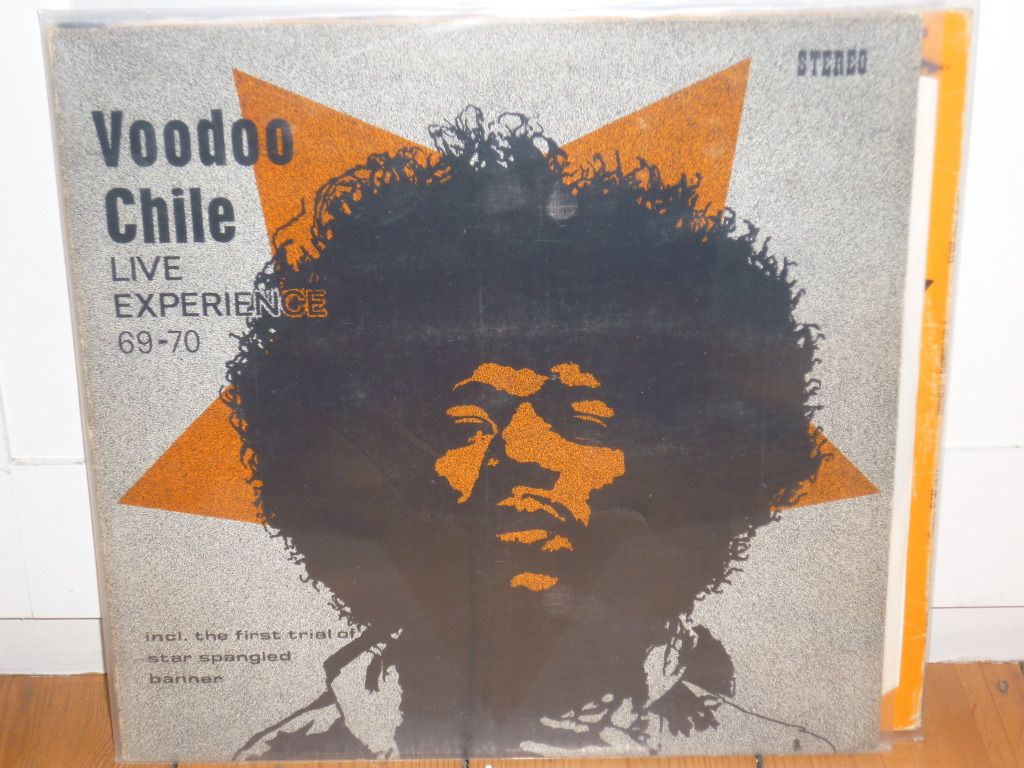
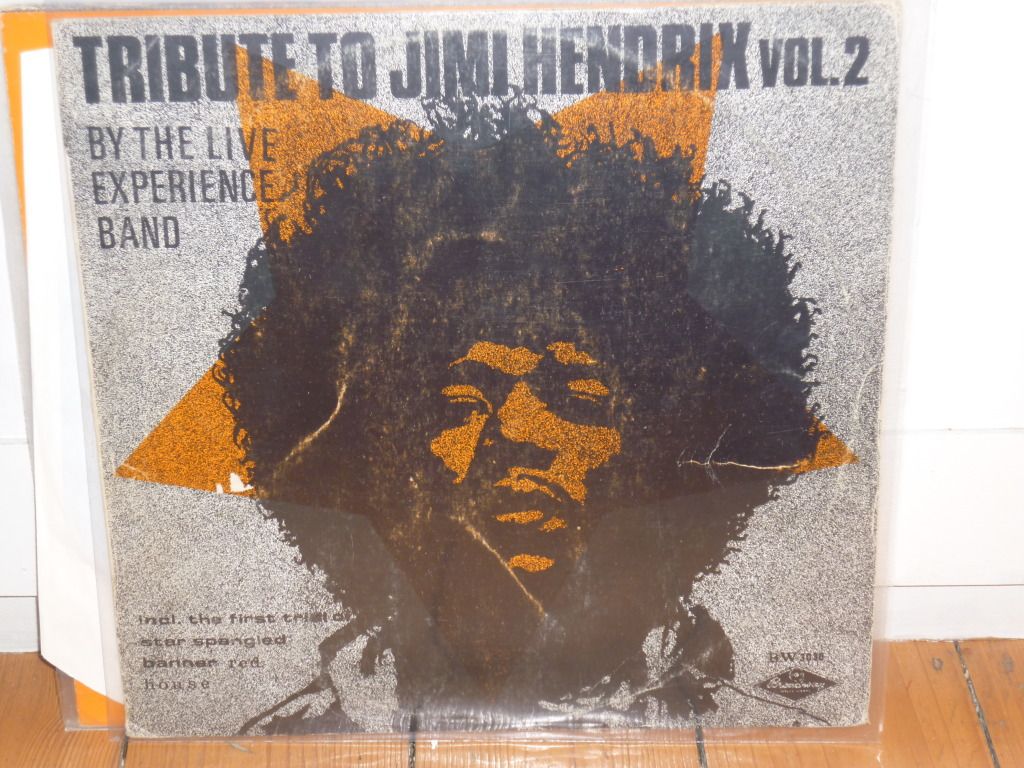
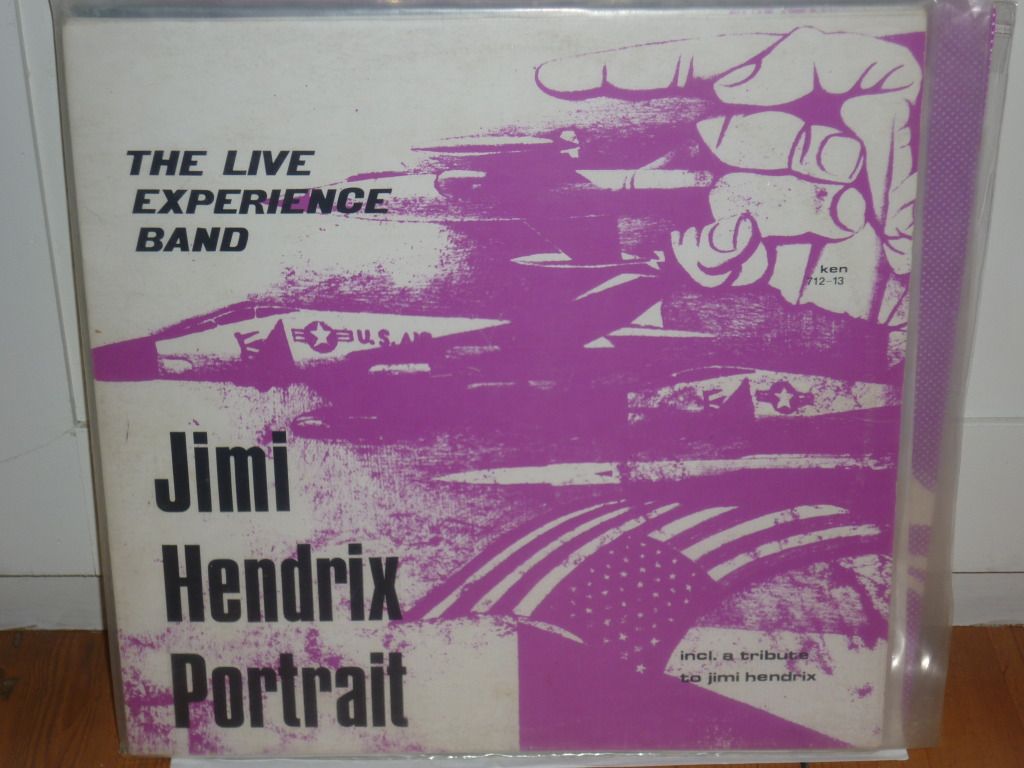
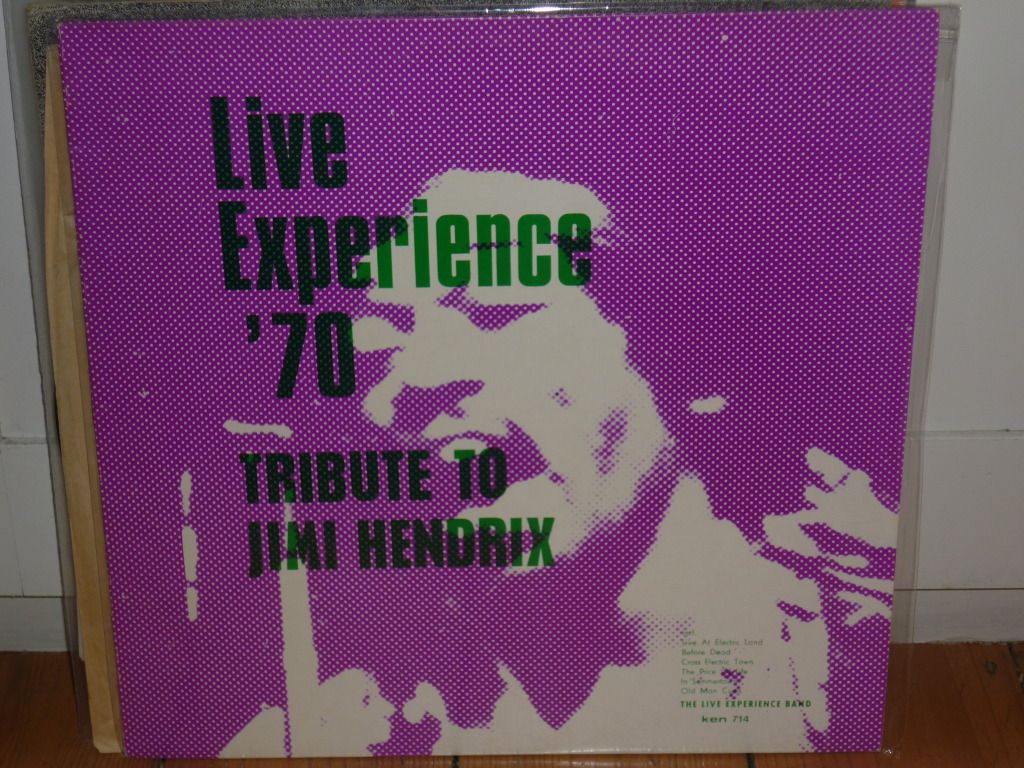
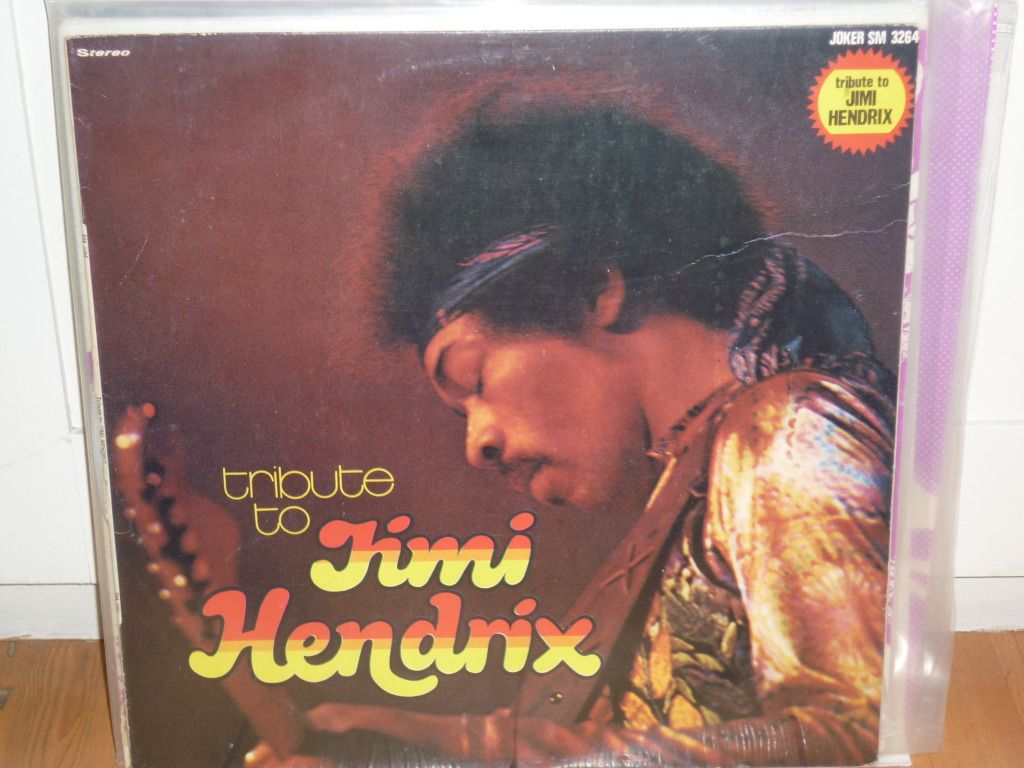
THE LIVE EXPERIENCE BAND - HENDRIXPLOITATION

Oh my ears, my beautiful ears!
The things I do for this blog! Its not all soft jazz and biscuits I can tell you.
Sometimes you have to suffer a bit, to put yourself through something that you otherwise might not do.
How else can I explain the fact that I've just sat through six whole records of wild, ear-busting, fuzz drenched, screaming, gut-bucket, primal, fuzzed out, no-holds-barred, crazed, derivative, unleashed, fuzz-monster, insane, guitar madness, grimy, gritty, fuzzy (have I already used that word?) Hendrixploitation. This music is so out there that at times it almost feels like free-jazz - there's a point and a melody but you don't always know it. My God, its the kind of music that can only be made by people who either want to break boundaries or who don't know that there are any boundaries in the first place.

Sure, there's the Hendrix connection - but you could have guessed that by the name of the band. Is the Experience Live or the is the Band Live?
Hendrix is the way into the madness. The work of the world-famous, and as at the time of the release of these records, recently dead, guitar-slinger is just a leaping off point.
Sure they cover the great man's songs, sure they want to sound like him and sometime achieve a quite reasonable facsimile, sure the records are marketed to trap unsuspecting Hendrix fans.
Having died young, and leaving behind a small and confused legacy of recordings, the world in the late sixties and early seventies was crying out for more of the good stuff. You know, the stuff that people loved about Hendrix - the controlled feedback, the guitar pyrotechnics (who else can set his axe on fire and still be cool?), the hard rock and crunching blues.

But there are plenty of records of people trying to sound like Hendrix. And plenty of records of people covering his songs (read about some of them here).

That's not what makes the Live Experience Band's records worth tracking down. Yeah, they tackle some of his well know stuff. Voodoo Chile, Hey Joe, Red House, Purple Haze, all appear. It's not really important to analyse which record includes which version. All we need to know is that it's the same band on every record, pumping out the same vibe. Of course, given the nature of these records, its inevitable that the same performances of the same songs appear on different records. What else did you expect?

Don't spend too long on the cover versions. Instead revel in the originals, let yourself dive into the ocean of fuzz and feedback. The musicians on these records, allegedly a German band from Hamburg, used Hendrix as a leaping off point, an excuse, a reason to go further, harder, deeper, fuzzier into the realms of the free. To explore some of the territory that Hendrix hinted at through his music and others thought they heard.
Its still hard rock, still blues-based but it contains a wild abandon that for whatever reason, Hendrix just didn't get into his music. Of course, there is none of the genius, none of the boundary challenging approach, nor even the musicianship. What you get is just a balls-out, devil-take-the-hindmost, inspired guitar freakathon. If you want something high-brow, look away now.

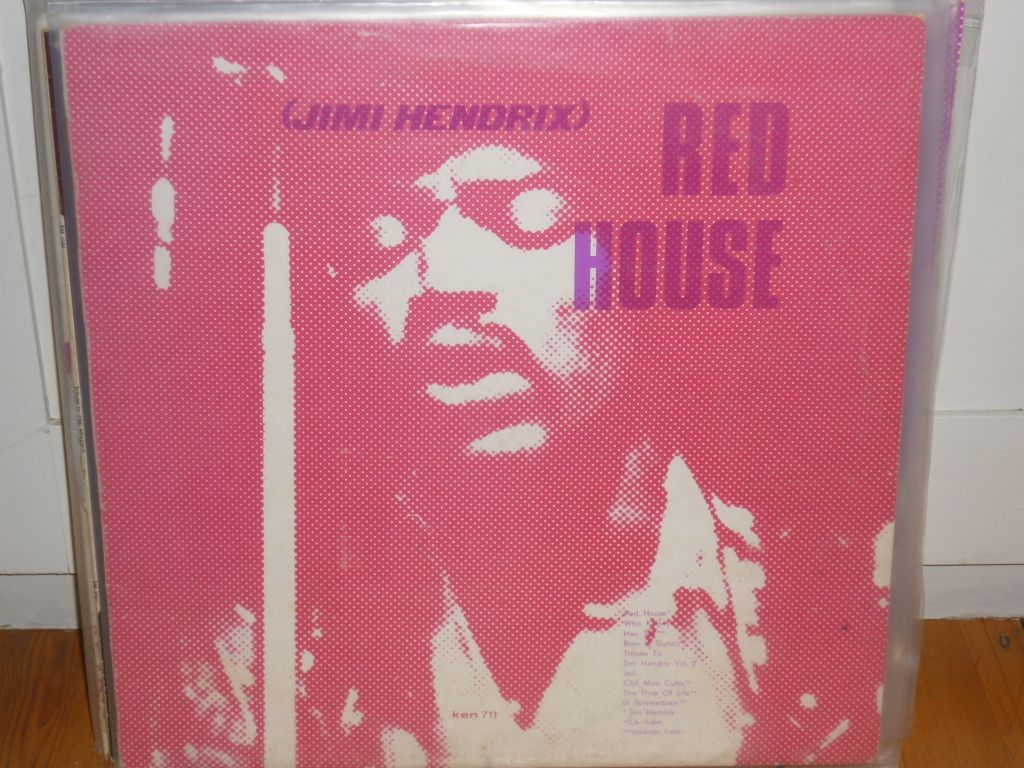
For my money, and lets face it I've bought all of these records, this is the one to aim for.
That's not because it has the best performances, although in places the music is transcendent, but because all of the songs are originals. Whoever 'Icem' is, he certainly could channel the muse of Hendrix.
You could see this as a final squeeze of the sessions that produced these pieces of vinyl. Or you could see this as the triple distilled, 100% proof Live Experience Band. Shorn of attempts to recreate Hendrix's efforts the faintly anonymous Icem lets rip.
What you are presented with are a set of songs that are wilder and more intense than anything Hendrix recorded. Its the kind of music that you wish was used in a biker movie, the kind of music that you know would soundtrack some wild drug-fuelled orgy, the kind of music that long-haired dope-smoking hippies listened to while having tantric sex. Or alternatively the kind music that middle class teenagers listened to because they couldn't get any sex or drugs. You decide.

Despite being attributed to Peet Shaw, this record includes music that came from the same sessions that produced the above records.
Repackaged for the Italian market, this one adds some vocals which suddenly brings the way-out music back to earth with a bump.

There is one last record from the same people, although it doesn't purport to be Hendrix related. Its called Blues Happening but, after pummelling my mind with hours of axe-wielding, face-melting, fuzz-busting, free-from, I just don't think I can take any more.

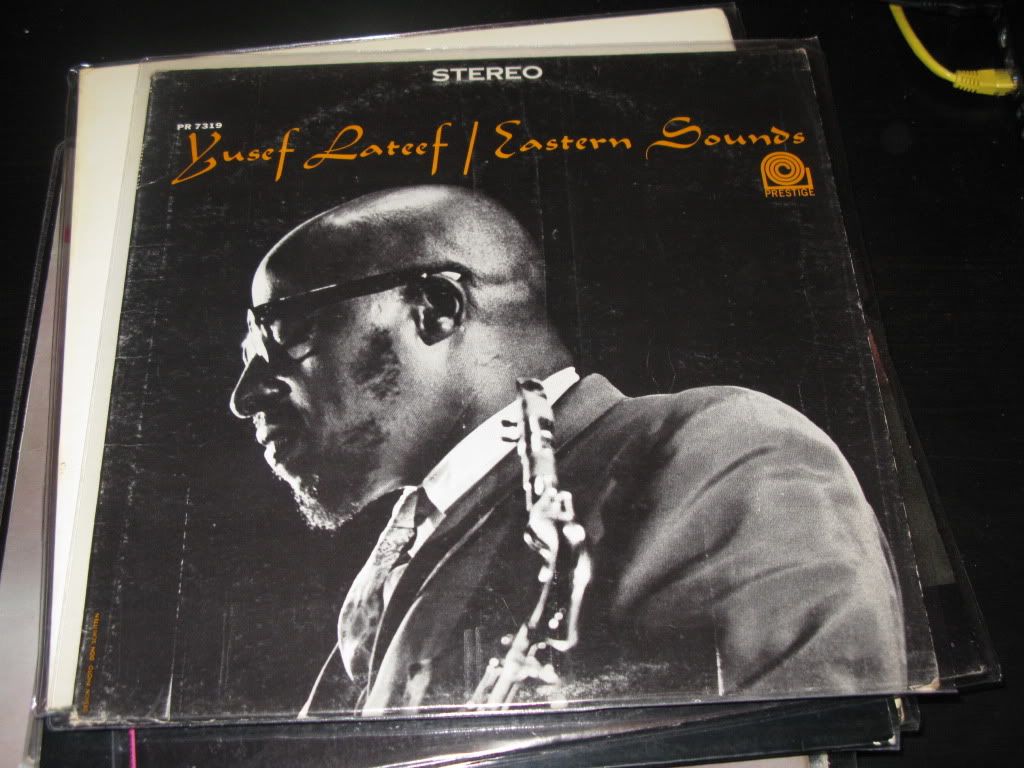
YUSEF LATEEF - EASTERN SOUNDS

I'm not sure I can do justice to this record. Whatever I write will only scratch the surface of what this amazing record has to offer. I feel as though I have decided to write about A Love Supreme or Milestones!

For me, it is a cornerstone of my love of jazz. It opened my ears to the potential that the music has and the fascination that I have for the exploratory nature of jazz stems directly from Eastern Sounds. Like all great jazz records it not only shows its jazz antecedents, it adds original elements, and the resulting mix points the way towards a new approach to the music.

It may sound slightly improbably but I found this record in a charity shop.I was out to lunch with my wife and had dropped her off at the restaurant while I parked the car. As I walked back to the restaurant I went passed a charity shop. Someone had obviously just dropped off a jazz collection, or perhaps it had been there for some time and the 'real' gems had already been bought. To find any jazz records in charity shops is pretty rare. Over many years I've been lucky enough to find a handful, but the reality is that you are more likely to find records by military dance bands or soundtracks to the Sound of Music than anything jazzy -much less original US pressings in perfect condition! Needless to say when I finally met up with my wife, a large bag of records under my arm, she was not very pleased that I had taken time off from being a husband to be a record collector instead!

But it was all worth it for Eastern Sounds.

This album was recorded in 1961. Lateef had been recording steadily for the previous five years, producing as many as four albums a year in 1957 and in each recording he included at least one experimental track. Often the experiment was the use of an unusual (for jazz) instrument such as an oboe, a piccolo or something from another country.

Lateef's interest in the music of Africa, initially the music of North Africa, stemmed from his conversion to Islam in the early 1950s. As he puts it in his autobiography, when faced with the prospect of having to produce records each year he realised that he would need something more than, then current, hard bop. "To break the mould, I began to study other instruments from different cultures. This new pursuit meant I had to spend time in the public library doing research on Africa, India, Japan and China."

Prior to Eastern Sounds, Lateef has been involved in Olatunji's Zungo and Randy Weston's Uhuru albums. Both records took their inspiration from Africa, the second particularly celebrating the recent withdrawal of British colonialism from many African countries. Music from Africa, particularly Nigeria in Olatunji's case, was used for both records and although Lateef's playing is not decisive on either recording, I think it is an indication of the man's interest in music from outside of America as well as his technical ability to play in other idioms.

Intriguingly, however, the recording Lateef produced of his own music prior to Eastern Sounds is Lost In Sound, which to my ears sounds very much a straight forward, of its time, hard bop record. While the record that followed Eastern Sounds, was Into Something, which again is less experimental than Eastern Sounds. What makes this record stand out from the records Lateef was making at the time, and in some ways from all the records he would ever make, is its relentless experimental approach. With the exception of Don't Blame Me, each track has something different, not just unusual instruments, but also unusual approaches to jazz, ,choices of tracks and influences. Ironically, although it is the least experimental track on the record, the writer of the linear notes, Joe Goldberg pays it more attention than any of the tracks. Perhaps he felt most at home with it?

Lateef's band comprised Barry Harris on piano, Ernie Farrow on bass and Lex Humphries on drums. They are all very competent musicians in the hard bop style and Harris is particularly good throughout, both inventive and sympathetic to Lateef and playing some really fine solos. However, I don't think it is disparaging to these musicians to say that I doubt they could have produced such a classic record without their leader.

The record kicks off with The Plum Blossom on which Lateef plays a Chinese globular flute. It produces such a particular sound that I have never heard anything like it on a jazz record. With some fine piano work from Harris and some interesting bass work from Farrow (is it the rabat he is playing? What kind of instrument is it?) the minimal nature of the song, its repetitive nature, its paucity of percussion and overall simplicity make it utterly captivating.


Blues for the Orient is slightly more conventional except that Lateef is playing the oboe rather than his tenor. This gives the track the, no doubted intended, 'oriental' feel. Its clearly an attempt to merge the American blues idiom with music from the 'orient' as the title tell us. To my ears there is a lot of blues and not a lot of orient - unless the oboe is all the orient there is!

Chinq Miau is, according to the sleeve notes, so-called because of a scale in Chinese music. Based on nothing more than a hunch I wonder if it is the most 'authentic' track on the record! While still 'jazz' it also points the way to the potential for something else, something more.


Lateef's interest in exotica is also evident in the two movie themes on the record. Lateef's versions of the Love Theme from Spartacus, written by Alex North for the movie of the same name, is one of my favourite songs in any genre of all time. Harris's playing is beautiful and Lateef's oboe is keening and heartfelt. I have to admit that there is something almost too deliberately 'exotic' about it, too knowingly 'out-there' and 'strange', as though Lateef is stretching to find the right way to express his interest and love of non-American music. Indeed the choice of covering a song 'about' an exotic place rather than listening to music from that place, only seems strange in the modern world. Coltrane, like Lateef, would listen to ethnographic recordings, but that would be some years hence. These records were not always easy to find in the US and the taste for them was not set in 1961. I am sure that there would be much to be gained from closely comparing this record to Coltrane's Africa Brass of the same year.


Snafu is, to my mind, an acronym from the US military which stands for Situation Normal, All Fucked Up. Is this song in some way a comment on the war in Vietnam. In 1961 the war had yet to become to take quite the divisive position in the US that it would later take. However, many young soldiers, disproportionately poor and therefore black, were being sent there to fight. The refrain maintains the 'exotic' feel of the rest of the record although the rhythm section play it fairly straight. I could see this as being the 'experimental' track on another Lateef record. Here is comes across as almost 'straight'.


Following the frenetic Snafu, Purple Flower is achingly slow. Lovely piano from Harris and restrained brushing from Humphries underpin Lateefs deep tenor tone. Makes me think of feeling 'heavy' and 'happy' - too deep to do anything but enjoying it nonetheless.

He also covers another sand and sandals tune, the Love Theme from the Robe. A film that has somewhat lapsed into obscurity, it tells the story of a Roman Centurion assigned to crucify Jesus. Supposedly set in Palestine it was shot in LA but retains a somewhat otherworldly character.


 The record closes with the Three Faces of Balal which acts as a coda to Plum Blossom. The instrumentation is similar as is the mood. I am not sure what the Three Face of Balal are, but I doubt the explanation given in the sleeve notes. Could it be another biblical reference to go with the two songs from biblical movies? Perhaps, given the composer's faith, it is not Biblical related, however, it may have a North African reference which would fit with the other tracks on the record.


Thursday, 8 March 2012

MONTEGO JOE - ARRIBA! AND WILD AND WARM

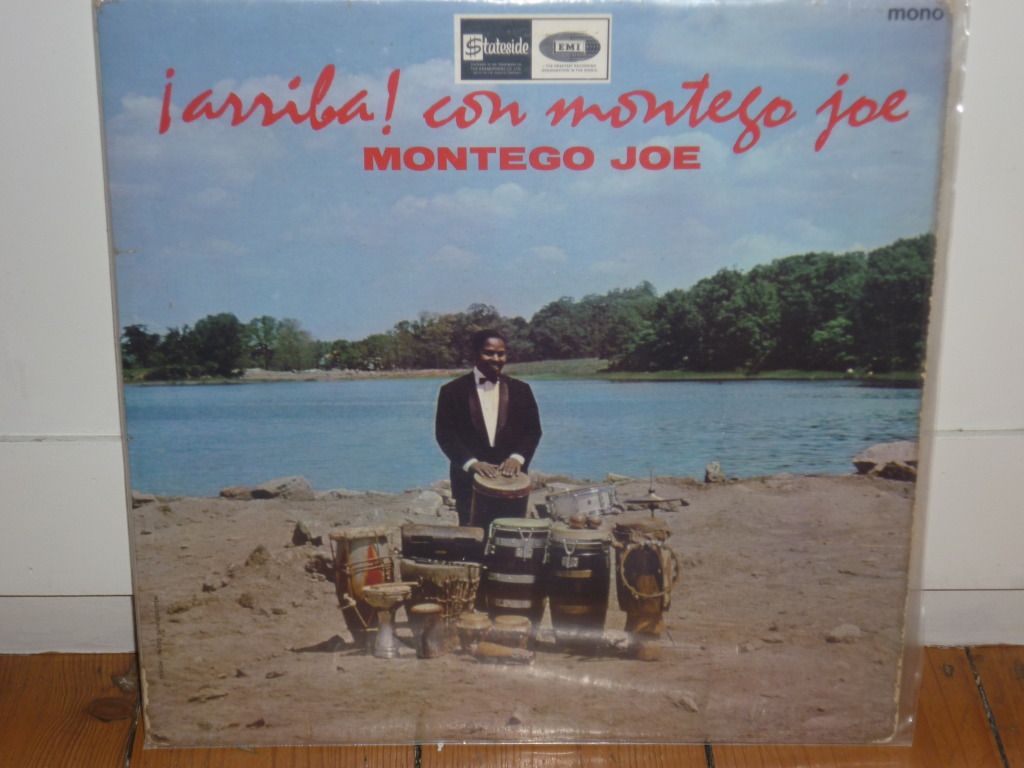
Look - its another budget-busting record cover!
Its a record by Montego Joe, a percussionist from Jamaica - hence his name. So where better for him to pose for the cover of his first album than on a beach? But perhaps it was difficult to find a proper beach as he's standing on what looks like a quarry with a lake behind him. It certainly doesn't make me think of a West Indian paradise! Just in case you don't know what to expect Joe (or Roger Sanders as he was christened) is standing behind an array of percussion instruments including a high hat!
Cover art aside, this is a lovely record. By the time it was released in 1964 on Prestige (my copy is a later Stateside UK pressing), Montego Joe had already played on records by Willis Gator Jackson, Art Blakey (read about it here) Roland Kirk and Solomon Ilori and was clearly 'in' with the New York drumming crowd.
He obviously learnt from his experiences as Arriba has elements of hard bop, funky danceability, afro-percussion as well as adding dashes of almost everything else to the mix - Latin, Brazilian folk music and apparently the last track is based on a Voodoo incantation.
There are two ways of looking at this eclectic choice of sources. The first is that Joe was widely influenced by musics from around the globe, that he could hear the essential links between the music of Africa and musics made by the descendants of African-slaves in the Caribbean and Latin and North American and was trying to bring them together in a kind of world-jazz fusion. The other, less charitable, is that anything 'foreign' or 'exotic' went into the mix to produce new sounds and sensations for the US record buying public.


The Latin feel is helped in no small way by the inclusion of Chick Corea (only 24 at the time) and Eddie Gomez (read about when Eddie met Phil here) in the studio band. The band is completed by Leonard Goines on trumpet, Al Gibbons on tenor, Milford Graves taking time off from his more advanced and avant-garde music to play drums here and Robert Crowder on 'miscellaneous percussion' (perhaps the high hat on the cover!).
I like this album very much. When it grooves it really hits the spot. Everyone swings nicely and the accent is clearly on the more dance-friendly jazz-listener. Its not quite boogaloo, not quite hard-bop, and not quite latin-jazz although the influences are clearly there. They even cover Horace Silver's Too Much Saki.


However, if I have one slight criticism of Arriba its not that it veers into 'exotica' territory - although it does slightly - its that there is not enough conga action from Montego Joe. Goines' trumpet, particularly in Too Much Saki, is great and Gomez' bass is masterful throughout. Chick Corea shows his latin chops and at times threatens to take over proceeding. It would, however, be great to have more unbridled Ray Barretto-esque 'Hard Hands'.
Things do improve somewhat on the second side but Joe's attempt to "make it as commercial as possible" just makes Maracatu a little dull.


Listen out for Eddie Gomez' bass solo on Dakar together with Graves' drumming - rhythm section heaven. Again its just a shame that there isn't more of Joe's congas.


________________________________________________________________________________________


Later in the same year Prestige released another Montego Joe record, Wild & Warm (as you can see my copy is the UK Transatlantic issue).
I'd guess that the first LP was successful enough to persuade Bob Weinstock to have another crack at it.
This time around, however, Corea and Gomez were not involved and were replaced by Arthur Jenkins and Ed Thompson respectively. Otherwise its the same team of Gibbons, Goines and Graves behind our man Joe.
As the sleeve notes explicitly say, this is a record for dancing. I'd guess that's why the tracks are so short. Each one could easily fit onto a 45 and so be played on a juke box.
The linears go on to say: "The music presented here is rhythmically akin to the rock and roll and rhythm 'n blues of the discotheques and teen hops - but with a difference. The 'big beat' with which almost everyone is familiar, has been seasoned generously with a variety of rhythmic twists and turns from African tribal musical traditions and from Afro-American music of Latin America and the Caribbean." Sounds very like a description of an exotica record to me! It could almost be a description of a Les Baxter record or a West Coast jazz/latin/rock cash in.
The music is, as with its predecessor rooted in Latin rhythms although it suffers somewhat without Corea and Gomez. And, similarly to Arriba there could be more up-front Conga action from Joe. He just seems too far back in the mix and isn't given enough time to solo. A, perhaps unfair, comparison, would be with Candido's earlier records which are conga-fests, or with Guy Warren or Olatunji who both brought some genuine African influences to their music. If I'm being really critical I would also say that I'd like to hear some more obvious West Indian influence - perhaps some calypso?
Having said all of that, its still a great record, and worth picking up if you come across it for cheap.

Here are some of my favourites - although I could just as easily have incuded the whole record!


Monday, 5 March 2012

DAVID MACK - NEW DIRECTIONS - ESSAYS FOR JAZZ BAND

One of the things I love about record collecting is the directions it takes you.
A few weeks ago I wrote about David Mack to say that I had never heard of him or of his record New Directions (in my review of Joe Harriott's Personal Portrait - read it here). Now I'm the proud owner of the very record and I was able to pick it up for less than the price of a couple of pints in the pub!
David Mack was a Scottish classically trained musician who played in the Scottish Symphony Orchestra. However, like many classically trained musicians around the world, he was also in love with jazz. And like many classically trained musicians around the world be tried to blend the two together.
New Directions, from 1965, is Mack's use of serial technique and jazz. You may not know what serial technique is.Indeed Mack acknowledges this in the sleeve notes: "An earnest searcher after the jazz truth might be pardoned, on seeing the schedule of this album for asking: Why serial jazz? And what is serial music anyway?"
He goes some way to answering the second question: "The method - not a system please note! - is founded on a twelve-note series, or 'tone-row'. It is not a scale, and any selected series functions rather int he manner of a Motive, being the source of the material for melodies, figurations, and so on, which the composer will use for that particular work."
For those with no musical training, the key aspect of Mack's work is that he took musical theory, originally developed by Schoenberg, and applied it to jazz. Mack was making use of classical avant-garde music and trying to weld it on to jazz.
Jazz is always being welded on to other types of music. You only need to think about soul-jazz, jazz-rock, jazz-funk, jazz-fusions of every kind and sort. And jazz and classical music have been bedfellows ever since Gershwin's Rhapsody in Blue.
In fact there are passages on this record that remind me a little of Gershwin, particularly the clarinet work.
Having read Coleridge Goode's description of the recording of this record I must say I was not expecting to like it at all. He says, "Whether it was an important record is hard to judge because the actual playing was not all that wonderful. Mack used some older musicians with a rather stilted style of playing which perhaps didn't do justice to the music."
However, it is surprisingly interesting and imaginative music and not at all the dissonant and difficult stuff I had expects. Perhaps my tolerance for this sort of stuff has become quite high!
The album does, however, have the feeling of being film music without a film. I'm not sure what it is about each track, perhaps its the careful composition or the slightly rigid format, or the formal playing, but I can see them being used in a spy or detective movie. 
The standout on every track is Shake Keane's playing. Having, together with Goode, recently finished playing in Harriott's Freeform group, Keane was well used to taking on difficult and demanding concepts.
Harriott would also become involved in a classical music/jazz hybrid with Laurie Johnson's Synthesis but Mack's effort has no strings and, to my ears, falls more on the jazz side than the classical side.
My copy is the US edition on Serenus Records, a small US label that tended to put out avant-garde classical recordings. In the UK it came out on as a Landsdowne Recording on EMI - that Denis Preston man again! This cover was designed by Uri Shulevitz and its worth reading his Wikipedia entry if you have a moment (click here)
Anyway, see what you think for yourselves. Here are four of, what I think are, the most successful tracks:

David Mack - Johnnie's Door

David Mack - Chaquita Moderne

David Mack - Clockwork Boogie

David Mack - Tonette 

Saturday, 3 March 2012

INDO-JAZZ: SITAR AND SAX


The funny thing about purity is that it can often lead to sterility. Mix things up a bit and all sorts of unique and unforeseen combinations can result.
Of course the act of 'mixing things up' can also be difficult or worse. People don't always like the challenge of the new. Stasis can be very comforting.
So it was for Joe Harriott. His music was a constant example of trying to 'mix things up'. Although his Free Form experiments were daring and original, his playing was not inherently Jamaican, or British for that matter. His musical building blocks were from the US and he used these to build roads in new and unforeseen directions which would ultimately separate his music from that of his hero Charlie Parker (here).
Musics from outside Europe, often from countries in the British Empire, or recently freed from it, had been increasingly common in Britain since the Second World War. Kwela (read about it here), calypso, ska, highlife, Latin American music as well as many others had been gradually making inroads into the consciousnesses of the British record buying public.
Not only that but the people who made that music had also been coming to Britain. People like Joe Harriott and John Mayer.
Pat Matshikiza, who wrote the South African jazz opera, King Kong (here), in his short and very moving autobiography recounts coming to London and being thrown together with others from across Africa and the West Indies, their differences momentarily put aside by their shared experiences under colonial rule as well as the inability of Londoners to think of any black person as anything but 'African'.
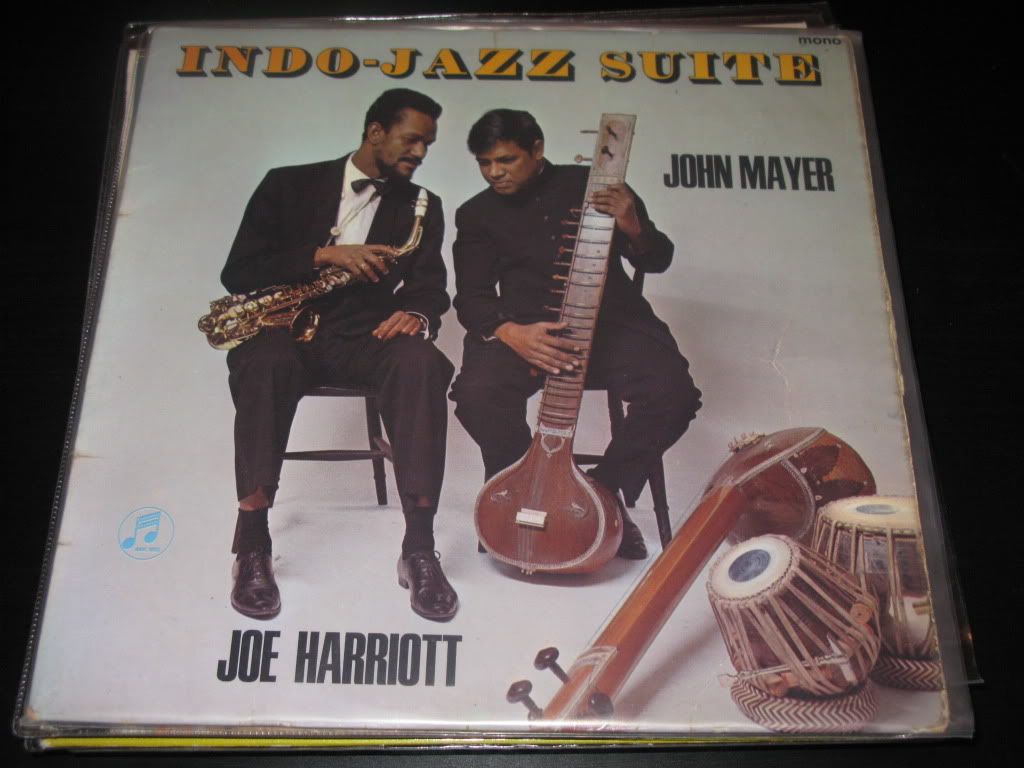
In many ways Harriott and Mayer's Indo-Jazz Double Quartet was a product of the collapse of the British Empire. How else to explain the 'rainbow nation' of musicians? Lead by an Indian and a Jamaican, including musicians from both countries, as well as from elsewhere in the West Indies, England and Scotland, the band was multi-racial and multi-national. But before we get carried away, here is John Mayer on the hostility that the band sometimes received: "Joe Harriott was a man who took all the stick, like myself. We took all the stick from everybody because I was Indian and he was a Jamaican." You only need to read Val Wilmer's marvellous book My Mother Told Me There Would Be Days Like These, to appreciate that most people in Britain had little understanding of cultures outside of their own, much less of people outside of their own country. Wilmer also wonderfully evokes the London of African exiles and immigrants trying to assert their independence and that of their homelands.
John Mayer was a classically trained violinist and composer from Calcutta. He had come to London to play in the London Philharmonic but his ambitions as a composer made this difficult for him. A chance meeting with producer Denis Preston lead to him composing a jazz piece (which he hurriedly wrote from scratch the night before the recording) and this in turn led to the concept of the double quintet. There is some dispute as to who originally had the idea, but I don't think that matters.
In my opinion Denis Preston was Britain's answer to Bob Thiele. In America he would have been running a label like Impulse. As it was, his Lansdowne Records and the Lansdowne Recordings he produced for EMI, embraced the best of British jazz but were also wildly experimental and adventurous. Preston made jazz records with Indian musicians, Ghanaian drummers (here) and (here), Goan guitarists, some Jamaican avant-garde free-form, classically inspired serial compositions, jazz and poetry, jazz inspired by poetry, he even produced Stan Tracey's tribute to Duke Ellington and, if he had been in America like Bob Thiele, he would have got Duke himself to play. Not all the musicians he worked with appreciated his style, indeed many allege he ripped them off, but like Thiele, he got the best from them and those who did fall for him remained loyal for life.

 The Indo-Jazz Suite is not the first jazz record which used sitar. This accolade must go to a Bud Shank record in 1961 which used Ravi Shankar for one track. What is completely different about the Indo-Jazz Suite, what elevates it, and all of the Harriott/Mayer collaborations, above mere exotica, is that it is not music that utilises Indian instruments for the sake of their 'foreigness'. Rather it is an amalgam of an Indian compositional tradition and a jazz tradition. For me, why they are superior to Bill Plummer's Cosmic Brotherhood and Emil Richards' Microtonal Blues Band (read about them here and here), is that Mayer was the driving force and not Harriott. In a way, this could only have happened in London. In America in the fifties and sixties, non-Americans, whether from Indian, Africa or South America, were only exotic sidemen. Perversely, the hangover from Empire, acknowledged in the sleeve notes to the Indo Jazz Suite by reference to Rudyard Kipling, the arch-defender of colonialism and the Empire, allowed Mayer, and to a lesser extent Harriott, to be given control of the music.
All the tracks on all three Harriott/Mayer Indo-Jazz records were composed by Mayer - although one track is an adaptation of Harriott's  Subjecty and one a co-composition with Pat Smythe. This really does mean that it is Indian music plus jazz and not jazz with some Indian sounds to spice it up - although this was an accusation levelled at the music at the time. It is Indo Jazz and not Jazz plus Indian music.
Nevertheless, without Harriott, I don't believe the music would have the force that it does. He is completely uncompromising. His playing is not above the Indian ragas, or even weaving between the pulse of the Indian players. He is harsh, abrasive, cutting this way and that through the music, carving out his own space that is completely Joe Harriott. Perhaps it shouldn't work but it does. He brings the hard edge of his free form playing and forces it to mix with Mayer's structures. It is quite brilliant.
Another factor in the music is that Harriott and Pat Smythe are the only constants in the jazz side of the double quintet. The Indian classical side (really a quartet plus classically trained flutist Chris Taylor) remain unchanged through all three records. I think that this provides a base for the Indian side of the music to remain dominant while the jazz side of the equation is constantly learning how to fit in.


Coleridge Goode, who played on both Indo Jazz Fusion records but not the Indo Jazz Suite recounts in his autobiography how complex the process of producing the music was. His take on it was that the jazz musicians would have to practise to be able to play in the different time signatures and different modes so that the Indian musicians could join them.
I can hear a definite development from the first record through to, in my view without doubt the best of the three, the last record. In the Indo-Jazz Suite there is a tentative feel to the playing and the music as though no one is quite sure where it will go and how to play. Harriott sounds crisp and sharp but he is not as completely in control as he would become.
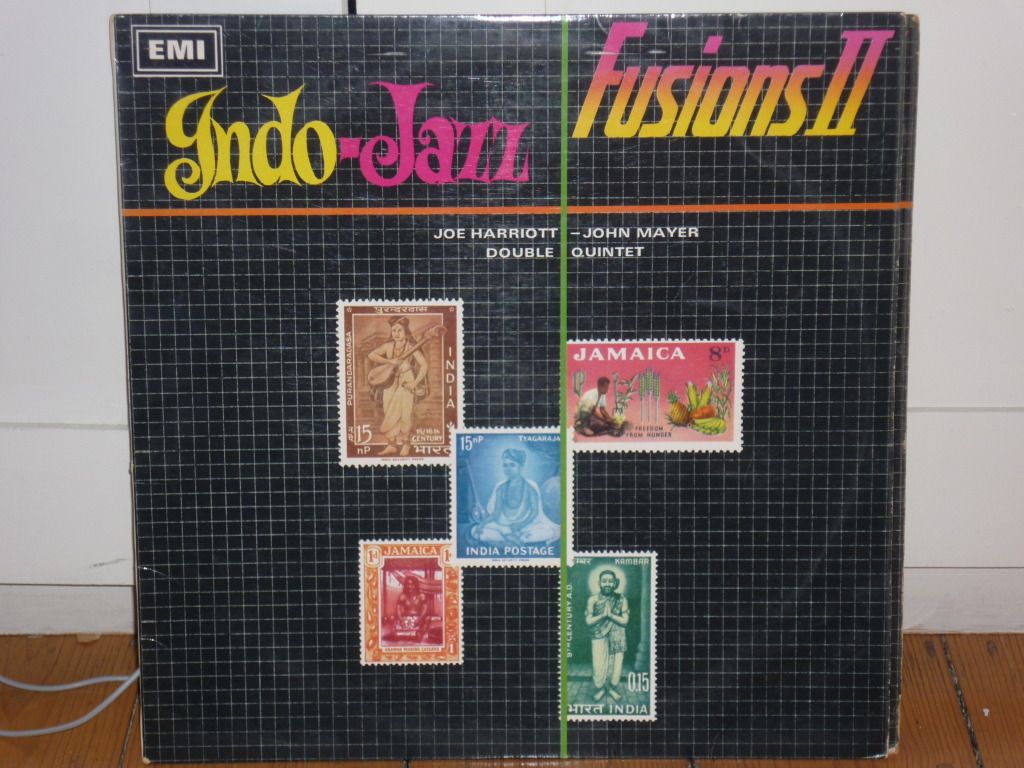
I guess, given the success of the Indo Jazz Suite, and the touring that followed it should not be a surprise that the band improved. For Indo-Jazz Fusions, Harriott is joined by Coleridge Goode (who replaced Eddie Blair who would go on to play with the Mahavishnu Orchestra with that other lover of Indian music John McLaughlin) and Shake Keane (read about Keane here). Goode found the experience interesting and exhilarating and his autobiography contains a quote from Harriott saying the same thing. However, you have to wonder whether there could ever be room for two leaders and I suspect that having been the leader and song writer for his own quintet it was difficult for Harriott to be a member of the double quintet.
Nevertheless, Indo-Jazz Fusions II is the masterpiece of the three records. Harriott is clearly now at home in the idiom, although ironically he seems to play less. Of the jazz musicians, Smythe and Taylor seem most at home, both of them putting in amazing performances. Meanwhile Diwan Motihar, the sitar player is simply incredible. As Ian Carr says in the sleeve notes "now problems and compromises are over: the fusion has taken place".
All of which makes it a shame that it is Harriott's last Indo-Jazz record.

Mayer would continue with the concept, producing a further album, Etudes. Don't what ever you do make the same mistake that I made. I saw the above record from France, which on the reverse is credited as including Harriott. It doesn't. It is Mayer's Etudes repackaged to fool idiots like me. Sax duties are taken up by Tony Coe, with Kenny Wheeler on trumpet and Goode still on bass. The Indian musicians are still the same as the other Indo-Jazz records.
It is a good record, although Harriott's presence is sorely missed. Coe, as good as he is, simply doesn't have the irascible character to take on the Indian aspect of the music with the result that he is too understanding and understated. Good but not great.
Clearly other people noticed the success of Indo-Jazz. The project was lucky in its timing with George Harrison's adoption of the sitar and a general turning towards Eastern mysticism amongst hippies. A number of sitarsploitation records would be released on both sides of the Atlantic to cash-in on this growing desire for non-Western sounds. In many ways this was simply an extension of the exotica craze that had taken off in the 1950s. Non-European instruments were pressed into service either covering the hits of today or to give a slightly 'foreign' sound to otherwise western musical forms. Indo-Jazz was different from that but nevertheless benefited from it.
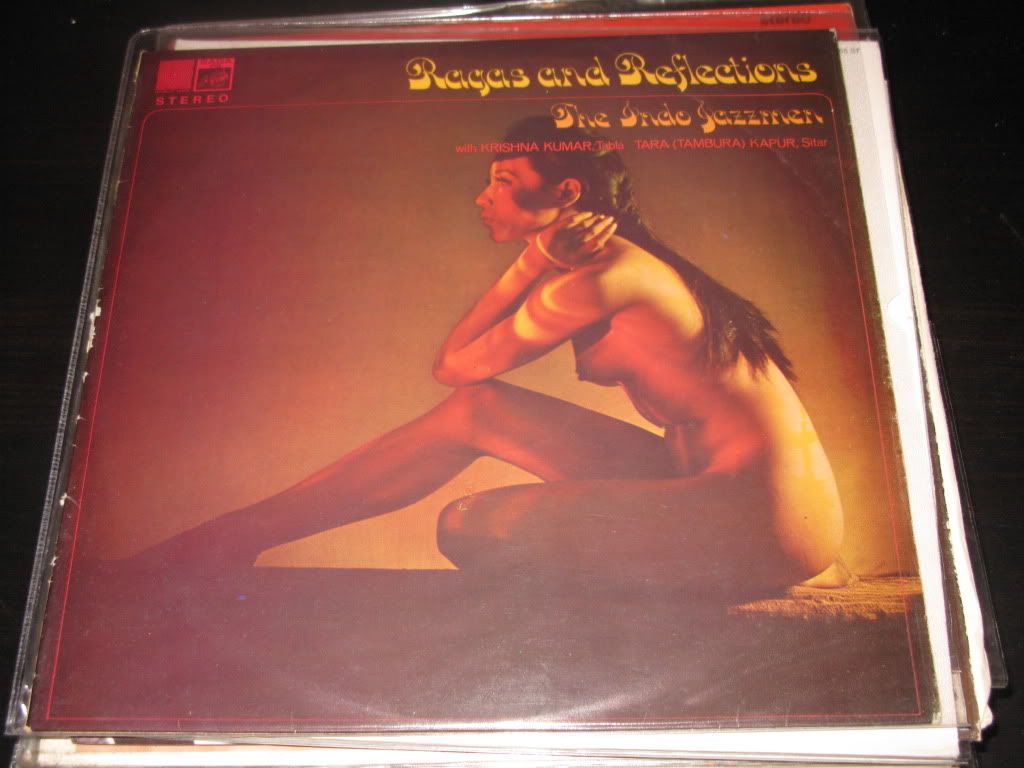
First of the Indo-Jazz cash-ins was Raga's and Reflections by the Indo Jazzmen. The sleeve credits Krishna Kumar on tabla and Tambura Kapur on sitar but does not mention the jazz musicians. The tracks are credited to Issacs who may be Ike Issacs. Anyway, its great stuff and even the inclusion of a Christmas Carol can't pull it down. While the Harriott/Mayer records are cerebral and inquisitive, Ragas and Reflections has more of a feel of a jam session - as befits a cash-in record. I'd like to think that this is some of the same musicians as from the double quintet, moonlighting to make some extra money. However, having listened to this back to back with the Indo-Jazz records, it just doesn't seem likely.

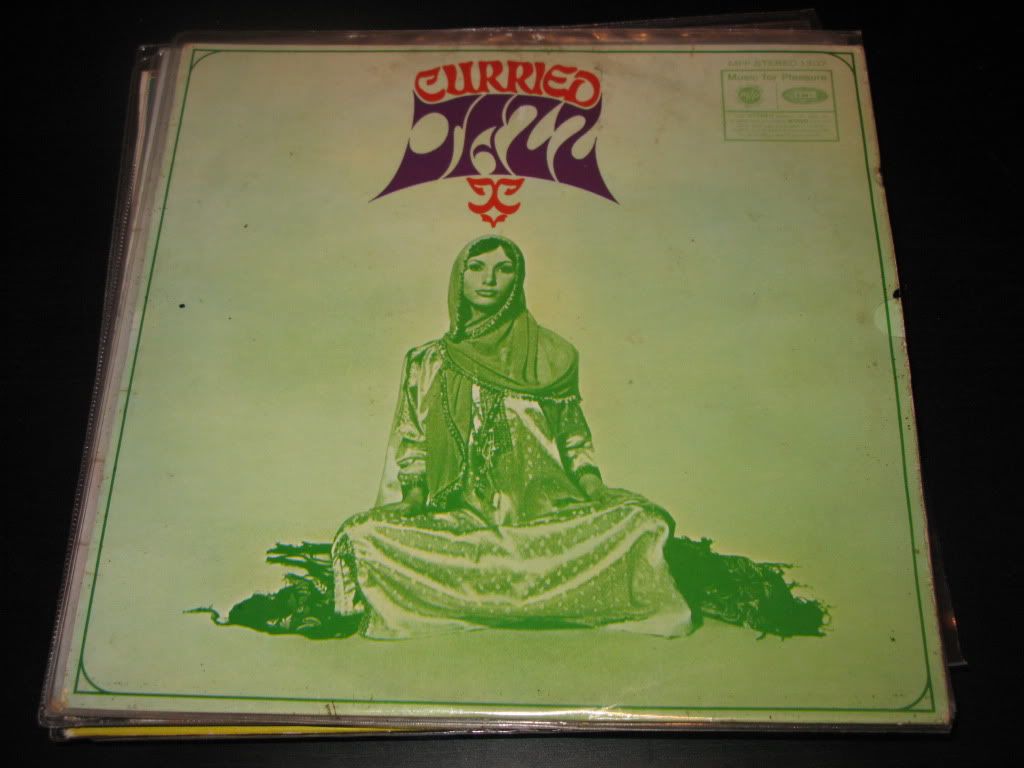
Finally, the last hurrah for Indo-Jazz, we get Curried Jazz by the Indo British Ensemble. The band includes Kenny Wheeler who had played with John Mayer as well as the Australian Chris Karan on tabla which I feel just adds to the Empire feel of the thing. The opening track Yaman (The Colonel's Lady) is one of my favourites. However, despite the inclusion of Dev Kumar on sitar and Sitara on tabla the whole thing is arranged and composed by a Brit Victor Graham. Jazz with an Indian flavour indeed.

Indian music would continue to influence jazz, and jazz musicians would continue to be interested in musics from around the world and use 'exotic' instruments to produce usual sounds. However, the collaboration between Harriott and Mayer would prove to be the high point of this hybrid music.