Writing about music is like dancing about architecture

Wednesday, 23 March 2011

MINNY POPS - DRASTIC MEASURES, DRASTIC MOVEMENT

"Take that racket off! Its even worse than jazz!"
This was my wife's reaction to the Minny Pops' LP.
Indeed its hard to reply to this kind of response when the first track on the LP, Springtime I, consists of little more than repetitive electronic beats and sounds a little like a broken heart monitor.

In terms of user friendliness things do improve. However, the Minny Pops make no concessions to popular music or to an easy listening experience. Which is why you should search out this record as soon as possible.
Recoded in 1979 Drastic Measures, seems, to my ears, to be the work of people who wanted to push to the boundaries the simple electronic music devices that they had. Thus we get simple sounds, repeated or looped, discordant squalls of sound, odd noises and sudden moments of clarity. Great stuff! However, I would hesitate to put Minny Pops into the Industrial category. Although their music is at time abrasive there is much humour and many silly moments.
For Minny Pops, the second track there is a recognisable tune and a guitar. The vocals repeat the phrase "I can feel a machine, I can feel a Minny Pop/ He wants to be a machine, he wants to be a Minny Pop". No, I don't know what it means either. However, it is clearly their manifesto and the merger of man and machine is evident throughout the record.
Hologram could be a transmission from another planet. A transmission that is breaking up or being jammed by hostile forces. Or, as my daughter thought, it sounds like Donald Duck talking on a broken mobile. You decide! I think it sounds like the kind of thing that you would make if you have access to synthesizers and a sense of humour.
Total Confusion is underpinned by some electronic percussion sounds which remind me of the tennis game that you used to get for your TV. Over the tennis-like sounds are swirling electronic noises, the occasional murky vocal and some tinny keyboard.

For me the standout track is Dolphin's Spurt. As with all of the other songs here I have no idea what, if anything the lyrics are about. Delivered in a cold manner, very much in the way of a lot of electronic music, stabbing jerky guitar repeats itself while the keyboards make whistling sounds (perhaps a Dolphin's Spurt) and the precise electronic drums act as a metronome throughout. You could dance to this in the slightly spasmodic way that people danced in the post-punk era. And then suddenly its all over.

Motor City could almost be something from Sonic Youth. Clashing discordant guitars vie with the dry emotionless singer in a squealing fight to the death. Or something.
Over on side two we start with Springtime II which again is largely the broken heart monitor but this time with added stylophone.
According to Monica "Living in Bolivia Ain't So Pretty". The pounding bass pushes Monica along, giving it a dark menace. Velvet's like guitars add to the claustrophobic feel as the song drills down into your head. With the robotic vocals, bass and drums there are clear krautrock influences but the shear tightness of the song seems to turn it away from anything 'hippy'.

Flash Goes the Eye features a sound that is part creaking door hinge, part violin bowed a la John Cale, and part kazoo. Yips and howls abound. Its a children's party gone horribly wrong!
I've always thought that MD Mania, the next track, is a song from the Silicon Teens album that has somehow escaped. Upbeat and perky with the kind of bossa drumming that only early synths could produce, its fun and happy until you listen to the lyrics.
RU21 predates the Mary Chain by a good six years and, although it doesn't have the bubble-gum influences of the Reid brothers, it channels the drones of the Velvets and marries it to some 'young love' lyrics. Although in this case there is something not quite right about the attention the singer is paying to the girl. Hypnotic like a road crash. 

Mono continues the tightly wound, choppy guitars, precise drumming theme but adds some arrhythmic hand claps and some dense and almost choking swampy sounds. I'd hate to hear what Stereo sounds like!

The record ends on New Muzak which sounds like a snippet from a Brian Eno ambient LP. If that's the new Muzak I'm going to spend more time in lifts.

RAMSEY LEWIS - MOTHER NATURE'S SON

In his brilliant book 'How the Beatles Destroyed Rock and Roll', Elijah Wald suggests that the Beatles changed the way that popular music was appreciated by Americans by introducing the concept that bands had to be original and unique. Prior to the arrival of the Beatles, Weld says, musicians had to be able to play in a number of styles and to know the hits of the day. When they played live the main purpose of the music was for people to dance to. They wanted to hear music that they knew, that was familiar and which enabled them to dance.
The Beatles changed all that, according to Weld, by showing that popular music could be original, exploratory and have a unique sound. Suddenly it was no long enough for bands to sound like the popular hits of the day, they had to have their own sounds. This was particularly so for recorded music. Why buy a record by a band if it sounded just like someone else?
Of course, this process took a long time and even Weld is forced to acknowledge that, unlike the exclamatory title of the book, the Beatles didn't destroy rock and roll but changed it instead.
Its a fascinating theory.
However, what doesn't quite fit into his theory is the enormous proliferation of Beatles covers records that were produced during the lifetime of the band and well after. If the Beatles created a desire for original music why did people continue to cover their songs (and indeed those of the Stones, Donovan, Dylan etc.)? If you could buy a Beatles record why buy someone else having a go at their songs - much less someone filling a whole album with them?
There were jazz cover versions, Moog cover versions, folk, easy listening (especially easy listening!), gospel, funk and there have been disco and house cover versions.
Even Sinatra ended up singing Yesterday!
The Beatles changed the way that young people thought about popular music but they also changed the way that older people thought about popular music. Many forms of music had relied on popular songs to form the core of their repertoires. Folk singers, jazz bands (of all sizes and types), instrumental groups, pop singers, had all drawn from popular songs - often the same tune was performed by radically different types of musicians. Rather than the Beatles killing off this tradition, their music was absorbed into it.
Whether you wanted safe sanitized versions, jazzed up versions, or lounge versions, the songs themselves were so good that they could be adapted to almost every style. Which isn't something you could say about Gerry and the Pacemakers.
For the rock cognoscenti, original sounds, new forms, boundary stretching became the norm. But that had always been the case with musical forms that considered themselves avant garde.
However, what the majority of people wanted was something a little less challenging, and more palatable.
Currently, cover versions of popular songs are uncommon unless the songs are 'classics'. As Weld suggests that's partly down to the ubiquity of music so people tend to want the original rather than the cover and partly down to the way that we hear music. If you're dancing it probably doesn't matter who is making the music as long as you are having a good time. If you are listening at home or on your headphones you may want to go for the most unique sounds.
Which brings us round to Ramsey.
Throughout his career he made conscious efforts to be on the pop side of jazz. Perhaps his most enduring 'hit' was his version of Wade in the Water which only a cloth eared poltroon would say wasn't fantastic and it is justly a Northern Soul/Mod classic.
But not all of his output was so successful and one could look at his discography as a long attempt to find the best outlet for his undoubted musical skills. He did a folk record, a Bossa Nova record, two Christmas records, a few 'standards' records and had even put out a few singles of Beatles' covers before this record.
In a way very similar to the way that Weld describes popular dance bands, Lewis rode the waves of popular music, producing records which featured his typical tight, percussive playing but on music that his audience would have recognised from elsewhere.
The result is that there are a lot of Ramsey Lewis records out there and most have only one or at best two decent tracks. And don't even think of delving into this late seventies electric output!
So Lewis was a musician with form when it came to popular covers.
And that is what you get here. But luckily someone at Chess records had the foresight to get Charles Stepney to produce.
Stepney had enjoyed huge success with the Dells and in 1972 produced one of my favourite records of all time - Terry Callier's What Colour is Love. He had written many R&B chart entries and later worked closely with Earth Wind and Fire. Maurice White who formed Earth Wind and Fire was Ramsey Lewis's drummer for many years and plays drums here.
So what did Stepney do? Two things. He brought in a Moog, which for a jazz Beatles covers record must have seemed pretty weird. Although the strange sounds of this strange instrument are relegated to intro and outros they do give give the listener warning to expect something different. The Moog parts, which must have been added to the music at a different time to the sessions given the problems with actually playing the Moog, do seem slightly gimmicky. But they also form a bridge between rock and jazz and in those terms work well.

I love this record. Its got just the right amount of unexpectedness and strangeness, just the right amount of funky as you like drumming, just the right amount of interesting piano playing and some songs written by some blokes from Liverpool. On top of that its got a cover that's so bad it's good. And according to the reverse you can find Mr Lewis's clothes at  P.J. Boutiques!


Wednesday, 16 March 2011

AL HAIG TRIO - INVITATION

My record collection is full of things I have bought, usually from charity shops, as blind punts. Something about the cover, about the personnel, about the record label, has appealed to me or somehow set off a connection in my brain. Usually, the blind punt turns out to have been ill-advised and the record goes back into the wild to, hopefully, give joy to someone else.
So it was with Al Haig's Invitation. I prevaricated for about 10 minutes before buying this record. I even had a cup of coffee to think about it!
You can probably tell from the fact that I'm writing about it that I'm pleased I did.
Al Haig was part of the bebop revolution and played with Charlie Parker and Dizzy Gillespie. Classically trained he was able to keep up with the frantic pace of many of bop's songs. He went on to play with Stan Getz and was part of the nontet that played on Miles Davis's Birth of the Cool.
Intriguingly, he was accused after his death, by his second wife, of killing his first wife and of being a serial spouse abuser. Of these violent tendencies there is no obvious evidence in his music, unless you count his propensity to explode into playing as many notes as possible in as short a space of time as possible before relaxing back into a more languid style.
This record was recorded in 1974 by which time Haig's career was seeing something of a revival, particularly in Europe. Perhaps his slightly 'cool' style was regarded as a relaxing alternative to some of the prevalent styles of jazz. Indeed jazz has always had a rather divided attitude to its elder statesmen, lauding them while at the same time regarding those who like their music as being, in Philip Larkin's wonderful phrase, 'mouldy old figs'.
A brief glance at the track list confirms that Haig wasn't playing for modern jazz tastes with songs written by Cedar Walton, Billy Strayhorn, JJ Johnson and Tad Dameron. Intriguingly he also records Invitation by Bronislaw Kaper which was recorded by John Coltrane in 1958 and Art Blakey in 1961, as well as Dorothy Ashby, Harold Land and Haig's old partner Stan Getz. Kaper also wrote On Green Dolphin Street another of my all time favourite jazz standards.
Haig is very ably assisted by Gilbert 'Bibi' Rovere, the French bassist who played with amongst others Bud Powell (see the bop connection?) and Kenny Clarke on drums. In my view Clarke is to bebop drumming what Parker was to saxophone, Gillespie was to trumpet and Charlie Christian was to guitar. Clarke moved to France in 1958 and went on to form the Kenny Clarke/ Francy Boland Band - about whom we will hear more in the pages of this very blog!
As an aside all three men had, had some experience of jazz and classical music. Haig with his classical training used to play Chopin as a warm up before Parker came on stage, Rovere played with Martial Solal who was well known for including classical elements into his jazz music, and Clarke played in the first incarnation of the Modern Jazz Quartet, when it was still the Milt Jackson Quartet.
That all three men came from similar musical backgrounds can be heard in the way they play together.While Haig is obviously the leader the others in the band are more than merely a rhythm section. Clarke in particular, who was particularly experienced in playing behind pianists is in wonderful form throughout.
There is much to enjoy on this record but recently I have become slightly enthralled to one track - Haig's own composition Linear Motion.
On this song the trio suddenly seem to find their voice together and begin to make some distinctive music.
It starts with some beautiful interplay between Haig and Rovere, the double bass notes booming out above the jumping piano chords, Clarke using the brushes gently in the background. Suddenly the tempo is upped and they spring into action. Clarke playing with his cymbal and Rovere walking all over the bass, provide an inventive but solid backing for Haig to improvise over. Whatever the meaning of the title Linear Motion I don't think it can apply to Haig's playing as he sweeps and soars, at one moment racing upwards in a clutch of high notes and then the next moment dropping down with only a few well placed touches of the keys. Then, Haig and Clarke drop back to let Rovere take a solo and there is a brief moment of funkiness before Clarke drops a few drum bombs and rolls, sounding effortless and determined at the same time. With a brief refrain this beautiful song comes to an end.
I'm not a big fan of posting clips but I am prepared to make an exception for this simply lovely piece of music.
I hope you enjoy it as  much as I do.

Al Haig - Linear Motion


Saturday, 12 March 2011

SHAKE KEANE - An Angel Horn - His solo albums

I don't think that anyone would dispute that a major part of the success of Joe Harriott's experiments in jazz was the interaction between Harriott and Shake Keane.
The two men were temperamentally dissimilar but musically they understood each other and worked together to produce exciting and exploratory music.
Both Harriott and Keane were from the West Indies, Harriott from Jamaica. As well as being a jazz musician Keane was a literary man - his nickname was Shakespeare, shortened to Shake. When he first arrived in Britain from the West Indies it wasn't to make a career as a musician but rather to work in the BBC World Service where he read poetry and did interviews.
Quite rightly his work with Harriott and Michael Garrick is seen as the high points of his career. However, I feel that his solo records are rather unjustly over looked.
Keane had played in a number of styles before becoming involved in avant-garde jazz and, like most British jazz musicians was at home with big bands.
When Keane finally left the Joe Harriott Quintet it seems that there was some frustration over the lack of success that the group had achieved. Despite pushing the musical envelope, gigs were hard to come by and money was tight.
It seems to me only natural that Keane should have taken an opportunity to try something more commercial. The result is Shake Keane with the Keating Sound. Although this was not his first record under his own name, it was his first LP and teaming up with Keating must have seemed a very commercial move. Keating was a successful big band leader and he was not above being experimental - witness his Johnny Keating and 27 Men LP, with Keane in the band and arrangements by Basil Kirchin.
However, there are no experiments on this record. Given the poor reception that Harriott's free form recordings had gathered this was probably deliberate. It is tempting to imagine a poor, hard done by, jazz cat being forced to record music in a style he doesn't care for. However, given the nature of Keane's solo efforts I just can't believe that was the case.
His playing is marvelous. I particularly like the ending of Makin' Whoopee and the quite passages of I Have  A Dream.  Even old chestnuts like Jobim's Meditation has a wonderful moment when Keane seems to be about to leap out of the genteel arrangement and threatens to play a storm. Keane is very much to the fore throughout the record.
Keating's arrangements are fine and they have their moments and if its not 'red hot' music it is not intended to be.
I do wonder about the cover though. There's Shake, the epitome of jazz cool in his crumpled suit, loose tie and ever present shades. You might think that the music on the record was 'proper' jazz rather than smooth jazz.
However, the design department at Decca clearly liked the photo because here it is again on his next record.
But those clever design guys have just reversed it. In fact they were so cunning that they cropped out his watch - just so you couldn't see that his left hand had switched round.
Decca also took a slightly different tack with this record.
Gone is the Keating Sound. Instead Shake has a small group of friends almost all of whom had played with Joe Harriott.
On tenor and oboe was Bob Efford who had played in the front line with Harriott in Tony Kinsey's Quartet in 1957, Pat Smythe, Coleridge Goode and Booby Orr had all played with Keane in Harriott's Free Form group. Finally Olaf Vas provides some lovely flute. Pat Smythe relinquishes the piano stool to Stan Tracey on three tracks.
One might think that with such a great group Decca would have allowed them to stretch out and try something new.
However, the lure of commercial success was obviously too great and someone obviously thought that covers was the way to go. However, unlike his previous LP, Shake and the band leave the standards behind and have a go at some contemporary pop covers.
Therefore we get some Stones (As Tear Go By), Beatles (Girl), Dylan/Byrds (Mr Tambourine Man) and Smokey Robinson (My Guy).
However, it must have been difficult to completely control a band of seasoned jazz-men as they managed to sneak a few original compositions in as well. Shake, as its his record, has two. The beautiful and brittle New Sunday which has some really lovely interplay between Keane and Efford and the wonderful Latin-tinged Fidel. I would imagine that the Fidel in question is Mr Castro from Cuba. Is there some kind of political comment in the choice of song title? Perhaps some call for Caribbean revolution? More likely it was just a name that Shake liked the sound of. Stan Tracey's piano is wonderfully off-kilter in a Monk kind of way.
The other original is Morning Blue by Joe Harriott - although perhaps its a bit of a stretch to call it an original as it appears on the Harriott Quintet's Movement LP, on which Keane, Smyth, Goode and Orr played. Their version is swinging nicely and Efford's oboe is a nice touch. On balance though I'm not sure that Keane's flugelhorn can take the place of Harriott's tenor.
Otherwise stick to side two which has some great covers of Tony Hatch's Downtown which includes some outstanding playing from Coleridge Goode and Donovon's Colours.
Overall an intriguing record which succeeds more that it fails.
Which is why the choices behind the next record are so hard to fathom.
No doubt the ever elusive commercial success was, again the driving force.
Dig It! sees Keane supported by the Ivor Raymonde Orchestra and Singers. In 1968 when this record was released Raymonde was still riding high on his chart success most notably with Dusty Springfield.
The choice of Raymonde must have been similar to the way that today you might get a famous producer in to give a contemporary feel to a singer's record (step forward Madonna). However, the sound is so Ivor Raymonde that there sometimes doesn't seem to be much space for Keane to do anything except blow his lungs out over the top.
I would guess that it is Raymonde himself on organ in so many of the tracks.
He provides some solid backing for the standout tracks. It might be completely impossible to produce a cover of Green Onions that doesn't feature some prominent organ and Keane's version is no different. However, after Raymonde's organ and a tasty guitar solo about half way through and the arrival of the backing singers there isn't very much room for Keane. That doesn't stop him and he produces a really individual performance that simply takes over the second half of the song and, when its finally faded out, leaves me wanting more.
Interestingly he again covers The Stone's As Tears Go By and not with any more success.
Raymonde's selection of songs goes from pop (By the Time I Get to Phoenix, a very slow Goin' Out of My Head and Sunny), rock (the aforementioned Stones, Bend Me Shape Me) and soul (Green Onions, Chain of Fools). He may have been trying to cover a lot of different tastes but instead only manages to drag all of them into a mid-ground of orchestrated mush.
However, the whole proceedings are saved by the one original. Make Like Shake is by Raymonde and is wonderful. It opens with some driving funky bass before Keane comes in over the top. He bows out and the strings take up the challenge, repeating his parts. But Keane is not having that and he comes back harder than before. However, now he has to contend with the backing singers but they can give no serious opposition and fade out. The guitar joins the fray and for a moment takes over but Keane is on to him in a moment and just blows him out of the water. As Keane and guitarist tussle the track fades. Its not jazz but it is a great piece of funky sixties instrumental action.
By now it must have seemed clear that commercial success was going to elude Shake Keane. He had had the backing of a major record label, had been
produced by Johnny Keating and Ivor Raymonde, both of whom were successful band leaders and had tried his hand at covering some of the most popular songs of the day.
His final solo effort therefore was a much more subdued outing. For a start he was no longer on a major label but instead on the budget Pama label. Best known for putting out cheap reggae compilations, the Palmer brothers who ran the label also tried to encourage local talent. Rising Stars at Evening Time stands as their only jazz record. Like all budget labels the Pama story is complicated. If you want to know more you should go here: http://www.studiowon.com/pama/index.asp
In many ways to my ears, this is the most successful of all of Keane's solo LPs. When I first bought it, I was expecting some blistering free form jazz action. So when I put it on and found that it contained gentle delicate arrangements, and on some tracks wordless singing that reminded me of Esquivel I very nearly took the record back to the shop and demanded a refund.
I am very pleased to say that I didn't. It is a record of rare beauty and charm.
Keane's playing is, as you would expect, impeccable. But more than that, he is not competing with massed strings, or heavy production techniques to make himself heard. And because it is comprised soloey of originals it seems far more timeless than the pop covers of previous records.
Admittedly on some tracks the smoothness goes too far and everything falls into a kind of stupefying mulch. But when it works, particularly when the Hastings Girls Choir are used, the music is simply lovely.
Keane has three of his own compositions on the record. Perhaps the most successful is Ruanda (is it allusion to Rwanda?). It would, of course, have been greatly improved if the person playing the organ had been Stan Tracey but you can't have everything.
His version of the his 1962 track, Bossa Negra has also grown on me and it is still a tremendous song.
For my money the song Rosing Star is worth the effort of getting the record alone, however, the otherworldly A Song of Romance is also very intriguing.
There were to be no more Shake Keane records. He worked in Germany with the Kurt Edelhagen Orchestra and also with the Clarke-Boland Big Band (who I am sure we will come to in another post!). But as Coleridge Goode points out in his autobiography "..he was frustrated that he had not received the recognition he wanted and clearly deserved."
It must indeed have been a cause of deep unhappiness to have tried so hard to find commercial success and for it to have alluded him. He had, played the game, as it were and had nothing to show for it. From ground breaking jazz to radio friendly covers it  must have seemed to Keane that he had tried everything to make it in  British jazz. He had played with some of the best musicians that Britain had to offer and he had make four records under his own name. However, money was still tight and the name Shake Keane was still a long way off from being well known.
Goode writes very movingly about his friend. He quotes a poem the Keane wrote in 1997. It goes
When I was born
my father gave to me
an angel-horn
with wings of melody.
That angel placed her lips
upon my finger-tips,
and I became, became
her secret name.

....

Now light is low,
new angels come and go.
The passion-tree
spreads as dense as destiny.
But this old angel-horn
strives like the lifting dawn.
Love moves to claim, to claim
our secret name.

Monday, 28 February 2011

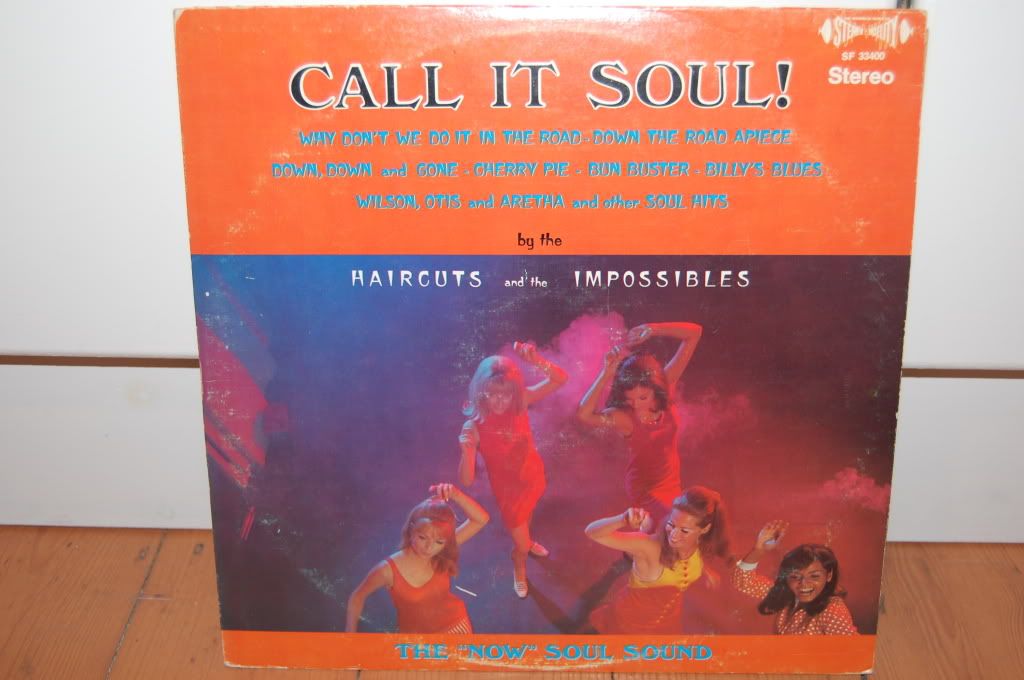
Exploito # 6 - The Haircuts and the Impossibles - Call It Soul!


Recognise those happy frugging girls? Its the same cover shot as the Mustang Freakout but with the Mustang cropped out. They're still having a far out time though.
Kicking off with a cover of the Beatles Why Don't We Do in in the Road (uncredited of course) the Haircuts, or is it the Impossibles get off to a good start.
I would guess that this was Miller and Sherman's attempt to tap into the Beatles market. After all, what did people know about the Beatles? They had funny haircuts!!!!
The guitar playing on the second song Bun Buster sounds familiar - could it be Jerry Cole?
And then we get to Sock It My Way, which thankfully is the Animated Egg. Its such a good song - slightly weird and freaked out, slightly slow and menacing, the shimmering guitar refrain is pure class and the tightly coiled, aching lead seems to be imitating an evil snake and it coils and darts at us. Brrrrrr!
Wilson Otis and Aretha however, is Paul Griffin which is the same song as Joshua Got Busted on the Mustang Freakout record. It sounds too much like 'I'd Rather Be A Hammer than a Nail' to me.
Billy Blues is a fun sax led thing. Its taken from yet another exploit record, Guitars a Go Go, which was yet again done by Cole but before psychedelic music became popular. I'm sure that I'll get round to Cole's pre-Animated Egg/Id output.
Over on the B Side Cherry Pie is not another Beatles cover, unfortunately but a very lame slow organ dance thing with some truly awful singing.
Down the Road Apiece is another weak song but I'm fairly sure its Cole in an earlier guise.
Luckily its followed by more Animated Egg - Inside Looking Out. This version though seems to have been recorded in a well. Its full of very odd sounding and strange echo. Perhaps Miller and Sherman had their engineers play around with it. Or more likely it was just another take on the song - why spend money on anything.
Next comes more Paul Griffin on Frankie and Johnny which was one of his 'hits' of 1968 - or indeed on his Dance to Swinging Organ LP from 1964.
And finally yet more Animated Egg on Down Down and Gone. Perhaps not the best Animated Egg track but still a fuzzy piece of danceable fun.
Its time to say goodbye to Paul Griffin aka the Mustang. But don't worry exploito psych lovers - next time we're going to get into T Swift and the Electric Bag.

Sunday, 27 February 2011

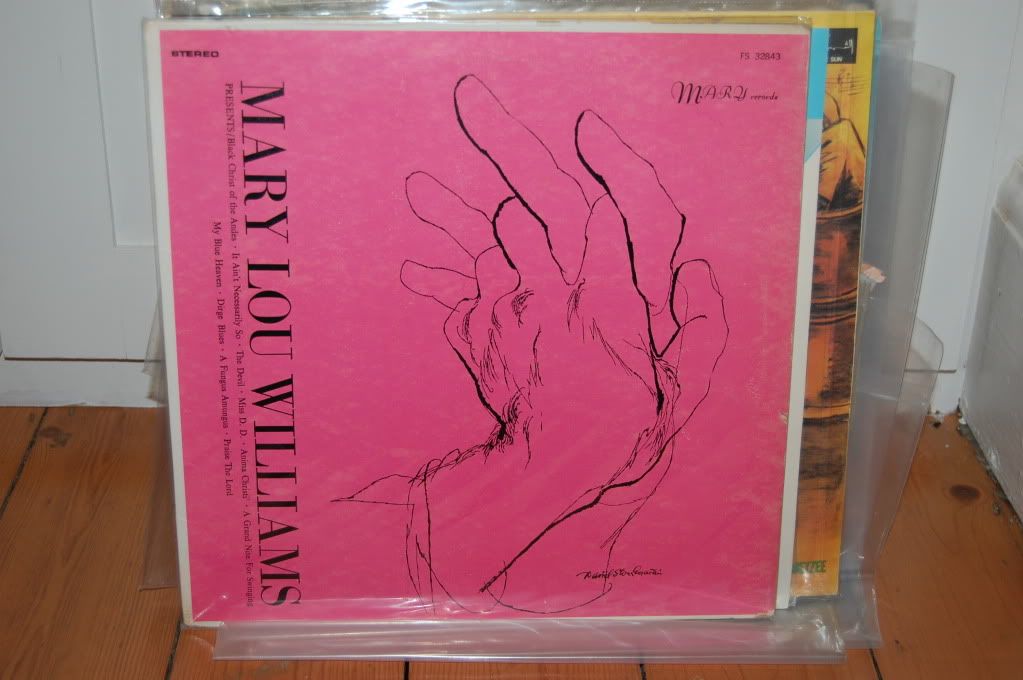
MARY LOU WILLIAMS - BLACK CHRIST OF THE ANDES

Sunday again and more jazz with a Christian twist.
Mary Lou Williams was a key figure in the bebop scene in New York in the late 1940s.
She played and arranged for all the 'great' names such as Charlie Parker, Dizzy Gillespie and Thelonious Monk and arranged for Duke Ellington and Benny Goodman.
She was one of the many musicians interviewed for Nat Hentoff and Nat Shapiro's Hear Me Talkin To Ya where her central place in the group of jazz musicians who were creating bebop is clear. In one passage she recalls seeing a female pianist Lovie Austin sitting cross-legged, cigarette in mouth, writing with her right hand while accompanying the band with 'her swinging left'. "I told myself, 'Mary, you'll do that one day.' (And I did, travelling with Andy Kirk's band in the 'thirties on one-nighters.)"
Although she was not the only woman in jazz she was one of the few who was not a singer. She was tough and determined and in love with music.
However, in 1954 she stopped playing music and devoted her energies to the Catholic Church. She is quoted in the sleeve notes as saying "Music had left my head and I hardly remembered playing." What an extraordinary comment and an extraordinary thing to happen. Imagine being at the centre of a revolution, being part of a movement of ideas that would change the course of music and influence people around the world. Imagine being part of that and then, not only deciding to do something else, but being so immersed in your new path that you forget all the revolutionary passion you had before. Amazing.
If the sleeve notes are to be believed she would not have returned to music had she not been persuaded by her priest Jesuit Father Anthony Wood. Apparently he said "Mary, you're an artist. You belong at the piano and writing music. Its my business to help people through the Church and your business to help people through music."
What a remarkable journey for a musician to go on. I wonder what it was that prompted her to give up the thing she loved most. Was she tired of music, or the life that came with the music? Had she seen too many wild nights and debauched times that were ruining the lives of the people around her? Or was it rather the pull of the Church? Was there a calmness and certainty and purpose in Catholicism that she liked? Did it give her something to devote her considerable energies to, other than music?
I have to admire that in a person. Very few of us know the path that we should take. Very few of us devote ourselves to that path regardless of the costs. I hope she found happiness in her period of abstinence.
On 3 November 1962 at the Saint Francis Xavier church on 30 West Sixteenth Street in New York a civil rights mass was held in honour of Martin de Porres a Peruvian saint of African descent. At that service Mary Lou Williams' Black Christ of the Andes was first performed.
I think it is significant that her first piece of music to be performed was a piece intended to fit into the Catholic liturgy but also intended to praise a black saint. During 1961 and 1962 Martin Luther King Jr had been campaigning in Albany, Georgia for desegregation of the city. Mary Lou Williams' home state was Georgia and she had grown up in Atlanta, King's hometown.
The beautiful, haunting singing of Black Christ of the Andes is reminiscent of ecclesiastical music as well as gospel music from the black Baptist church from which she came. When I first heard Black Christ of the Andes I wasn't even sure it was jazz. Of course, debates about what is and what is not jazz are ultimately pointless but the 'non-jazzness' of this piece also makes me wonder whether Williams, in composing it, was trying to move away from the bebop she had helped for develop and was searching for another type of music. Perhaps Williams was trying to push the boundaries of jazz into the furthest corners of where is had not been before. In the way that Christianity was pushing into Peru and up the Andes, exploring new territory, was Williams trying to push her music into new territories and explore new modes?
She was, certainly, making a statement about racial equality, or rather the lack of it in the US. Not only was she introducing jazz into the Church but she was doing so in praise of a black saint. I am sure that no one could have failed to understand the significance.
The album, to me, seems strangely divided between the overtly religious pieces, Black Christ of the Andes, The Devil (described as humorous in the sleeve notes but I find nothing about being dragged to hell very funny), Anima Christi', Praise the Lord (which is a swinging piece of gospel) and A Fungus Amungus.
The last is a very experimental piece of music that you either think it daring and exciting or you think is a tuneless mess. You decide.
The other tracks, It Ain't Necessarily So, Miss DD, A Grand Night for Swinging, My Blue Heaven and Dirge Blues are less obviously religious either in execution or content. Of these my favourite is Miss DD apparently dedicated to Doris Duke a famously wealthy New York socialite, philanthropist and jazz fan (her Doris Duke Jazz Foundation still supports jazz). With just Williams and bass its a wonderfully vibrant and enjoyable piece of uptempo stuff. If Ms Duke was like Miss DD she must have been great fun.

Of course the cover artist is David Stone Martin whose wonderful work graces many jazz records. Are the hands locked together in praise or in pain? I've looked at this image a great deal and it seems to me to be showing the agony of the faithful as they turn to their religion during difficult times.


Thursday, 24 February 2011

Exploito # 5 - Part 2 - Even MORE examples of exploito versions of the 'Now Generation'

So, just when I thought I had shown you everything I had about Donnie Burks, Little Joe Curtis and Paul Griffin, I find that, lurking at the back of my record collection there's more.
But not only that, some very kind people have either pointed me towards cheap acquisitions or even given me records (thanks Daniel in Oz and Steve in London)

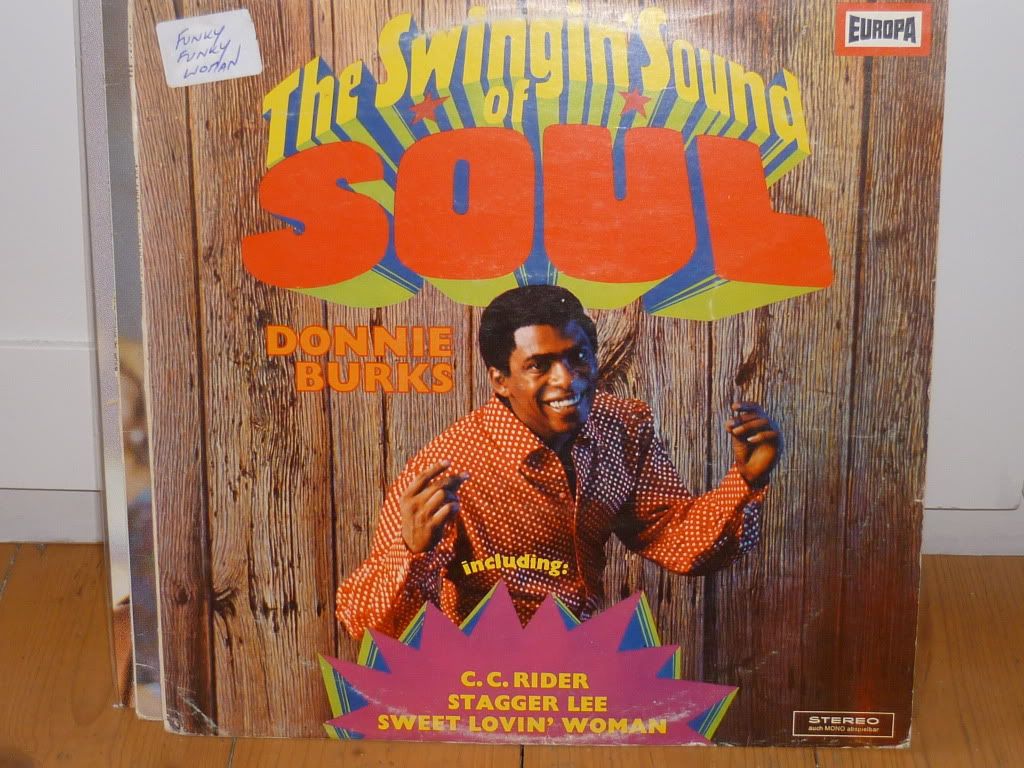
So, without further ado here's Donnie Burks' solo album

I hope that it's really him on the cover as he looks like a nice bloke. But I have to wonder - why put him in front of wooden boards?

Anyway, released on Europa, Miller's German operation which, as well as inflicting a world of pain through oompah music and beer drinking songs, managed to sneak out a few good records, Burks', record is really pretty good.

You'll find CC Rider from the Now Generation record here and its just as good. The other tracks are also fun but the standout - as one of the owners of this record clearly knew, which was why he put a sticker with the name of the track on the sleeve, is Funky Funky Woman. No doubt its the kind of thing that people would have danced to on Northern Soul nights - but then again they danced to a lot of stuff.

I have to wonder why this record only got a 1969 release in Germany and not the US. Maybe DL Miller knew something about the US market. Anyway, as usual with him, over half the tracks are credited to him. However, Burks does get a few credits. I hope he got some money.


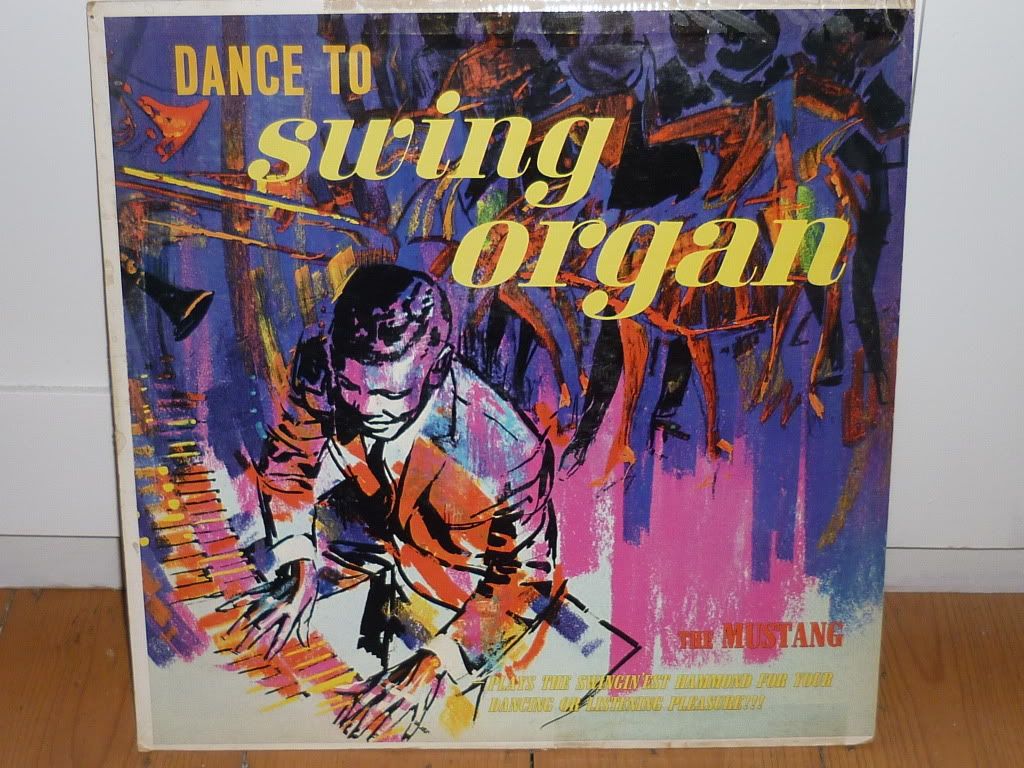
Next we have some more Paul Griffin aka The Mustang, this time from 1964.

This time, its pretty good. I might even be persuaded that Jerry Cole is the man on guitar.

The sleeve notes try and draw a connection between The Mustang and jazz organ greats like Jimmy Smith but only a cloth eared poltroon would make the link.

This is good time stuff in an old time rock and roll vein with some hoking sax and fuzzy guitar. I prefer it to Organ Freakout. For some reason I can only find one of these tracks on another record - but I'm sure that's just me. We'll get to that other record in a moment. Paul/ Mustang also produce a Beatles cover record. If life takes me past one I'll let you all know.

We've already come across Oscar Records before with their repackaging of The Now Generation. This time round they get to have a go at the Otis Redding, Little Joe Curtis record. Notice that poor Little Joe still gets the tiniest typeface.

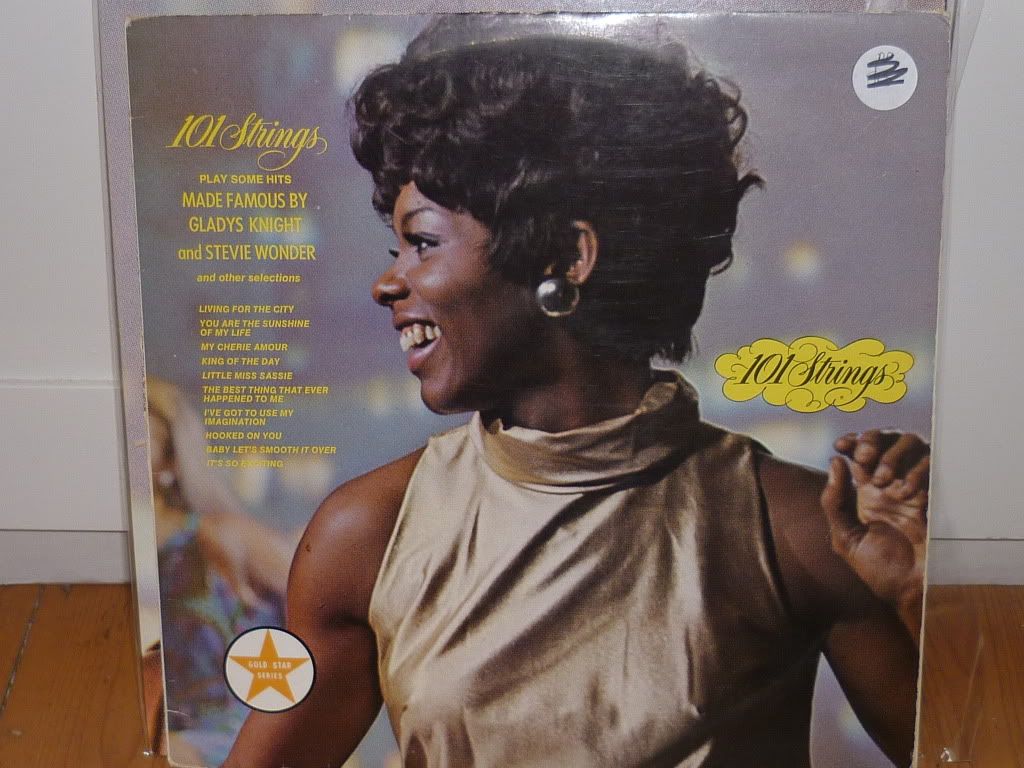
Haven't we seen this happy woman before? Of course, we have. Never let it be said Oscar Records had an ounce of originality. This is a close up of the woman on the Soul Sauce cover shot. Gotta love it.


 And so, of course, is this! This is an Australia record on the Astor label, another Miller nom de plume.

No funky stuff here I'm afraid, unless you think that the 101 String doing string leaden covers of soul songs is funky. They make a reasonable fist of some of them but to be honest no one would buy this record for the music alone. Would they?

But there is something so wonderfully exploito about the reuse of the cover, albeit in reverse, for the 101 Strings that it tickles me.


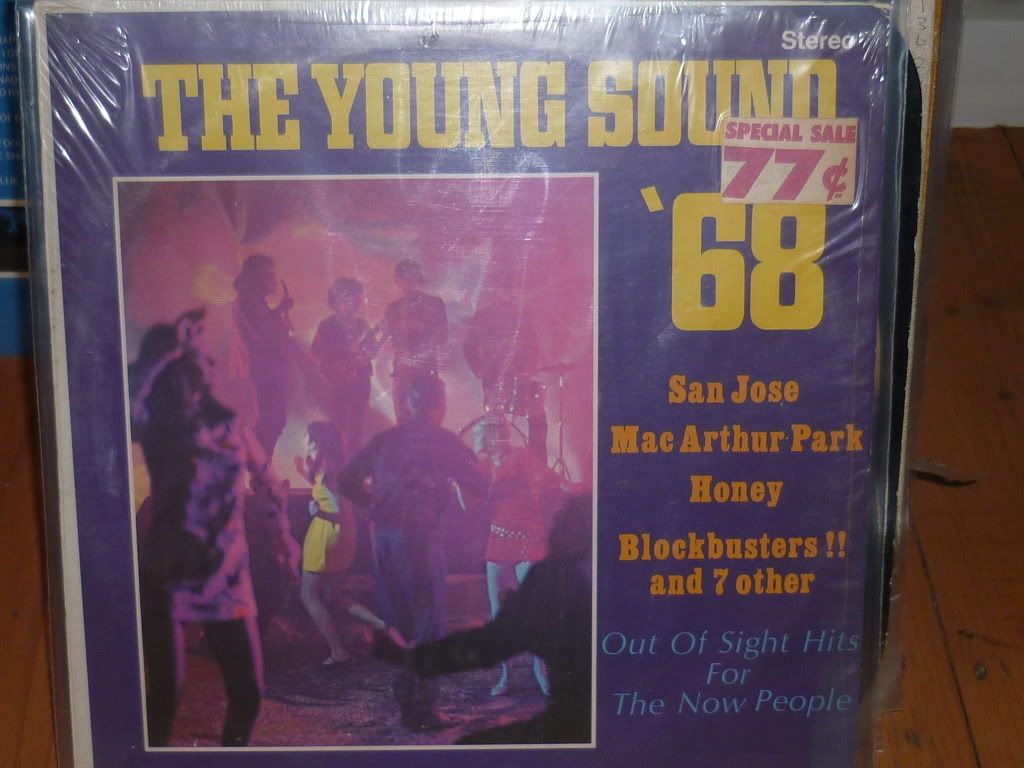
Finally we get back to some Animated Egg. The Young Sound '68 even has the sub-title - Out of Sight Hits for the Now People.

From the Animated Egg we get Sure Listic and I Said, She Said, Ah Sid - prime stuff

From the Mustang we get Frankie and Johnny from Swingin' Organ. What a hit from 1968!

From Little Joe Curtis we get Your Mini Skirt. I think I'm beginning to really like Little Joe.

And finally Donnie Burks gets in on the act with CC (Or See See) Rider.

You also get some 101 Sting pop cover action if that's your bag.

Have a long look at those rather mop-top looking guys on the cover. You'll be seeing them again too.

Although I like this record you have to remember that this is supposed to represent music in 1968. It goes without saying that anyone into popular music wouldn't have been seen dead listening to such out of date stuff. However, notice the 'Special Sale' sticker on the sleeve. This record was being sold for 77 cents. This was what these types of records were all about. Cheap records for supermarkets. Just think how low the production costs had to be to make any money from a 77c record!

For our next excursion into this amazing world we get back on the trail of Jerry Cole and the Animated Egg with the slightly ludicrously named Haircuts and the Impossibles - tune in