Writing about music is like dancing about architecture

Thursday, 30 June 2011

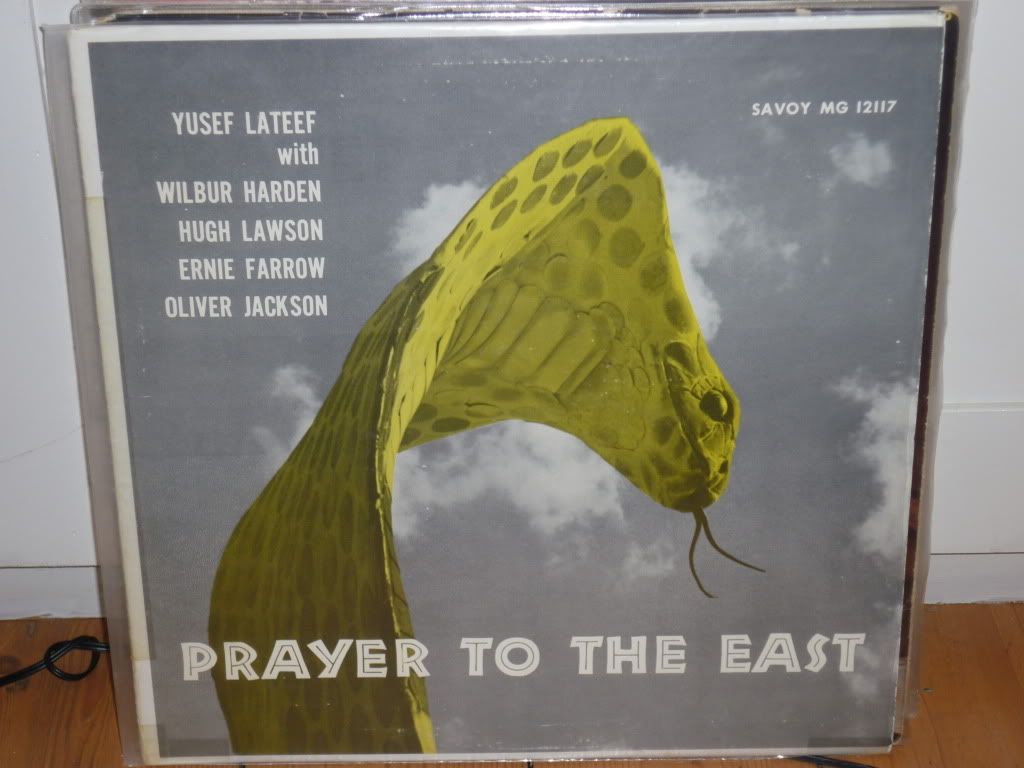
YUSEF LATEEF - PRAYER TO THE EAST

Ever since I found Eastern Sounds in a charity shop in Hammersmith I've been fascinated by Yusef Lateef - the man and his music.
He seems to me to have been unfairly relegated to a footnote in jazz history. He is mentioned as a friend of Coltrane's who made available to him books about Islam. If he is mentioned it is usually in the context of some of the exotic instruments he used such as the rahab, shanai, koto, Chinese wooden flutes as well as the oboe and the flute. Sometime he is referred to as a precursor of 'world music' - whatever that may mean. The depth and beauty of his music, however, is rarely mentioned.
Jazz musicians have always attempted to expand the range of the music through the use of different instruments, different combination of instruments and different ways of playing.
Lateef's interest in 'exotic' instruments should be seen against the background of the introduction into jazz of a range of unlikely instruments from the harp to the cello to the bagpipes. Before sounds could be generated by a computer they had to be made by people and jazz musicians were always looking for new sounds. The long shadow cast by bebop encouraged younger musicians to experiment with form as well as content. Nothing was off limits, everything could be co-opted from Broadway musicals, to classical music and even in the case of Sonny Rollins, calypso.
However, Lateef carried these experiments furthest, at least until the seventies. From the early fifties when he started to lead his own groups almost every record he made has at least one track on which he plays oboe, flute or another instrument from beyond the United States.
To this love of different sounds Lateef added a love of the blues. Unlike Eric Dolphy who sometime seemed to be dismantling the post bop/ hard bop sound, Lateef used his ability as a multi-instrumentalist to give the blues based form of jazz a dose of energy, to revitalise it and to make it relevant.
Lateef puts it best himself: "Having completed two albums for Savoy, it dawned on me that perhaps I could be recording for few years, and it was no use reinventing the wheel with each new album. To break the mould, I began to study other instruments from different cultures. This new pursuit meant I had to spend time in the public library doing the research on Africa, India, Japan and China."
But the use of other instrument was not just a gimmick. As well as introducing new musical sounds Lateef hoped that the use of instruments from other countries could help to promote understanding and possibly friendship. He felt that other cultures had much to teach the US and that interaction could be beneficial to all involved.
I am certain that his interest in different musical instruments and in religion, leading to his conversion to the Ahmadiyya Muslim Community, are linked. Indeed later in his life Lateef would travel to Nigeria to teach music but also to study Nigerian music. Lateef also became an educator and developed his theory of Autophysiopsychic music. Clearly he is a man who with a deeply searching and enquiring mind.
Lateef fully converted to Islam in 1948, after a few years of intense study. In his biography he recalls: "My embrace of Islam came in about 1946 while I was working with the Wally Hayes Band in a club on the west side of Chicago. One night a trumpet player named Talib Dawud sat-in with us. He told me that he was an itinerant musician and that he was practicing Islam as a member of the Ahmadiyya Movement."
I think that it is significant for Lateef's music that he chose the Ahmadiyya Movement rather than the, albeit still nascent Nation of Islam. The motto of the movement is 'Love for All: Hatred for None' and, although it has been rejected by heretical, particularly in Pakistan, it is far closer to the mainstream of Islam that the Nation of Islam.
Although  one could infer that the adoption of Islam by Lateef, changing not only his name but the names of his wife and children, was an implicit rejection of elements of post-war American culture, Lateef does not seem to have been militantly calling for mass change. As he puts it, "I believe that the motivation for any human being to embrace Islam is that when almighty God turns a person's heart towards Islam (peace) there is no other choice for the person." This does not sound to me like the words of a many set on violent change - or indeed violence of any sort!
In a passage of Dizzy Gillespie's autobiography that is often quoted, Gillespie attributes the attraction of Islam to black Americans to the fact that they would treated with respect and as equals, something that could not easily be found in American institutions of the 1950s. Gillespie goes on to recount a story of one of his band members persuading a racist restaurateur to serve him by saying that he was not a Negro but a Muslim.
For Lateef, and indeed other jazz musicians such as Art Blakey, Dakota Stanton, Ahmad Jamal, McCoy Tyner and Shihab Sihab, conversion was a matter of deep faith not expedience
The record opens with Dizzy Gillespie's A Night In Tunisia.
The track begins with a gong and Lateef playing eastern sounding notes while in the background there are strange percussive sounds. Altogether a very evocative beginning , perhaps derived from Lateef's studies of North African musics or from folk records from the region.
The song soon, however, returns to the US and follows the well trod path of other covers of this standard. In 1957 when this record was made, Lateef
Lateef had played in Gillespie's band and must have been very familiar with Night In Tunisia. Written in 1942 and first recorded in 1944 the title refers to the Allied involvement in Tunisia rather than attempting to evoke a mythical exotic paradise.
I particularly like the very end where Lateef and trumpeter Wilbur Harden quote Charlie Parker's famous version. Harden would record four albums as leader with John Coltrane - yet another Coltrane connection!
Endura, written by Lateef is a very straightforward post bop number with fine solos from Lateef on tenor and Harden on flugelhorn. It swings in a funky manner but after Night In Tunisia is seems rather flat to my ears.


Side Two opens, like Side One, with a gong. Bassist Ali Jackson, who would also play with Coltrane as well as on other dates with Lateef, provides the wonderful Prayer to the East. Lateef's flute soars majestically above the tight rhythm section. Although the use of the flute seems to be an attempt to invoke a sense of prayer or reverence, Harden's flugelhorn is just too loud and tough to hold the same mood.
I find the next track fascinating. Why Lateef chose to cover exotica maestro Les Baxter's Love Dance, perhaps we will never know. He must have owned, or at least have had access to a copy of Baxter's Le Sacre Du Savage.
Exotica has become renowned for its fakeness, its lack of authenticity and its use of foreign instruments, usually from the Pacific, to spice up some otherwise pedestrian music. Les Baxter, however, was the one who started it all and his music is never pedestrian.  The Ritual of the Savage LP contains Quiet Village which when covered by Martin Denny on his Exotica LP became a smash hit.
I think its worth quoting the description of this track on the Ritual of the Savage sleeve notes.
"The fervid sun has dropped behind the jungle curtain ... living creatures of the tropics make their nests. A chattering chimp squawls a final command to its young. Over the softening sounds of evening comes the beat of the tom-tom... bringing together the entire native populace for a ritual as stimulating as it is sacred. Here is music for a slow, surging and erotic dance ... a dance as seductive and pulsating in its concept as in its execution ... gentle in tempo ... violent in extreme." Heady stuff!!!! And I still don't understand why Lateef would have covered it.
If anything it threatens to give credence to accusations that he is just using foreign instruments in the same manner of people like Denny or Arthur Lyman - as pure exotica, employed only to evoke a feeling of a dangerous, sexually freer primitive place.
Did Lateef, still a young man of 36 really believe in the savage and primitive nature of Africa?
The sleeve states that Love Dance was arranged by Ali Mohammed Jackson, no doubt the same Ali Jackson who wrote Prayer to the East. From the name one can infer that he is a Muslim too.

The set concludes with the lovely ballad Lover Man which shows the depth of Lateef's playing to the full.

Sunday, 19 June 2011

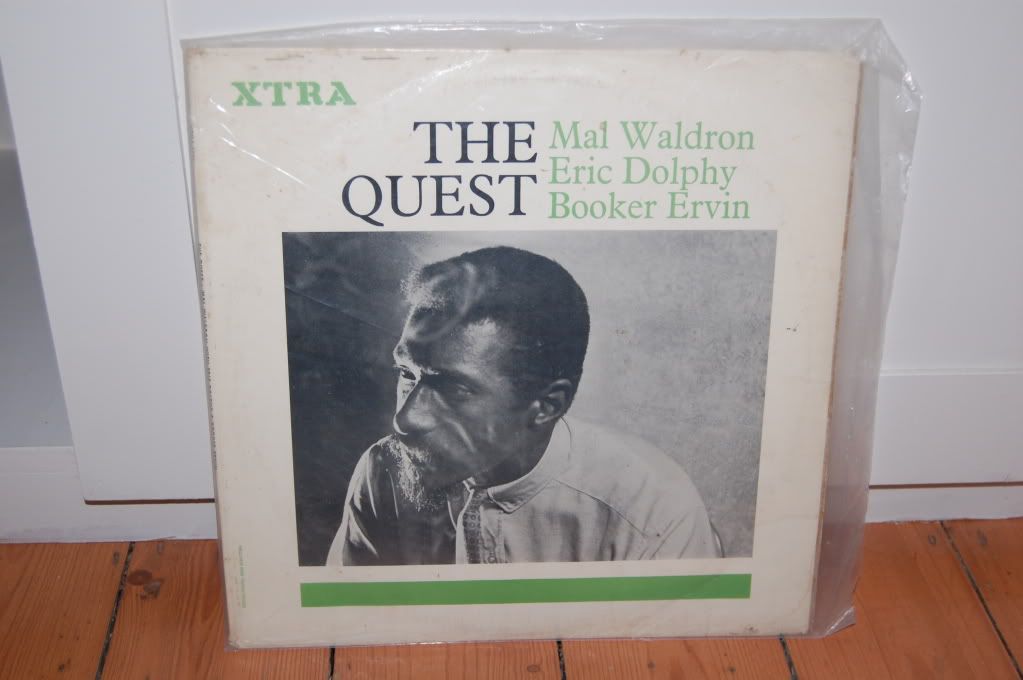
MAL WALDRON - THE QUEST

As my journey to the outer reaches of my record collection continues I pulled this out recently. I haven't listened to it much over the years but have now  become strangely obsessed by it over the last few weeks.
It doesn't quite fit into any neat categories and is all the better for that. Its not really hard bop - its far too experimental, Its not free - although its recorded in 1961 and includes Eric Dolphy, the presence of Booker Ervin ensures that hard bop is very much a presence. Its not third stream - although the inclusion of the cello might make you think there were some classical pretensions.
For once the title does seem to convey what is happening on the record. Waldron seems to be on a quest - but a quest for what?
The Quest was recorded for Prestige in 1961. The Prestige label had a reputation as something of a junkie's label. Its owner Bob Weinstock often paid musicians in cash which made it very attractive to those who needed quick money. What's more, Weinstock didn't like anyone rehearsing in the studio and was against second takes, unless absolutely necessary. If the band needed to record the song again he'd get the engineer, Rudy Van Gelder, to wipe the tape so they could record over it. This kind of hit and run approach was, he said, intended to capture the spontaneity of live performances. Perhaps, but it also meant that many musicians felt that they didn't need to play their best. It also meant that musicians were loath to try new things, or sometimes even new compositions, unless they could get it right first time.
At the time of this recording Waldron was in the grip of heroin addiction. It wasn't until an overdose in 1963 that he was able to quit. Apparently, a result of the overdose was that he temporarily forgot how to play the piano. It would be another three years before his memory was restored,
However this isn't a drug record. Dolphy was famously straight and I don't think that Ervin was part of that scene either. Its a very experimental record, regardless of the Prestige habit of capturing first takes, Waldron clearly wanted to stretch out and explore new areas. There are no standards and all the tracks are Waldron compositions. However, one has to wonder if, given more time in the studio, more rehearsals or more encouragement to stretch out, Waldon might have got to closer to the goal of his quest.
Waldron, Dolphy and Ervin all played with Mingus although never at the same time.
This record has been released under Eric Dolphy's name and given the prominence he has on it I can see why you might think that he was the leader. Waldron's piano seems to be very low in the mix and, even on his few solos, he is not very demonstrative in his playing. His music, and his playing, seems to conjure up images and pictures of real places and things rather than impressions of feelings and emotions.
Waldron is joined by Ron Carter on cello, Joe Benjamin on bass and Charles Persip on drums. Benjamin and Persip are an adequate rhythm section and they anchor each track perfectly well, if at times somewhat unimaginatively. Ron Carter's cello on the other hand is a very adventurous addition. Not only is it a very unusual instrument to find on a jazz record, Carter's playing is not at all conventional and in some cases is a front line instrument in its own right.
The record starts with Status Seeking which, as Waldron in the linear notes point out reflects "the hustle and bust of the way we live. Everybody's trying to make it, and I try to show here the two main ways in which that struggle is carried on - some guys are pushing just to get there first and to make it in a materialistic way. Other guys, John Coltrane for instance, are pushing to realize their fullest potential as musicians, and that's the kind of status I identify with." Its a fast busy track which a very cinematic quality. Waldron would go on to write film scores and music for dance.


The pace is slowed for the next track, Duquility. Waldron's piano and Carter's cello are the main instruments here. Waldron is a very interesting pianist, soft and gentle and engaging but at the same time angular and sharp. Ron Carter began his musical education playing cello before he started on the double bass. I must admit that on this particular number I find his playing rather grating.


For Thirteen, according to the linear note, Waldron was influenced by tone-row conceptions of contemporary classical composers. Carter's cello finds itself soloing in the front row as do Ervin, Dolphy and Waldron himself. Despite the classical influences Thirteen comes over as hard bop rather than third way.

Side one closes with We Diddit. Persip gets a chance to let rip on a fierce drum solo while Dolphy provides some typically interesting alto work and Ervin underpins with his tenor. Its another fast and busy track and I keep feeling that its about to bust out of its bop roots and head off into uncharted territory but however inventive it is, it just can't quite break free.

 Side 2 opens with, in my view, the outstanding track from this record. Warm Canto features Dolphy on achingly beautiful clarinet, with Waldron providing calm, blocking playing behind him. Benjamin provides a lovely plucked bass solo.As Waldron says in the linear notes "It's an odd mode (the PhrygianWaldron's discordant, restrained ending.


Warp and Woof is underpinned by solid playing from the rhythm section allowing everyone else to solo over the top. Ervin is good if not very adventurous, Carter tries to push his cello to swing, which it struggles to do, Dolphy is. as always, very interesting, and Waldron remains calm and measured.

 Finally the record concludes with Fire Waltz and some of Waldron's best playing. I think his solo on this track is wonderfully flowing and imaginative. I'm less convinced by Benjamin's plucked bass solo unfortunately. However, its a marvelous piece of music.


And just for fun here is Dolphy playing it live. He takes it, typically, much further into the free territory that is only hinted at on the record. Underpinned by the same 3/4 waltz time, Dolphy uses it as a basis to be very exploratory and adventurous. Perhaps this is the direction that Waldon might have taken the music if he had recorded in different conditions?


Monday, 6 June 2011

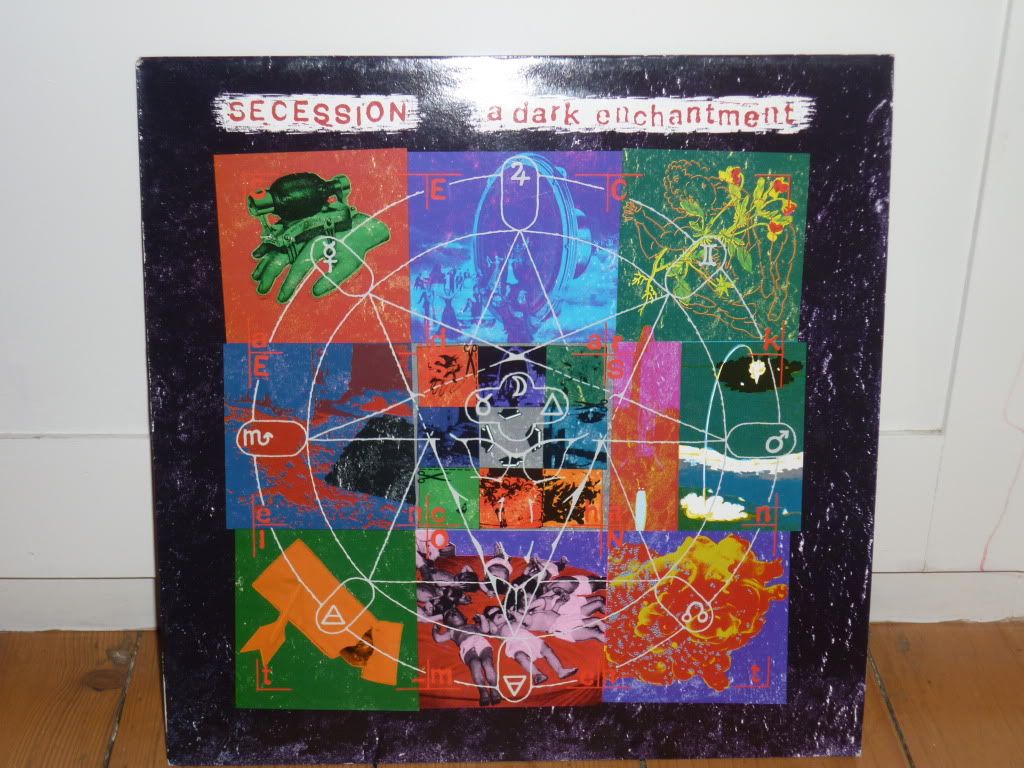
SECESSION - A DARK ENCHANTMENT

In the pre-Internet age it was sometimes impossible to find out anything about a band.
When I was a teenager the only source of information on most bands was the NME. If you couldn't read about a band in the music press then there was no hope of finding out anything. No glossy monthly magazines, no newspaper coverage of pop music, no websites or itunes and of course with the likes of DLT and Kid Jensen ruling the Radio 1 airwaves you could be sure that you would only hear the charts. On reflection it's a small miracle that anyone knew anything about anything!
I simply cannot remember why I bought this record. I can remember the tiny record shop I bought it in. I can remember who I was with and what they bought. But why did I pick this record and not any others?
So let's pretend that we are in a world with no Wikipedia. How do you find out information about the bands you love? Well one way was to look at the sleeve. Really, really look at it. After all that was all you had. Unfortunately this sleeve doesn't give much away. The inner sleeve declares 'Songs About Love and Death'. The band mysteriously use initials instead of first names, although there are some band photos so I knew that one of the band was female.
Don't forget that A Dark Enchantment came out in 1987. I'd grown up with record sleeves that were so well designed that it sometime didn't matter what the record was like. Think Peter Saville and Factory, think The Smiths on Rough Trade, or 4AD.
So I get home and put the needle on the record.
This is a record with so many ideas that it can never settle on one thing.  It wants to be a happy sparkly kind of record but at the same time it wants to be a dark brooding angry record.
The inescapable comparison, which I thought the very first time I listened to it, is with New Order. But that is a good thing not a bad thing. Listen to Love Lies Bleeding and you'll hear a band that deserved to play for clubs full of spannered ravers.
Love Lies Bleeding is them at their happy dancefloor friendly best.
 And then they follow it up with something like Sneakyville, apparently inspired by the Manson killings and sounding something like Depeche Mode all deep voices and brooding synth lines.

The whole record is somewhat off-kilter. It flirts with so many styles, masters some and fails to get others right. The lyrics are, for the most part impenetrable. I can never seem to get on top of the music, or perhaps I mean under the skin of it. Just when I think I have Secession down, they slip out of my grasp and lead me on to somewhere else. For every moment of beauty on Ocean Blue there is the terrible sax solo on Radioland. For the wonderful synth sounds in The Magician there is the terrible guitar in the same song.

I loved that unknowable element to them. All I had was the music and even the music couldn't be pinned down.

I love the internet but sometime I feel that we have lost something too.

Of course now I can find out as much as the band as I want.
Here is what Wikipedia has to say. Does having the story of the band add to the music? Not for me, as I loved the music already even when the creators were faceless.
In a way it was this way of thinking that prepared me for my love affair with house music when I first heard it in 1988 - only a year after buying this record. It was the 'purity' of the music, untrammelled by images or human faces that I loved. Finding and falling for this record prepared me for that.


I've never met anyone else with this record and although I have now discovered that it only had a very small pressing, I like to think that there is a select band of lucky people who took a chance on something unknown and were rewarded.

Monday, 16 May 2011

MUSIC OF THE DEAD - SOUNDTRACKS TO ROMERO'S ZOMBIE MOVIES

From the title of this blog you could probably guess I was a Romero fan. I've loved his Zombie movies ever since I caught Day of the Dead on late night TV when I was far too young to be allowed to watch it. Which made it all the more thrilling!
I had never seen anything like it. The gore and blood were good, although I don't remember being too grossed out by them - perhaps it was a cut version. But it was the political message of the film that got me. Even as a small kid I could tell that this was an attack on consumer society - or shopping as I called it in those days. I can barely go to a shopping mall today without looking at all of the shopping zombies around me. I am, of course, not like them!
When I discovered that there were more films by the same director I was thrilled. What I didn't realise is that they were all so different. Of course, being different they also have very different soundtracks.
The soundtrack to 1968's Night of the Living Dead wasn't released until 1982. In part that was because the 'soundtrack' consisted of library cuts chosen by Romero from the Capitol Hi-Q Library.
When choosing the music he wanted, Romero made a deliberate effort to select music that he thought evoked earlier horror films. Whether deliberately or accidentally he chose tracks that had been previously used in The Hideous Sun Creature, Teenagers from Outer Space and Terror from the Year 5,000 (none of which I've seen!).
The use of library music, although undoubtedly financially motivated, unintentionally adds to the tension and in some places horror of the film. The music is 'familiar', it instantly evokes the kind of emotions that are expected. We have all heard this 'kind' of music before and, even if we don't consciously hear it our emotions are directed by it.
String driven and melodramatic, these tracks have, for me, moved beyond mere background music and now remind me of each scene. However, without the images of the zombies the music can in places be quite beautiful. I particularly like First Advance by Ib Glindemann for its imaginative use of heavy percussion and strings.
If you haven't seen the film, shame on you. And now is your chance to see it:-


Night of the Living Dead was such a success that it was inevitable that Romero should make a sequel, although he tried not to and made the not very successful romantic comedy There's Always Vanilla, the unsatisfactory Season of the Witch, the creepy Crazies and the even more creepy Martin before returning to the undead.
The story of the production of Dawn of the Dead is convoluted. You can read about it here.
One of the results of Romero's partnership with Italian film-maker Dario Argento was the use of the Italian prog rock band Goblin on the soundtrack. Goblin's first film score had been for the European cut of Romero's Martin.
Needless to say the music is much more modern than the 1950s cuts in the previous film. But then Dawn is also a more sophisticated film. Shot in colour, with a bigger budget and superior special effects the synthesisers and metronomic beat of the Goblin score provides the perfect accompaniment.
I love the space that each track has and the way that they develop slowly. The build of tense is achieved in much the same fashion as the earlier library tracks, but this time it is a synthesiser rather than a string section that produces the creepy effect.
Claudio Simonetti, keyboardist for Goblin went on to write disco and I think you can hear it in some of the funkier passages of the record.
Although, for me, the highlights are the electronic pieces there are also some, very strange, violin tracks which sound very unconvincing.
Just as there are many versions of the film there are many versions of the soundtrack, even a Japan only 45!
I am afraid to say that mine is the Dagored 2000 release.
In the end the Goblin music was only used in the Italian/ European release (which was cut in a different way too).
However, my version of the extended cut includes the Goblin music as well as the music used on the American release.
Again if you haven't seen the film then there must be something wrong with you:
Here it is:

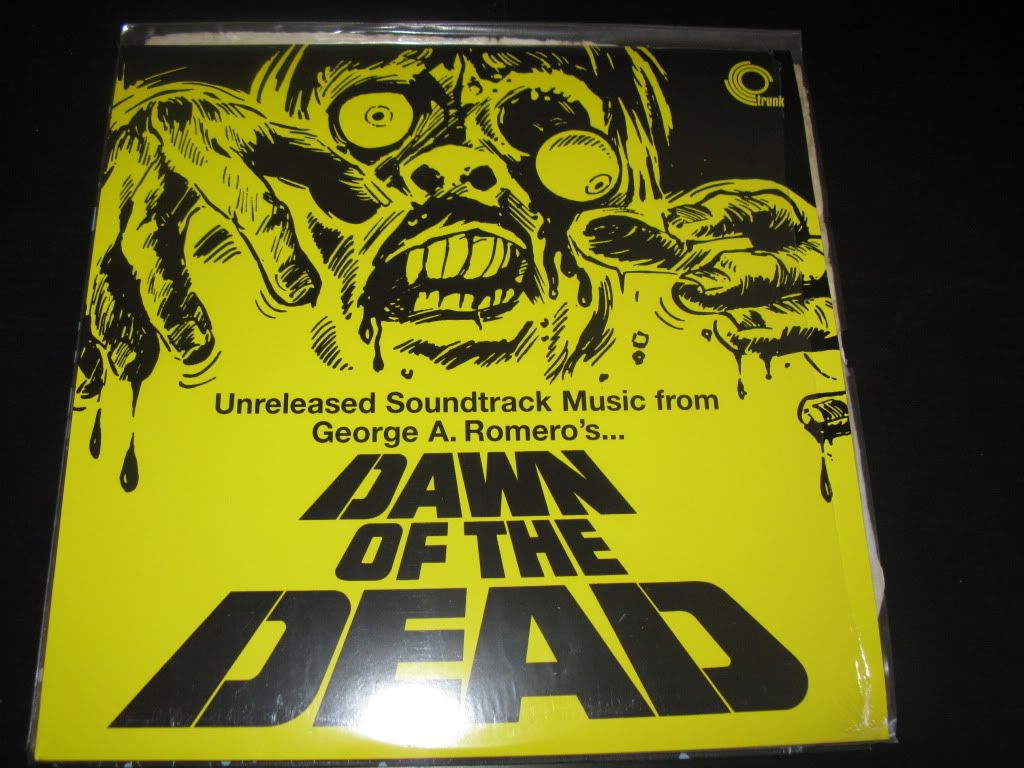
The Goblin music was only part of the Dawn of the Dead soundtrack but until the nice people at  Trunk Records it was unavailable.

Terrible sleeve mind you. Doesn't it look slightly like Phil Seaman? Check for yourself here.

Just as he had done for Night of the Living Dead, Romero used library recording for his soundtrack to Dawn of the Dead. Using the De Wolfe Library this time Romero brought together a group of song with a completely different feel.
Gone are the 50s B-Movie horror strings and in their place is a mix of menacing synthesisers, some very avant garde sounding works and even some Radiophonics.
I tracks such as Cosmology Part 1 by Pierre Lemel are almost too difficult for me to listen to - although just for the sake of this blog I have done!
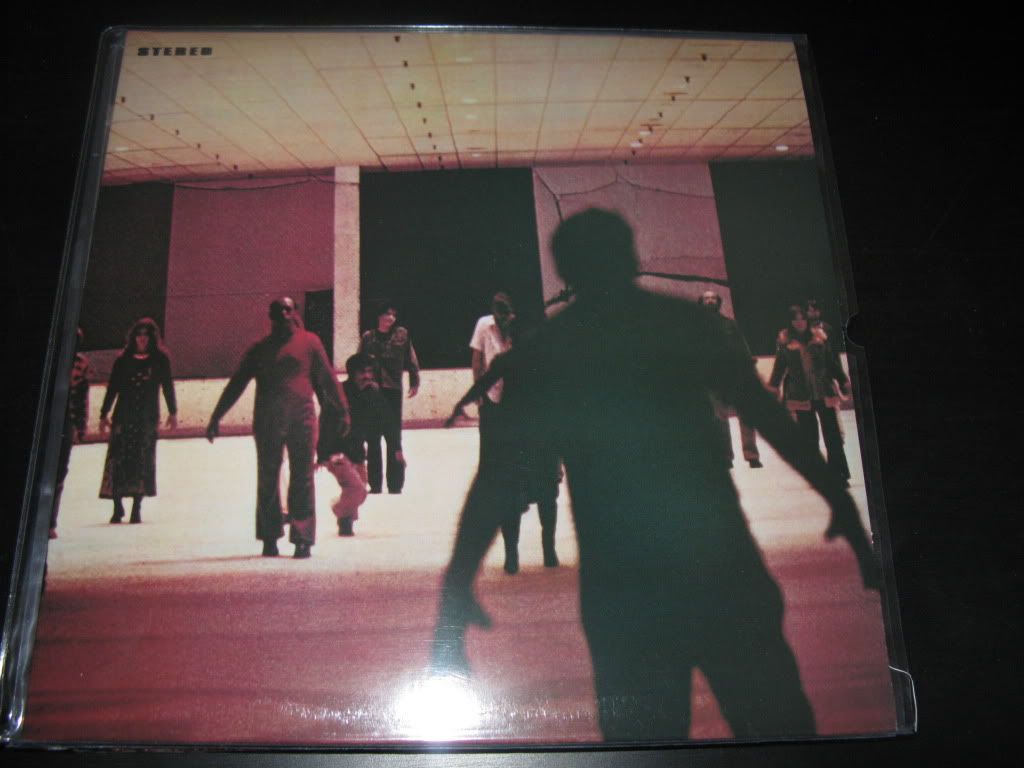
One of the 'highlights' of the record is The Gonk by Herbert Chappell. It appears at the end of the film as the zombies take over the mall and in particular as they walk across the ice skating rink. Personally I've never really liked it but others do.....
Figment by Simon Park on the other hand is a great bit of uptempo action music, not really horror more cop music.
Hats off once more to Romero for finding these perfect tracks.


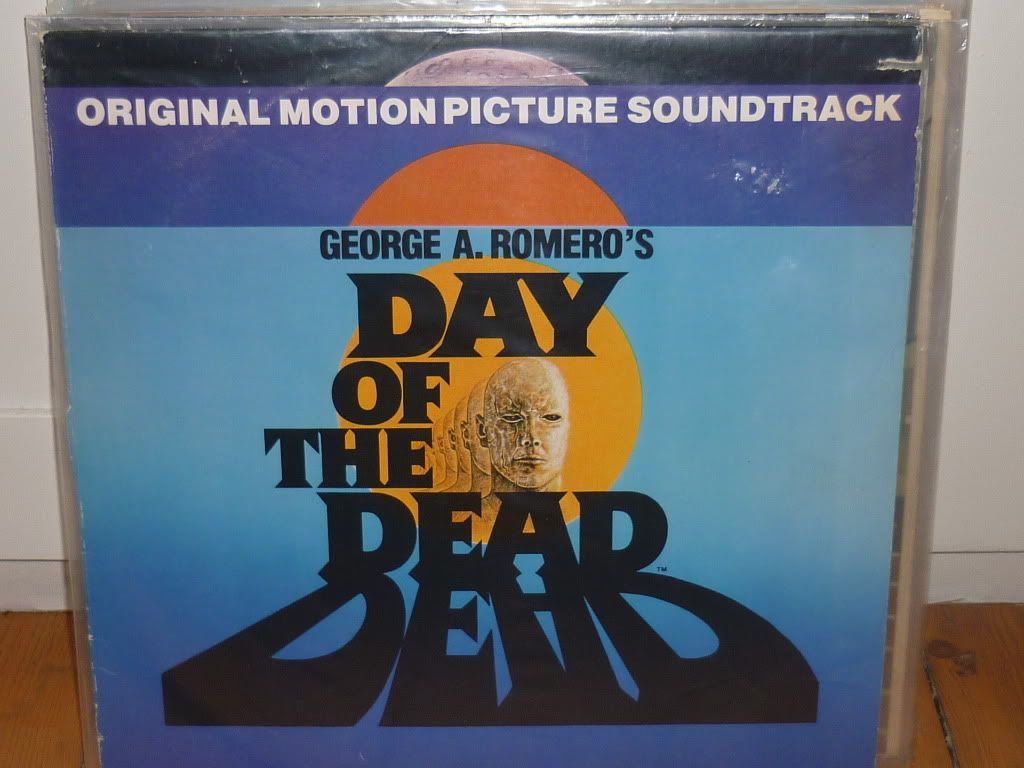
Perhaps the experience of having Goblin score Dawn of the Dead influenced Romero but I suspect that the decision to involve John Harrison in the soundtrack was an attempt by t the studio to produce a marketable product. Some of the quirkiness of the library tracks has gone unfortunately.
That said I like this soundtrack very much indeed. The opening track The Dead Walk is almost disco. In a way this record reminds me of the music of John Carpenter, particularly his score for Assault on Precinct 13, particularly Breakdown which is fantastic.
The vocal numbers If Tomorrow Comes and The World Inside You Eyes, could, perhaps, have been left of the record but you can't have everything.
I was playing the side long The Dead Suite recently and my daughter asked me to take it off. "Its very scary music daddy," she said. And that is all you need to know about it.
If you've read down to here you have surely seen the film but if not here it is:

Friday, 6 May 2011

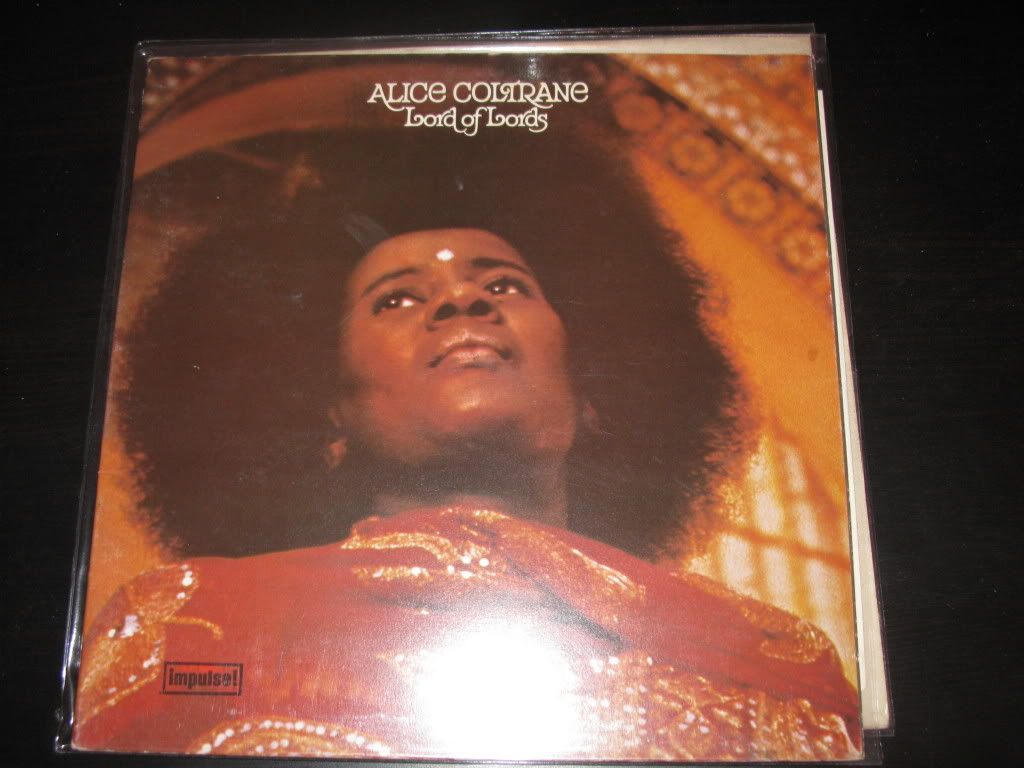
ALICE COLTRANE - LORD OF LORDS

Nina Simone once said: "Jazz is not just music, it's a way of life, it's a way of being, a way of thinking. I think that the Negro in America is jazz. Everything he does - the slang he uses, the way he talks, his jargon, the new inventive phrases we make up to describe things - all that to me is jazz, just as much as the music we play. Jazz is not just music. It's the definition of the Afro-American black."
Is Alice Coltrane's Lord of Lord's jazz? Certainly musicians who appear on jazz records are on Lord of Lords. Apart from Coltrane herself there is Charlie Haden on bass and Ben Riley on drums. But, perhaps surprisingly given her famous husband, there is no brass.Instead the trio of jazz musicians are joined by a string section consisting of four first violins, four second violins, four violas and four cellos.
The music that they make is not 'jazz' in a pure sense. Indeed it is a fruitless discussion to undertake to pin down what is and what is not jazz. My purpose is rather to point out the uniqueness of this record, not just as a record in the jazz idiom but as a record in any idiom.
Alice Coltrane was born Alice McLeod and had her musical upbringing in Detroit where she rubbed shoulders with the likes of Yusef Lateef, Kenny Burrell and Barry Harris.An accomplished pianist she had played for many years professionally when she met John Coltrane.
In some quarters she was blamed for the splitting up of Coltrane's 'classic quartet' but the truth seems to be that Coltrane was outgrowing the quartet format and his increasingly spirituality and interest in non-Western music were pushing him towards the further experiments that he would undertake in the last few years of his life. It was as much his quest for spiritual enlightenment as his music that influenced Alice - if the two could be separated.
When John Coltrane died Alice was bequeathed the rights to his recordings. This gave her a solid financial foundation and if she had wanted to, she need never have worked again.
Instead she entered into a deal with Impulse which allowed the label to release as yet unreleased works by her husband and for her to record in whatever way she wanted.
Initially with her first few releases she seemed to be continuing in the path of her husband. However, with each new release she was exploring more and more of her own musical consciousness.
Alice was one of the very few female musicians of the jazz avant garde and certainly the only one to lead her own groups. When I think of the 'new thing' or free jazz I tend to think of serious young men in suits and ties, of 'the struggle' and of attempts to violently break free from convention. Indeed many jazz musicians thought that women were not able to play, particularly instruments such as the sax and trumpet, in the same way as men.
I don't think that this casual sexism was particular to jazz in the sixties or even to music. However, most of the successful or critically praised female jazz musicians of the period were either singers or piano players. Alice's use of the harp was often criticised as a gimmick rather than an effort to bring new sounds to the jazz palete.
So, as well as being a woman in a very masculine world, and a woman who did not need the help, financial or otherwise or men, Coltrane was also a very spiritual person.

In 1969 Alice began to attend lectures by Swami Satchidananda. By 1975 she had founded the Vedantic Center. Her music began to evolve along more eastern and spiritual lines until, by the late 70s she was recording only her interpretations of bhajans or Indian devotional songs.
It would, I think, be wrong, however, to say that her music on this record was only related to eastern spirituality. Her earlier experiences in the Baptist Church are clear in the final track, Going Home. The linear notes say: "Going Home is a gospel-orientated spiritual that is sung in homes and churches throughout the United States today. It was one of my parent's favourite songs." However, she goes on to say: "Gospel and Spiritual music are some of the greatest Attributes of the Creator to have been bestowed abundantly upon the children of the Nile i.e. African Americans". And the link between the Baptist Church, Egyptology and eastern spirituality is made!
I think this record bring together many of the different strands of her life. The use of repetitive almost drone-like patterns seems to emulate Indian chants, most notable in the track Lord of Lords, the inclusion of Gospel and Spiritual music links, explicitly back to her youth, and the inclusion of a version of Stravinsky's Firebird not only echoes the composer's attempts to link jazz and classical music but could also refer to his  influence on her husband's music and indeed that of Charlie Parker who was known to carry a copy of the Firebird Suite with him.
I don't know how this record was made but I love this quote from producer Ed Michel about her recording style in general: "She would usually play something.At that period, especially among the New York players, they thought of themselves as pretty free guys. That was where it was headed. You would suggest a harmonic environment, with a bass figure, and open it up from there .... Especially in the beginning she would do that. She shared that desire to take whatever form existed and find a place where it would naturally, organically open up into what was a tremendously empowering space for musicians who had the capacity to deal with it. It was an astonishing experience. A lot of LA studio string players, who were symphony guys, when they first encountered it, thought 'wow, what's going on here?' and then ate it up. They loved it."
A great, spiritual record, this is not one for people who want to dance or even nod their heads. It is however, as 'way out' as any horn-led free assault you will ever come across.


If you are interested in Alice Coltrane this book is recommended.: Monument Eternal: The Music of Alice Coltrane

Thursday, 5 May 2011

King Kong - Article in Ebony Magazine

I discovered the following article about the musical King Kong in the December 1961 issue of Ebony  - thank you google books!

The writing is very much of its time but the photos are very interesting. I particularly like the shots of cast members in London.

Scroll down to page 80 to find it.

The article about female engineers is also very much of its time!!!!!

Have a look here Ebony - King Kong

Wednesday, 6 April 2011

Exploito # 7 - The German Connection

Anyone who has ever looked at the credits of a cheap exploito record will be familiar with the name DL Miller.
Often, when there are no credits of any sort to show who the musicians on an exploito record were, there would be some song writing credits. And DL Miller seemed to a very prolific songwriter!
Of course, he was no such thing.
Miller started the Somerset label in the late 1950s having already started and folded a number of other budget labels.
Somerset was a huge success, at least financially!
In 1963 Miller sold it to Al Sherman under whose control most of the records we've already come across were released.
But Miller and Sherman remained business associates and when Miller started his German-based Europa label much of the product were recyclings of already released US records.
In fact most of the best records that Europa released saw an Alshire release in the US and often a Marble Arch release in the UK - as was the case with The Animated Egg and Little Joe Curtis/ Otis Redding.
Here, however, are a few oddities.
Recognise these happy fruggers? Yes its exactly the same shot as the one used for the Now Generation LP.
Unfortunately the music is a much less successful affair. Unlike the trio of 'soul' artists on the Now Generation the trio of groups here are very lightweight beat groups. As with this kind of affair one has to wonder if these are real groups at all. The Dukes of Soho sounds to me like a made up name if ever I've heard one and the fact that all of the songs credited to them are organ-led instrumentals leads me to think that it must be possible to find the same songs on other records.
The Peers provide some absolutely murderous covers of well known hits, Black is Black, Winchester Cathedral, Yellow Submarine and most preposterously When the Saints Go Marching In!!!
And as for The Spots - what a stupid name. They can't have been real can they?


Recognise these guys? Of course it's yet another shot of the happy fruggers. This time the girl in the yellow shirt looks like she's really about to loose it.
Unfortunately whatever music is making her dance so happily it is not the music contained in this record.
The Spots, if ever such a group really existed, play a very watered down kind of Merseybeat. Which in 1967 when this record was released, must have seemed very passe. But then again, I guess the record is called Beat, Beat, Beat. One that is only for completest such as myself I'm afraid.

Following the time honoured exploito tradition of making a record from a broad collection of bits and pieces from a number of groups, Love is Blue features the afore-mentioned Spots, The Petards and the 101 Strings.
Of course, this being a Europa record its not exactly clear who contributes which track. Life, however, is made easier as some of the 101 Strings tracks are taken from their Sounds of Today record. 'Blues for the Guru, Karma Sitar and Strings for Ravi are all from that record.  If you don't have a copy of Sounds of Today pick this up for these tracks alone.
Killer Joe a GoGo, Kings Road Rock, San Francisco Sun, Guatanamara also sound to me like the 101 Strings and I'm sure one could find them on records by them.
The Petards contribute some of their own work, That's My Honeybee, Its Up to You, I Just Want to Be With You, I'm Still in Love and Love is All Around - not very original in their song titles were they? The last two are the best being workable beat group efforts.

Amazingly for this kind of record, The Petards were a real group who released at least one album and about four singles in Germany. I hope they upped their game for their own records.
The remainder are awful and are from the Spots.
I can't leave this record without commenting on the sleeve notes which coin the phrase 'youth plosion'. As they say "From San Francisco to London - from Paris to Hamburg - there is a renaissance in 'pop' music. Call it Soul, Psychedelia or beat - it's here, the sound of the now generation." Although not an exact reproduction of other sleeve notes, they could have been written for any number of other records!

Just to finish off I've included the Hell's Preacher's Supreme Psychedelic Underground.
This has been reissued recently.
My copy is actually on Marble Arch - remember that they had a deal with Miller and Sherman? The Europa issue has a different cover with spooky green eyes on it.
There is some speculation as to who the band on this record really were, no doubt springing from the feeling that they sound just too good to be a jobbing pub band brought into the studio for the purposes of knocking off a cash-in record.
If the band were really a 'proper' band and were just in it for the money, I think we should leave them some anonymity and self-respect and not name them.
The music, on the other hand, is very good hard rock that has some fine organ playing and wild guitar work in the vein of early Deep Purple - ooops!
Personally I love the name of the 'band' - Hells Preachers is so over the top and mad/bad it makes Black Sabbath seem sensible and as for Supreme Psychedelic Underground! Its just calling out to the teenage boy inside me.


There are no doubt many more Europa exploito releases that should be included here. If you know of any let me know!