Writing about music is like dancing about architecture

Thursday, 19 July 2012

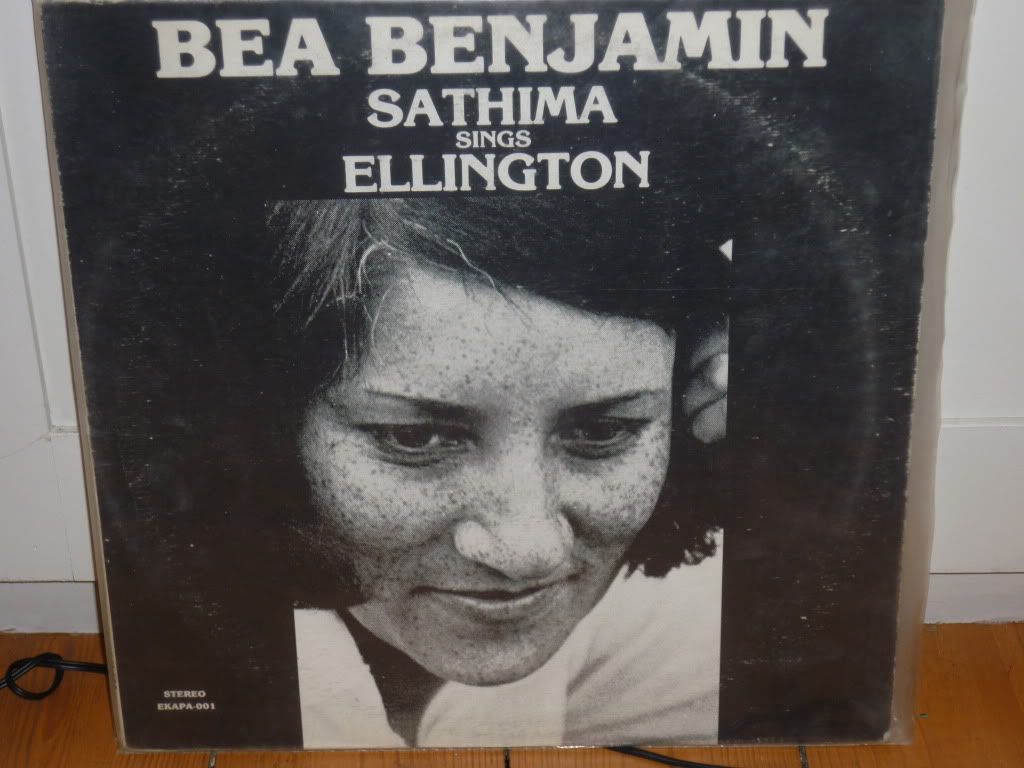
SATHIMA BEA BENJAMIN - SINGS ELLINGTON


When Bea Benjamin (or Sathima as she was nicknamed by Johnny Dyani) and Dollar Brand (who would change his name to Abdullah Ibrahim when he changed his faith) arrived in Zurich as self imposed exiles from apartheid their prospects cannot have been good. They knew few people, didn't speak French or German, and had little money.
That would all change when Benjamin managed to persuade their hero Duke Ellington to come and listen to them perform after a concert he was giving in the city. Ellington, recently given an A&R role at Reprise by its owner Frank Sinatra, loved what he heard of the pianist and the singer. He booked both of them into a recording session in Paris a few days later and out of this came Brand's Duke Ellington Presents the Dollar Brand Trio. However, the session also produced about twelve tracks which highlighted Benjamin's singing. For reasons that are not clear these were not released at the time and only saw the light of day in 1997 because an engineer kept a copy of the tapes.
Both Benjamin and Brand had grown up loving the music of Ellington and it seemed a natural move for them to record his songs. However, Benjamin continued to return his music. She recorded Prelude to a Kiss with Brand in 1969, sang with Ellington at a Jazz Vespers service in New York in 1972, in 1976 staged a concert tribute to Ellington in Harlem and in 1979 she recorded this record.
Sathima's musical development was marked by the influence of American jazz musicians, including Ellington as well as singers such as Sarah Vaughan and Ella Fitzgerald and more 'pop' singers such as Doris Day, Frank Sinatra and Nat King Cole. She has also spoken of the influence of the church on her singing as well as of South African songs, both traditional and modern. So, like most South African jazz musicians, her musical style was born from a mix of different and competing influences which came together to produce something unique.
There is nothing on this record that sounds as though it could only have come from Africa. However, Benjamin's take on these tracks is truly her own and, whether it is the glacial tempos, the sparse accompaniment or her precise and subtle singing style, she sounds as though she could not be an American singer much less a European one.
Benjamin is sympathetically backed by Americans Onaje Allan Gumbs on piano, Vishnu Woods on bass, John Betsch on drums and Claude Latief on congas.
My favourite track on the album is Benjamin's take on Billy Strayhorn's Lush Life. She really seems to encapsulate the world weary, dissipated, disappointed but still resilient essence of Strayhorn's lyrics. I can believe that she really has been through the 'too many through the day, twelve o'cocktail.' and that she will 'rot with the rest of those whose lives are lonely too'. Gumbs' is terrific and Betsch provides just enough brushing on the drums. It is truly moving and unique take on a classic song.


The World of Sitarsploitation

George Harrison's love of India, its music and philosophies, would have a profound effect on the Beatles and, as they were leaders of pop cultural matters in the mid to late 1960s, this influence would extend beyond the band to the rest of the world.
Allegedly first introduced to the sitar by Roger McGuinn and David Crosby of the Byrds in California in 1965, Harrison, the instrument first appeared on a Beatles track on Norwegian Wood.
The Beatles were not the only band interested in the exotic sounds of the sitar, in particular its drone effect. The Kinks, the Who and most importantly the Yardbirds can claim to have been ahead of the Beatles in utilising the Indian instrument on some of their tracks.
However, they did not go as far as Harrison and record a track that was closer to Hindustani music than to European pop music. Using musicians from the North London Asian Music Circle, Love You To, on Revolver started a minor pop music trend. Followed up by Within Without You on Sgt. Peppers Lonely Hearts Club band, the use of the sitar in pop and rock quickly became a shorthand for exoticism, spirituality and transcendence. In other words its was another way of saying that the music was like a trip!
Unfortunately, as Harrison discovered, the sitar is a difficult instrument to master and its use does not always complement the structure of pop music. Masters of the instrument such as Ravi Shankar and Ali Akbar Khan found themselves becoming increasingly popular in the US and Europe and audiences strove to become part of this authentic and new (to their ears) music.
However, where there is money to be made, there will be exploitation records. I have already written about the brief Indo Jazz moment in UK jazz (read about it here) as well as Bill Plummer and Emil Richard's jazz sitar experiments read about it here and here. Despite being musically intriguing and genre expanding, sitar jazz records were always going to be a minority interest. How much more lucrative it would be to use this strange sound and, just as the leading groups of the day were doing themselves, use it on pop music.

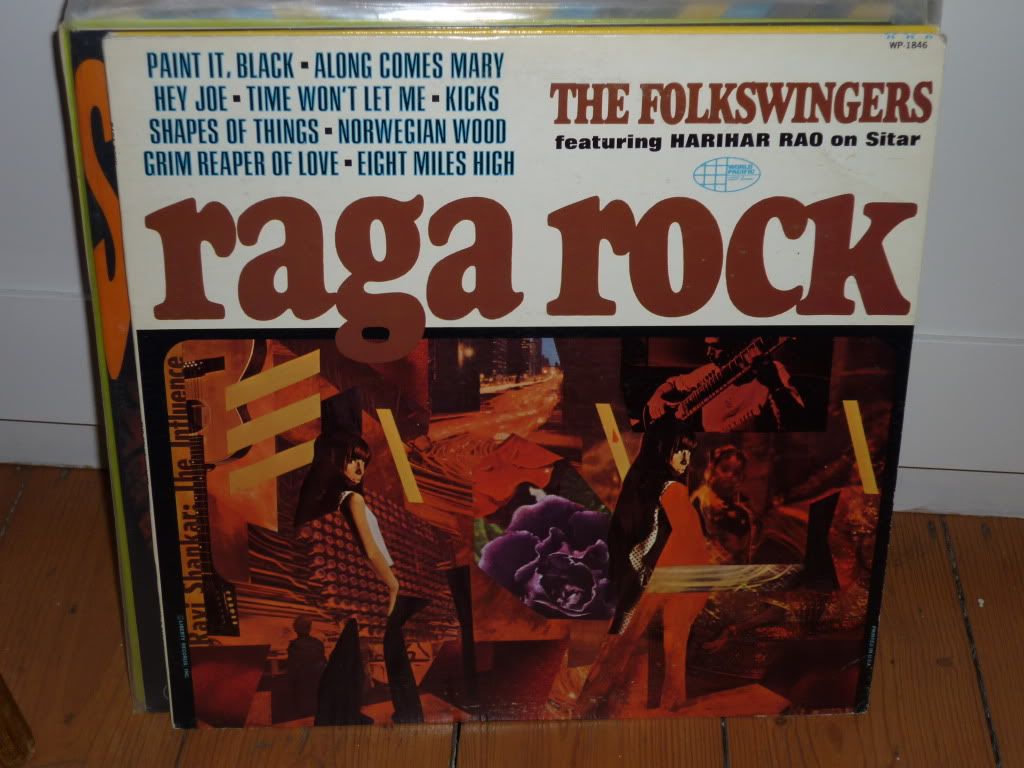
Released in 1966, Raga Rock in many ways epitomises the Sitarsploitation LP phenomenon. Using LA's crack session musicians, the Wrecking Crew, this record features Tommy Tedesco, Howard Roberts and Herb Ellis on guitars, Dennis Budimir on 12 String, Bill Pittman on bass, Larry Knechtel on organ and electric piano, Lyle Ritz on fender bass and Hal Blaine on drums. A killer band if ever there was one. Prior to this there had been another Folkswingers record, which although not including any of the same musicians, did include other LA session people. The first records more accurately lived up to the name being covers of folk hits of the day. This time round they added Indian sitar player Harihar Rao. Rao, an ethnomusicologist at UCLA and an associate of Ravi Shankar would, in 1967, publish the influential Introduction to Sitar.
Here he is mainly used to play around the American musicians giving the hits of the day an exotic feel, Having said that, it is a very enjoyable record. Songs such as Hey Joe, which has a very enjoyable exchange between Rao and one of the guitarists certainly benefit from a sitar treatment.
The choice of material is also important. Paint it Black, Eight Miles High, Norwegian Wood, Shapes of Things were all songs that in their original forms used Indian influences.
The first and possibly the best of the genre.
The concluding track is an original penned by George Tipton. Tipton was the arranger on this record and, according to the sleeve notes, was qualified to arrange a sitar record because he had worked with Jan and Dean and the Mariachi Brass! However, with its fuzz guitar, insistent sitar lines and tight rhythm section it is a triumph and leaves me wishing that they had given him the chance to write a whole album.

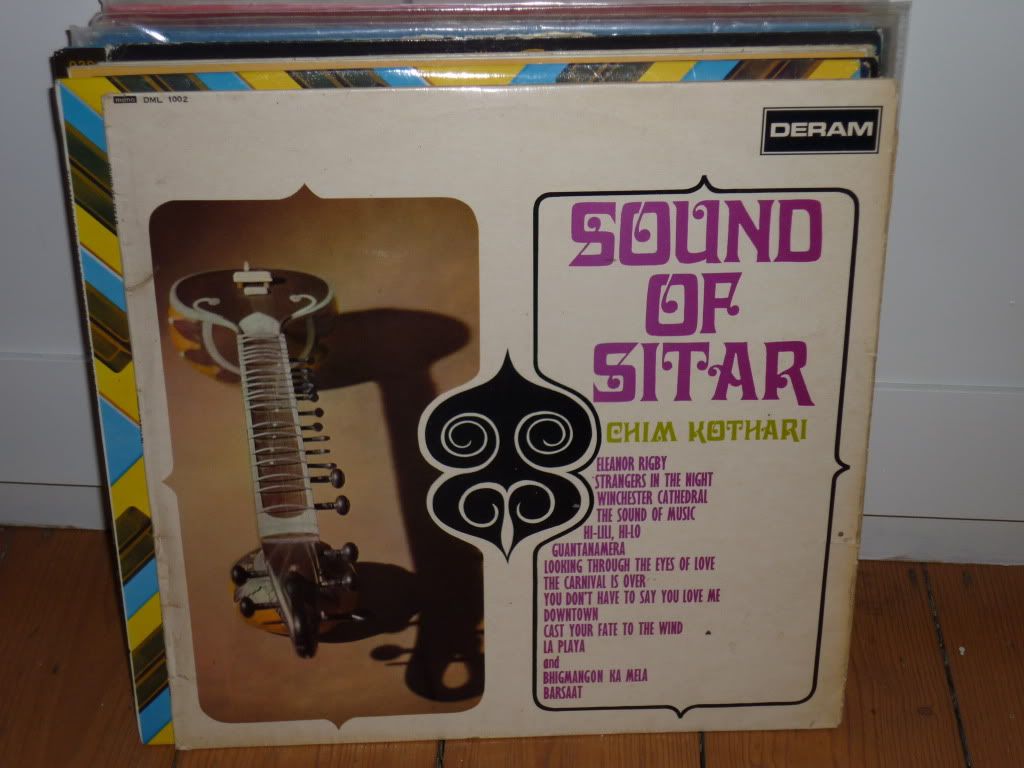
Meanwhile on the other side of the Atlantic at Decca, the label that had originally turned down the Beatles, decided to get aboard the sitarsploitation bandwagon with this effort.
I have not been able to track down any info about Mr Kothari other than what is offered in the sleeve notes. Kothari was a Ugandan Indian who at the time of recording the record had been in the UK for seven years. Amazingly during that time he has spent all of his leisure time playing the sitar.
Unfortunately instead of going down the rock route of the Folkswingers, Kothari draws on pop hits of the day. We therefore get Strangers in the Night, Winchester Cathedral, Downtown, Guantanamera, the Sound of Music and Cast Your Fate the Wind.
Of greater interest is his version of Eleanor Rigby which is the best thing on the record. His own compositions, traditional in sound rather than pop or rock orientated, are also worth listening to.
All in all I'd recommend passing on this one unless you find it in a charity shop for a few pence.


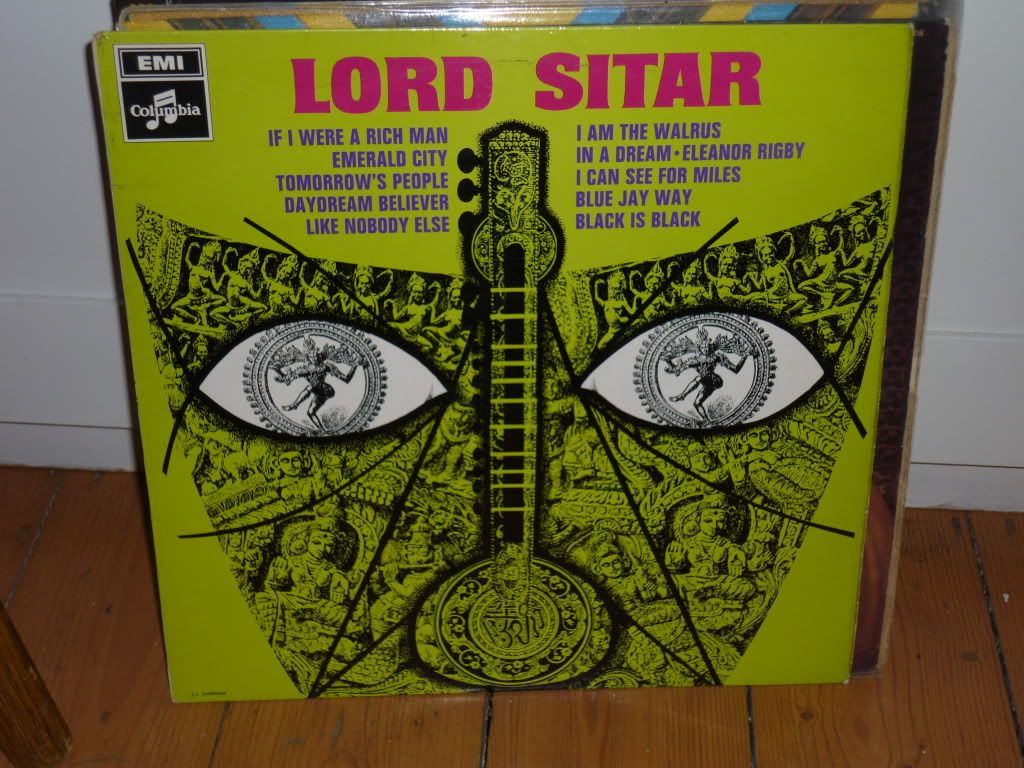
Who was Lord Sitar? Was he a moonlighting George Harrison as some believed at the time? No he was instead Big Jim Sullivan one of London's premier session musicians (Big Jim Sullivan as opposed to Little Jimmy Page), whose work appears on any number of UK records in the 60s and 70s including, apparently, over 50 UK number ones.
On the face of it, Lord Sitar looks as though he is going to give us more of the same medicine as Chim Kothari. Look at some of the tracks, If I Were A Rich Man, Emerald City, Black is Black. But wait! We also get Daydream Believer, I am The Walrus, Eleanor Rigby, I Can See For Miles and Harrison's Blue Jay Way. Can the good Lord pull it off?
Well its touch and go. If I Were a Rich Man struggles to overcome the material and in some places succeeds. However, its not until we get to the Monkees Daydream Believer that things start to look positive and that is more to do with the strength of the song rather than the chamber orchestra arrangements. Over on the b-side I Am The Walrus, already a very trippy track, gets the full sitar treatment and comes out all the better for it. Eleanor Rigby trundles along nicely. However, all the stops are pulled out for I Can See For Miles which I'm sure would have made Pete Townsend proud - or cry - or both. I'm also very partial to the version of Blue Jay Way with the wordless vocals at the start really giving me a thrill.


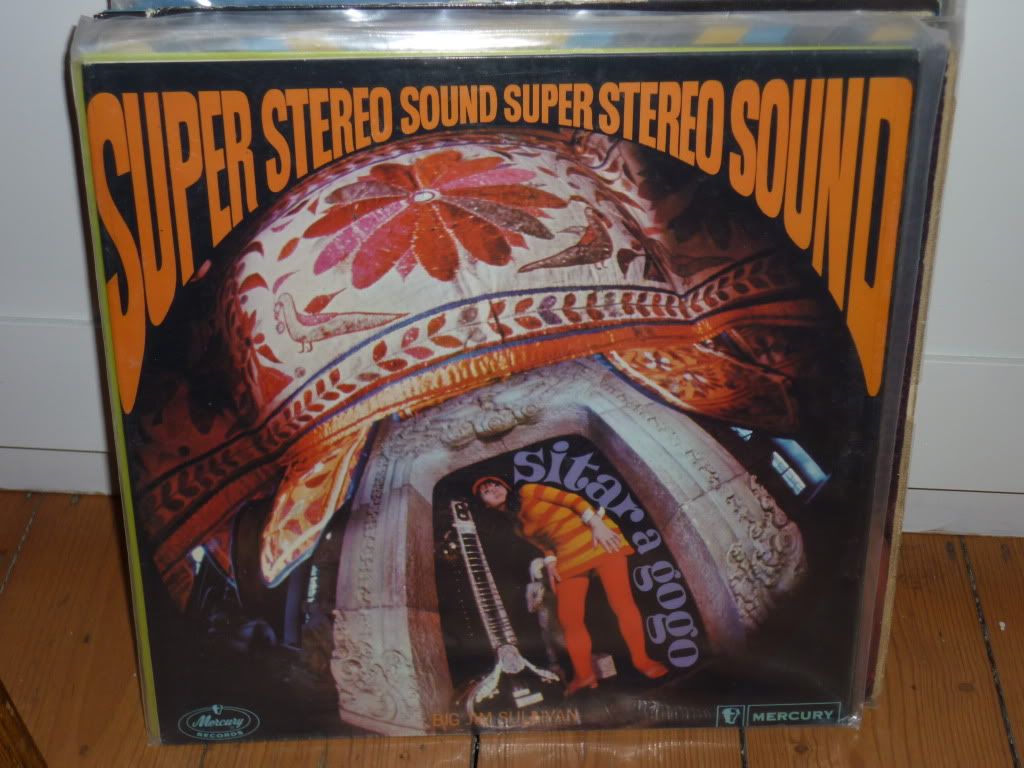
In the same Big Jim comes around for another crack at sitarsploitation, or as they call it Sitar A Go Go. My copy is part of the Super Stereo Sounds series that also reissued records by Pete Rugolo, Quincy Jones and others. The first press has a green cover with Big Jim twanging away and ethereal figures floating above him.
Perhaps because he arranged the record himself or maybe he was just getting better at it, but Sitar Beat is a far superior record to Lord Sitar.
Kicking off with a great take on the Beatles' (you almost can't have a sitarsploitation record without a Beatles cover!) She's Leaving Home, Sullivan gets stuck into Sunshine Superman which I love. Perhaps this version of Whiter Shade of Pale is a bit limp but then again the song nothing more than a puddle of slush anyway. However, it is on Sullivan's originals that this record really takes off. Ltts and The Koan are intriguing and effective tracks that show off his playing to the best. The Koan has some great tabla, flute and guitar as well - its a really interesting track.
On the second side Graham Gouldman's Tallyman lends itself well to Sullivan's sitar work. Another highlight of the album is the Sullivan penned Translove Airways (Fat Angel). Over a funky drum beat, fuzz guitar and maddeningly repetitive flue riff and a string section, Sullivan's sitar swirls around, creating a floating, flying, falling feeling. Far out man!
In the top league of sitarsploitation records and one that is well worth picking up.


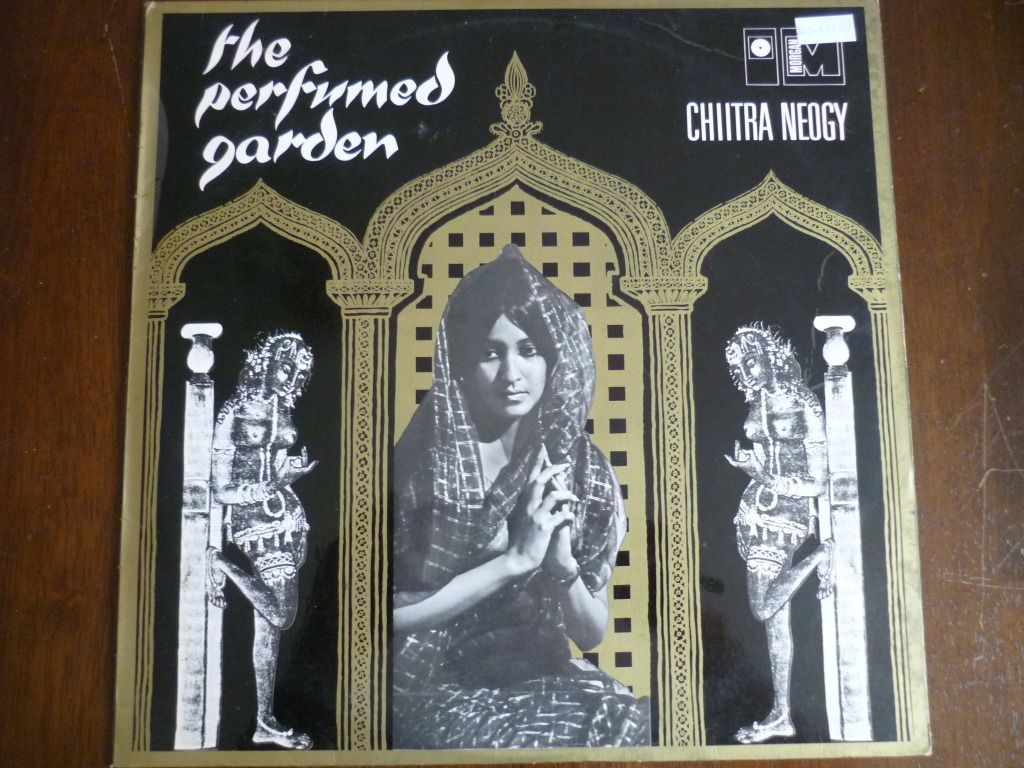
Chiitra Neogy's The Perfumed Garden isn't really a sitarsploitation record but it does have Jim Sullivan playing on it. Sexual liberation was a key tenant of the hippy ideal. The sexually explicit writing, sculpture and painting in India seemed, to Western flower-children to be more in tune with their views of sexual freedom than the button-downed European views on sex and love.
Thus a record such as this could be produced. The Perfumed Garden "contains writings which are designed to help human beings to achieve the fullest joy in their sexual lives." By today's standards they are not terribly sexual, but perhaps that's not the point.
Sullivan provided an underscore throughout the record and particular highlights are The Encouragement of the Lusty Wife, Leila the Flatterer and Krishna and the Cowgirls.My copy cost less than $5 on ebay and I wouldn't recommend you pay any more than that.

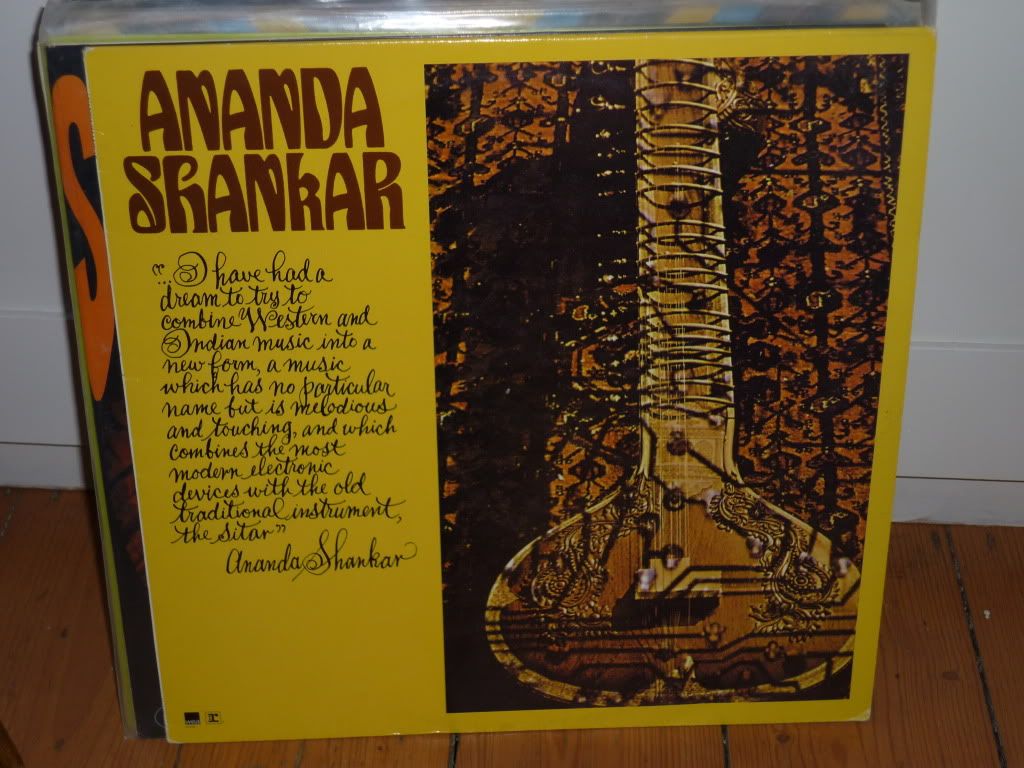
Ananda Shankar was the nephew of Ravi Shankar and he would go on the make a number of amazing records that fused jazz, Indian classical music and his own far-reaching vision.
However, his first record, made in the US in 1970, is often regarded as sitarsploitation because of its covers of the Stone's Jumpin' Jack Flash and The Doors' Light My Fire. Jumpin Jack Flash in particular is an amazing dancefloor killer. Throughout the record Paul Lewinson's Moog adds another layer of incredibly sounds and fascinating textures.  Listen to the washes of sound he adds to Light My Fire.
However, don't be fooled into thinking that this record is just about pop cover versions. Its so much more than the Folkswingers or Big Jim Sullivan. Shankar's own compositions are quite beautiful and are worth the price of the record alone. Tellingly he shares writing credits with Moog-player Lewison.
My favourite original compositions are Snow Flower, Metamorphosis and the epic Sagar (The Ocean). All three seem to me to combine the 'exotic' sounds of the sitar with some of the hippy peace and love vibe the instrument was meant to symbolise. Through using new music and with the addition of the moog, Shankar creates truly different music that is as spaced out as you want it to be.
It's really great stuff.

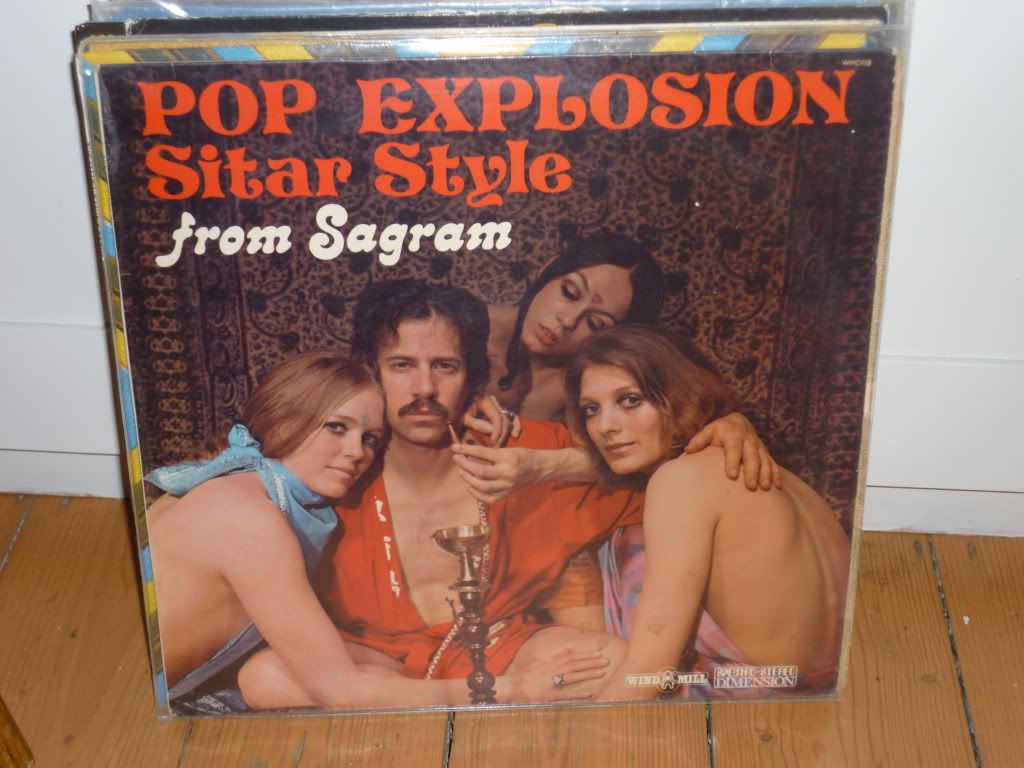
On first glance this would seem to be an exploitation record of the first order. I mean, why else would you call a record Pop Explosion Sitar Style and then NOT include any pop music. Why else would you have such an obvious 'eastern' sleeve that is an insult to women and Indians? Why else would the sleeve notes say that the music comes with "the heavy rhythms of the Rock Era"?
Strange as it may seem, however, the music on this record is not about exploitation but about authenticity. Read the story here. Suffice to say that the musicians behind this music, Clem Alford on sitar, Kashav Sathe on tabla and Jim Moyes on guitar did not expect their music to be packaged in this way.
Don't expect any cheap, ironic thrills from this record. Instead expect a serious attempt to fuse Indian classical music with western musical idioms.
Truly far out stuff.

Still to be included - Balsara and His Singing Strings, Rajput and the Seapoy Mutiny.

More info and soundclips to sitar records, including and amazing number of Bollywood soundtracks can be found here
Thursday, 5 July 2012

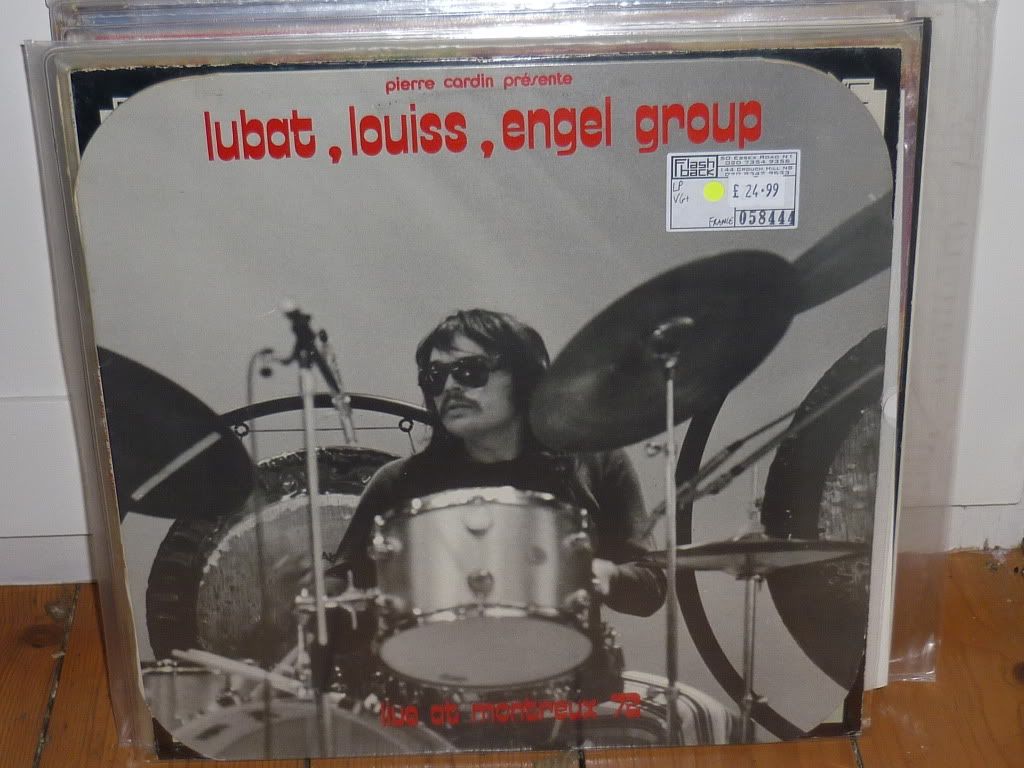
LUBAT, LOUISS, ENGEL GROUP - LIVE AT MONTREAUX 72

A while ago I wrote about Bernard Lubat and His Mad Ducks (read about it here).
In 1972 the band got back together, this time dropping the Mad Ducks name, and instead following a trend in rock groups (borrowed from jazz groups) of using their own names.
Still on the chic Les Disques de Pierre Cardin label, they were recorded in action at the Montreaux Jazz Festival. The '72 jazz festival also produced live recordings from label-mates Phil Woods and his European Rhythm Machine and Jean-Luc Ponty (neither of which have come my way yet but I'm sure they will!).
It like the fact that session-kings and studio-masters like Lubat and Louiss get the chance to play in front of people and at such a prestigious event as Montreaux. I also like the fact that this record consists of material that doesn't appear elsewhere - maybe even written with the event in mind!
And what a mix of music it is!
Unlike the Mad Ducks record, Live at Montreaux seems to stretch out and explore some pretty wild and frankly psychedelic places. Whereas the Mad Ducks was a fun, well dress mod, kind of a record this one really lets its hair down and goes on a trip!
Claude Engel's playing is also much more prominent and he bring a definite rock element to the proceedings. Perhaps not surprising for one of the founder members of prog group Magma, Engel's playing is technically brilliant and drenched in acid. Mindblowing stuff! His playing has the same effect as John McLaughlin's does in Miles Davis' group of about the same time. Its rock, its psychedelic, its 'out-there' and it pushes his band mates into some interesting and 'un-jazz-like' territory.
Jazz-veteran Eddy Louiss, however, is the jazz-foil to Engel's rocking. Playing fender and electric organ, his playing is more 'straight' jazz around which Engel seems to jump and dive.
Lubat's playing is also out of the top drawer. Never predictable, never repetitive (which for a drummer is really saying something) he isn't laying down the rhythm, he's a front-line contributor up there with Tony Williams.
Finally, Marc Berteaux provides the funk with his electric bass.
All of these elements come together on the opening track Les Adventures de Pinpin au Togo (Emmanuel Pinpin Sciot being their producer as well as the designer of the collage on the Mad Duck's album).
If you don't like jazz-rock or fusion then this track isn't for you!
What  I like best about it is that, while you can hear the fantastic musicianship of the people involved, it never becomes self indulgent like much fusion.
Live in a Magic Forest changes the tone from frantic and furious to calm and relaxed. Gently weaving the organ is relaxing, leading the listener further and further into the Magic Forest, accompanied by percussion and eventually joined by Engel's guitar and the music becomes more forceful and strident and suddenly the Forest is no long calm but buffeted by musical winds. Eventually, Engel takes off and we leave the jazz behind and move into a very prog world.
Over on side two we kick off with 5th of July, Dulong Street. A driving funky monster of a track this is, for me, the highlight of the record and the reason to track it down. Tight and funky bass, wild drumming, great organ work and, when he comes in blistering guitar, this is incredible stuff. I can only imagine what the audience where doing while this track was being played - and it wasn't sitting down! Engel's solo perfectly complements and doesn't overwhelm his band mates. It only lasts for 6 minutes and 20 seconds but it feels a lot longer.Terrific stuff!


The record concludes with Mickey Schroeder's Dream, which shifts gears from dancing through Dulong Street, to drifting away on a narcotic haze. Written by Lubat I wonder if it is him on the electric piano that opens the track. In a similar way to Live in a Magic Forest, this is swirls and eddies around your head. Gradually the drifting organ meets some phased percussion (could this really have been done live in 1972?) adding a further layer of psychedelia. Disembodied singing kicks off some slightly 'eastern' sounding percussion (still phased and treated) and we feel we are falling into a drugged up dream-like state.


That's enough for now. I'm off to find more Lubat stuff!

Tuesday, 3 July 2012

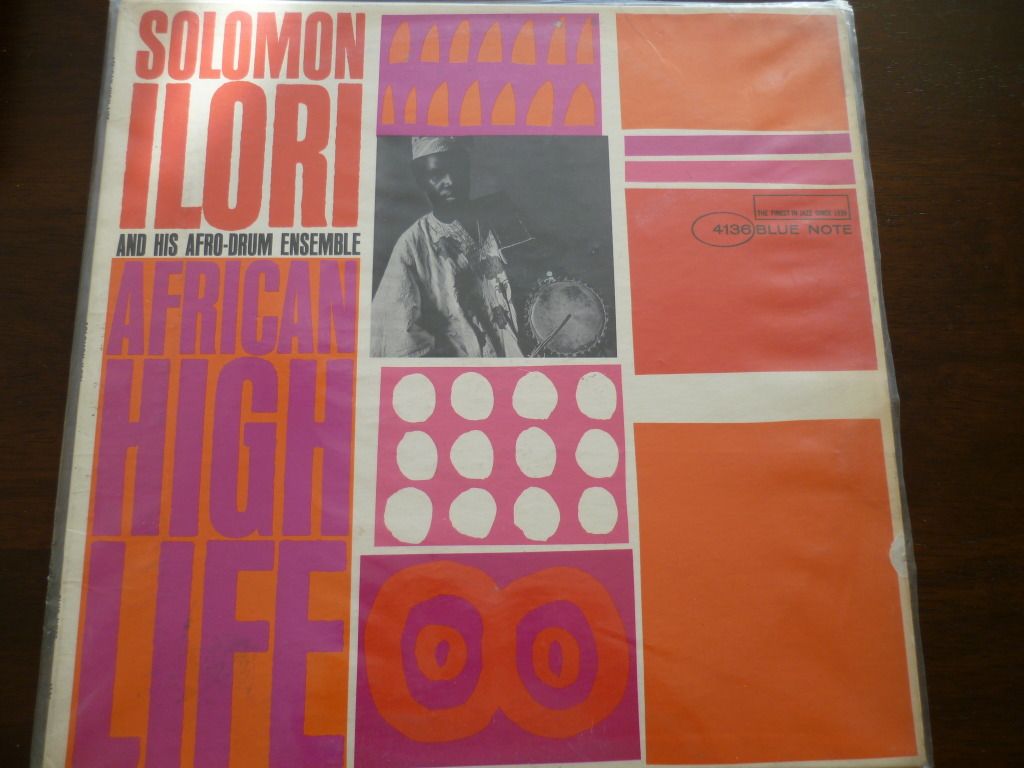
SOLOMON ILORI - AFRICAN HIGH LIFE


I don't really know very much about Solomon Gbadegesin Ilori and I would like to know more.
Ilori was born in Nigeria and, according to the sleeve notes of this, his only record as a leader, he had only been in the US for five years at the time of its recording. African High Life was recorded in 1963, a year after Art Blakey's African Beat on which Ilori also played. Read about it here.
In some ways this is a continuation of Blakey's African Beat as many of the same people played on both records. Ilori, Chief Bey, Robert Crowder, Montego Joe, Garvin Masseaux and Ahmed Abdul-Malik all appear on both sessions. They are joined by Josiah Ilori on sakara drums and cow bell (a brother perhaps?), Jay Berliner on guitar and Hosea Taylor on sax and flute.Taylor had previously played with Olatunji and also played on two unreleased at the time cuts on Freddie Hubbard's Blue Spirits. Hubbard of course played in Blakey's Jazz Messengers!
I don't know as much about Taylor as I would like to but his playing on this record is exemplary.
African High Life falls between the work of Guy Warren on one hand and Olatunji on the other. Neither as complete a fusion of American jazz and African highlife nor as obviously indebted to 'traditional' African music, Ilori manages to be both inventive and surprising. As the linear notes comment, "his use of African and European musical instruments on this album and the achievement of a perfect balance between them also point to his success in fusing together two diverse cultural elements without doing any professional injustice to either of them." The sleeve notes are penned by Oladejo Okediji, who I assume is the Nigerian writer. If so then these are the first sleeve notes on a US record by an African musician that I have read that are written by someone who may have been able to understand the music from its African source and not just as a new sound on American shores. Indeed Okediji's comments praise Ilori for attempting to correct some fundamental misconceptions about African music as being about "unmeasured and raw shouting", while "African dancers jump aimlessly into the air with a kind of martial impulse."
As the sleeve note make clear African High Life is not a percussion record of the likes of Chiano but an attempt to explore a wide range of African music and instruments. Of course, there are drums and in some cases they are prominent but Ilori also uses other 'African' instruments such as the pennywhistle (read about South African pennywhistle kwela here) and the guitar (read about the guitar and the Heshoo Beshoo Group here) to create music of depth and interest.
The opening track Tolani (African Love Song) is also the most drum focused track. It starts with some incredible drumming before the rest of the band join in. Listen out for Taylor's sax towards the end - New York meets Lagos if ever I've heard it!


Next is Ise Owula (God's Work is Indestructible). Berliner's guitar and Taylor's flute interplay are just beautiful and Ilori's sensitive drum work is perfect. His deep voice never fails to move me on this one!


The first side closes with Follow Me to Africa,which again, is a melodic and beautiful song. It opens with some fine pennywhistle playing from, I think, Ilori. Abdul Malik's bass also stands out for me. Happy stuff.


Side two kicks off with Yaba E (Farewell) which is pure highlife. It starts with a refrain from an instrument that sounds like a xylophone before breaking into an infectious dance groove.


The next track, Jojolo (Look at this Beautiful Girl), is another highlife track. With lovely call and response singing, Taylor's sax is once more to the front. The percussion is particularly good.

 
The record finishes with Aiye Le (The Troubled World) which, at the beginning, is almost a duet between Ilori's voice and Berliner's guitar - although, inevitably, there is some inventive percussion work supporting them. Then it sounds as though the rest of the band join in and everyone sings this beautiful song together.


The English 'translations' reveal that Ilori was a spiritually minded person for whom God and life were linked and worthy of respect.

In many ways this is a surprising record to come out on Blue Note, although it seems to have been an extension of Blakey's interest in African music.

I would very much like to know more about this fascinating musician. Did he stay in the US or return to Nigeria? Did he make any more records. There is a fairly recent release of tracks from the African Highlife sessions which I haven't heard. Is there any more? Any information will be very gratefully received.

Thursday, 14 June 2012

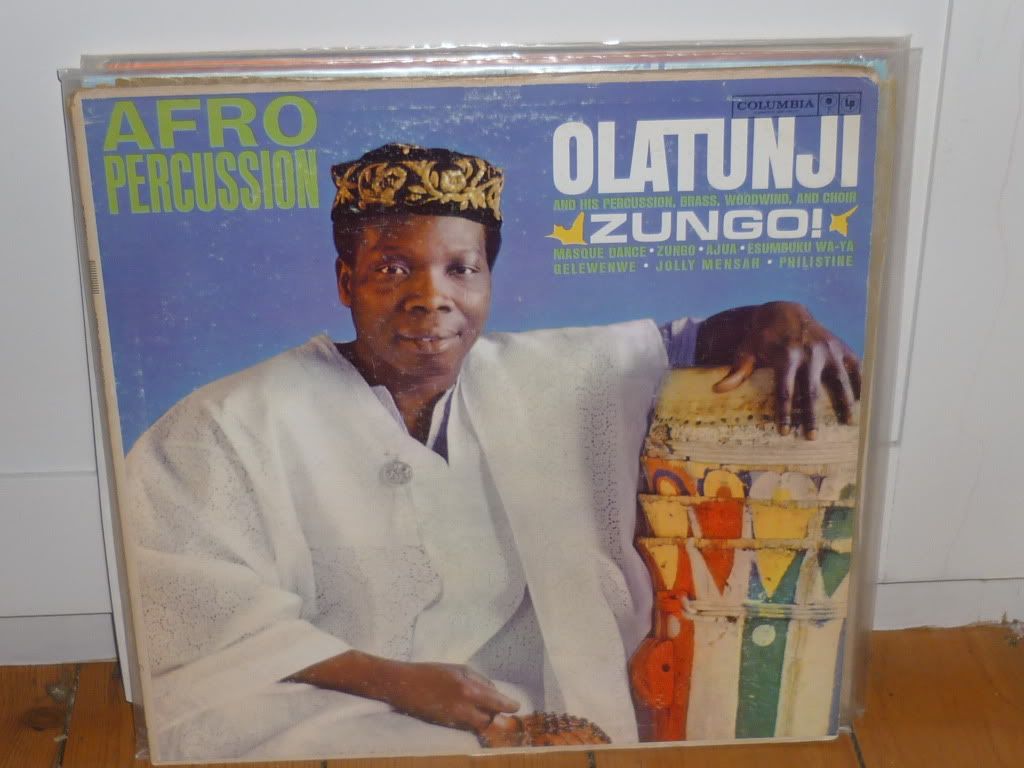
OLATUNJI- ZUNGO!

If Guy Warren's musical journey was an attempt to introduce African drumming to jazz then one might think that Olatunji succeeded in the attempt. However, rather than fuse jazz and African drums, Olatunji served up a watered down version of traditional Nigerian songs that captivated record buyers and jazz musicians alike.
Babatunde Olatunji was originally from Nigeria, first came to the US to study politics at Morehouse University and only started playing drums when he arrived in the US.
Due to a combination of luck and and good connections Olatunji became known in New York jazz circles as the go-to-guy for African drumming He appears on a number of jazz records of the early 60's appearing on Randy Weston's Uhuru African, Cannonball Adderley's African Waltz, Herbie Mann's Afro-Jazz Sextet and Max Roach's We Insist.
His Drums of Passion LP became a sensation, selling thousands of copies in the US. Unlike Warren and other African drummers such as Solomon Ilori, Olatunji's music was more 'traditional'. Using songs from his homeland and some of his own compositions (most notably Gin-Go Lo-Ba which would go on to become Jingo in the hands of Santana) Drums of Passion came off as a 'genuine' slice of Africa.
It was however, nothing of the sort. Most of the musicians on it were African Americans perhaps most notably drummers and percussionists James 'Chief' Bey (who played with Guy Warren on Themes For African Drums - read about it here), Thomas Taiwo Duvall and Montego Joe (read about his solo records here) and the singers were also from America.
Olatunji was not formerly trained as a drummer and his three co-drummers, by some accounts, provided most of the music and helped him overcome his initial limitations. Indeed in the introduction to his autobiography it is even admitted. However, Olatunji not only got top billing, the help he received remained virtually unknown.
All three percussionists appear on Zungo which was released in 1961, together with Yusef Lateef on winds, Clark Terry on trumpet, George Duvivier on bass, and Ray Barretto on conga and timbalis. Interestingly Lateef, Montego Joe and Chief Bey would go on to play on Blakey's African Beat (read about it here) in 1962, while the previous year, 1960, saw Lateef, Duvivier and Olatunji play on Randy Weston's Uhuru Africa. The 'Africa' link surely doesn't need to be pointed out!
Why was he so popular both with the jazz world and with record buyers if his playing was questionable and his music lacking in authenticity? Part of the answer lies in Lateef's recollections of playing with him. In his autobiography Lateef writes: "Later in 1960, I moved from Mingus to a group led by Babatunde Olatunji, the Nigerian percussionist. Playing with Babatunde was an interesting experience, mostly because for the first time I had to perform without a pianist or bassist in the group. It provided me with a lot of harmonic space and freedom. Olatunji's music also provided a wider appreciation for world music. To this extent he was a pioneer of what is termed today 'world music'."
For Lateef, Olatunji represented an opportunity to play with an authentic African drummer and to learn about African drumming so as to incorporate it into jazz. The same was true of John Coltrane, who became friends with Olatunji and he and Lateef agreed to help him financially with his Center of African Culture. Indeed the last concert that Coltrane played, and the last recording of him playing, was at a benefit for Olatunji's Center. Coltrane was always interested in rhythm and drummers and his love of playing with Elvin Jones because of his fierce drumming style is well documented. Coltrane also said in interviews that he intended to record with Olatunji or at least learn about 'African' drumming and music from him.
Even Nina Simone recorded Zungo, from this album, on her At the Village Gate LP. And Jack Kerouac, according to the sleeve note, loved Olatunji. Guy Warren must have been very put out by the song Jolly Mensah. After all he had actually played with the highlife king!
So, Olatunji represented a potential new musical direction but also a physcial manifestation of pride in Africa and, for African American, African culture. At a time when Africa was coming out of the oppressive period of empire and was yet to succumb to other forms of economic colonialism, the continent could become a source of pride for African Americans. Meanwhile, 1960 also saw the sit in protests in the US (shown in graphic form on the cover of Max Roach's We Insist), while 1961 and 1962 saw more sit ins, freedom rides and boycotts across the Southern states of the US.
However, despite his success both commercially and professionally I find Olatunji's music to be rather flat. It often lacks the rhythmic intricacies of other percussion records, notably by Guy Warren and Solomon Ilori. Both these musicians also strove, and sometime wonderfully succeeded to fuse Western jazz and African 'traditional' music, as well as the already existing fusion that was highlife. Lateef and Coltrane may have been fascinated by Olatunji's music, and I suspect that this was because he was perceived as authentic. They wanted something that sounded 'African' rather than sounding too 'Western'. Through wanting to create a fusion of their music with 'authentic African' music, ironically, American jazz musicians and record buyers ignored the music that already existed that was already a fusion of the two - highlife.


Thursday, 31 May 2012

If music be the food of love * - Cleopatra Goes Jazz

1963 was the year of Elizabeth Taylor and Richard Burton in Cleopatra. The epic movie won four Oscars, not however, for the soundtrack which, although nominated lost out to the music for Tom Jones - remember that one (nor me)?
But nothing could stop the juggernaut of Cleopatra and Alex North's music found itself covered by such easy listening stalwarts as Al Caiola, Ferrante and Teicher and Dick Hayman.North had already scored the  sword and sand epic Spartacus and Yusef Lateef had taken the Love Theme and made it an achingly beautiful jazz classic. Read about it here
Not only did Burton and Taylor sizzle on screen, their real life romance obvious to the millions who saw them, but the story of love against the odds, of passion and, lets face it, exotic sexual lust, was irresistible.
Who couldn't fall for it? Who could jump on the bandwagon?
In jazz, as in all other genres of music, a movement cannot be allowed to pass by in case it can bring you to the attention of more people. Hence the fad for producing records of jazzed up Broadway musicals, or doing James Bond knock-offs and exotica cross-overs. If millions liked the movie, maybe they'll buy a jazz records related to it?
Three Cleopatra themed jazz records made it into the shops and each would take a slightly different approach to turning the epic movie into a piece of jazz history.

Cleopatra represented something more than a sexy screen idol. She was exotic and sensual but not just in the way of any number of record covers that showed exotic ladies in states of undress, or North African belly dancers and concubines, or wild Cuban or Haitian female dancers. Cleopatra was a world famous beauty as well as a Queen. She was a perfect combination of beauty and brains - but because she was from Egypt and an historical figure she could be depicted wearing titillating clothes!
And although she was played by the very British Elizabeth Taylor, the real Cleopatra was, of course from Egypt. In 1963 there was an ever growing awareness amongst black Americans that the history of the world was not necessarily the same as the history of white Europeans. Egypt was part of the African continent and therefore part of the original homeland of many who were starting to question their white-American-determined roots and heritage. Of course none of this is visible in the movie, nor in the music. However, it is worth noting Sun Ra's Egyptian obsession, Wayne Shorter's Black Nile and Jackie McLean's On the Nile as instances of the jazz world taking notice of Egypt.
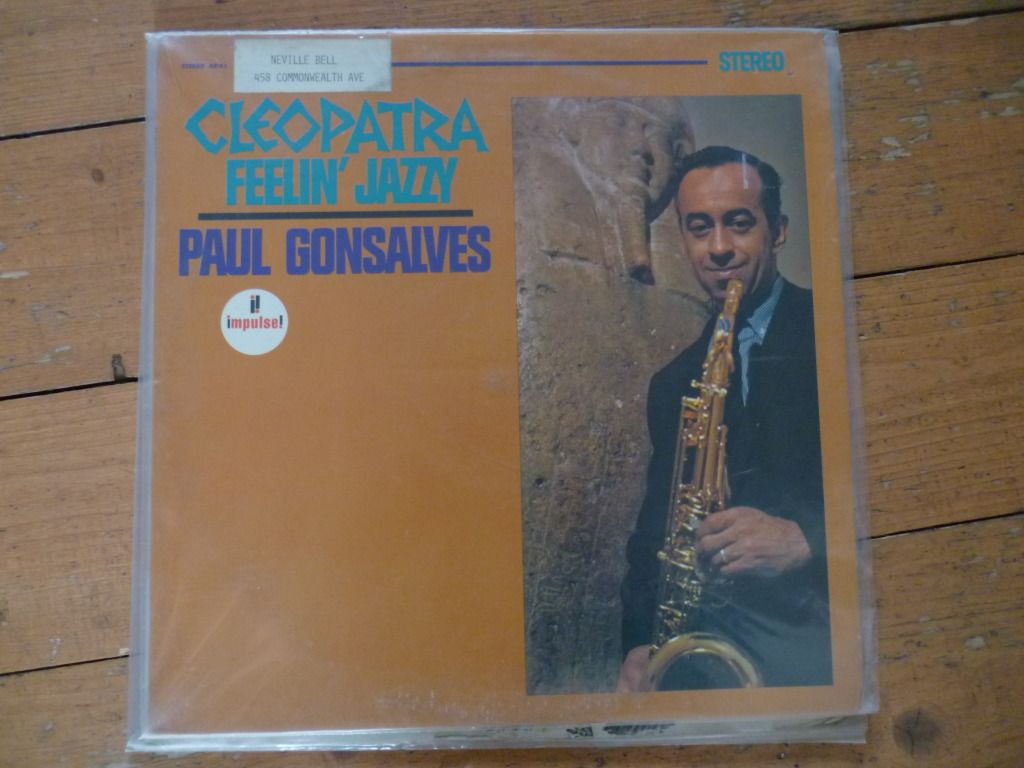
The first to give it a go was Paul Gonsalves.

Gonsalves for some reason didn't take full advantage of the opportunity to have a picture of Liz Taylor on the front of his record and instead opted for a picture of himself in from of a stone, carved coffin. No accounting for taste!
A very solid effort on Impulse, Cleopatra, Feelin Jazzy sees the ex-Ellingtonian teamed up with a crack group consisting of Hank Jones, Dick Hyman, George Duvivier, Kenny Burrell and Roy Haynes. Even I could make a great record with these guys helping! However, despite the all star cast its the least adventurous of the three records.
Gonsalves acquits himself magnificently throughout, his tone and phrasing are impeccable. They cover two tracks from the original soundtrack, Caesar and Cleopatra Theme and Anthony and Cleopatra Theme. After that they are free to let rip.
However, although the original compositions (and Ellington's Action in Alexandria) are all given titles that relate to the movie - Blues for Liz, Cleo's Blues, Cleo's Asp and Cleopatra's Lament, the music itself has no hint of Egypt, Africa, exotica or anything other than an American swinging hard bop. Its all very nice but not great. There is little that is either exotic, or indeed particularly spectacular about Cleopatra Feelin Jazzy. It a good sold listen but once the needle leaves the record the music quickly fades.


Next up is another Paul - Paul Horn and he is fielding a more West Coast team than Gonsalves. This Paul called up some mates, Emil Richards, Larry Bunker who would later play with him on his Jazz Suite on the Mass Texts (read about it here) as well as some other experienced studio musicians such as Brit expat, Victor Feldman, Chuck Israels and Colin Bailey.
They also used this opportunity to have a very suggestive picture of Liz Taylor on the cover. As you can see she fixes you with a direct stare before your eyes are dragged down over the amazing necklace and shimmering gown.
Horn and co did not bring any original material to this record but their interpretations of Alex North's music is so original that I don't think that matters.
Horn's soaring flute work is given an even more exotic backdrop by Richards' vibes and Bunker's percussion work and although it is uncredited Horn also plays the melodia on some tracks. Taken together this makes this a very enjoyable and satisfying record. It mixes just the right amounts of exotica and jazz to make it interesting throughout. Compared to the massive orchestration of the original, Horn's record sound refreshingly clear and fresh.
There is nothing remotely North African or indeed Egyptian or even Arabian about this music. It owes its exotic nature as much to the movie's depiction of Cleopatra as to any knowledge of music beyond the borders of the United States.
Having said all of that, this is one of my favourite Horn records and although it takes Alex North's music as its starting point it is, in my view, has very much its own character. Of course, Horn and Richards would go on to make more 'authentic' records later in the decade.


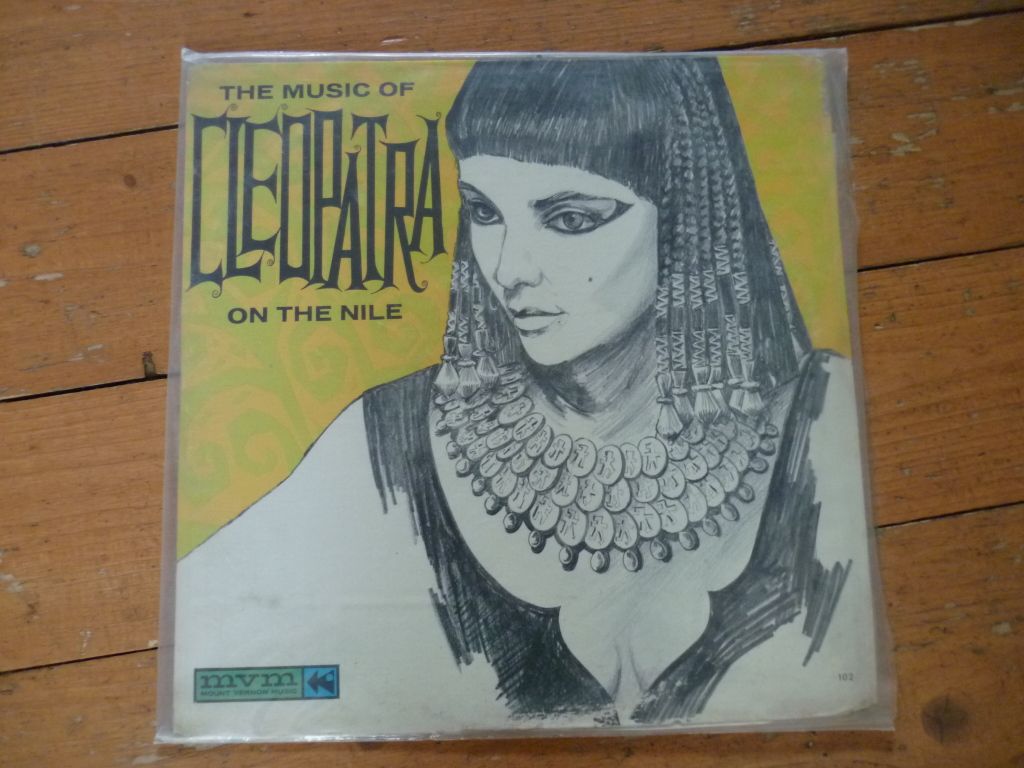
So, finally, on to the wild card in the pack.. What is this all about?
The Music of Cleopatra on the Nile was released on the small Mount Vernon Music label based in New York.
There is exactly no information on either the sleeve or the label as to who was behind this record. No musicians listed, no producer credited, no writer acknowledged. It seems to have come out of nowhere.
And the music, I hear you ask? Well the it is an amazing amalgam of jazz, of what to my ears sounds like Eastern European clarinet - almost klezmer in places, an instrument that sound like an oud (read about Ahmed Abdul Malik and his fusion of oud and jazz here), and some great percussion of bells, gongs and hand drums. It sounds like music from North Africa rather than music from America - or more precisely it sounds like music played by musicians who were familiar with music outside of jazz but familiar with jazz as well. Particular highlights for me are Passionate and Exotica, both of which provide a great danceable mix of styles. Dance of the Perfumed Veils is strangely hypnotic and alluring.
Who made this music? There is some speculation on the web that Sun Ra had a hand in it. I'm afraid that I just can't hear that. I know he made the Batman and Robin record but this just doesn't sound like anything by Sun Ra I've ever heard.
I like the fact that we may never know who was behind this. It just means that there is nothing to distract you from the music. Unless its the busty drawing of our Liz on the front cover!
Track this one down. Its an obscure joy.


Or click here to go to the whole album


* Yes I know this is from Twelth Night - so sue me!

Thursday, 24 May 2012

Jerry Cole - Super Charged Knock Offs

Jerry Cole was a go-to guy in the LA session world. Not only that he had a sideline (lucrative I hope) in exploito records, usually, but not exclusively with Crown Records.
Hot Rods, Surf, Bikes and even Drag Boats - he provided soundtracks to them all under a number of pseudonyms.

Here are some.


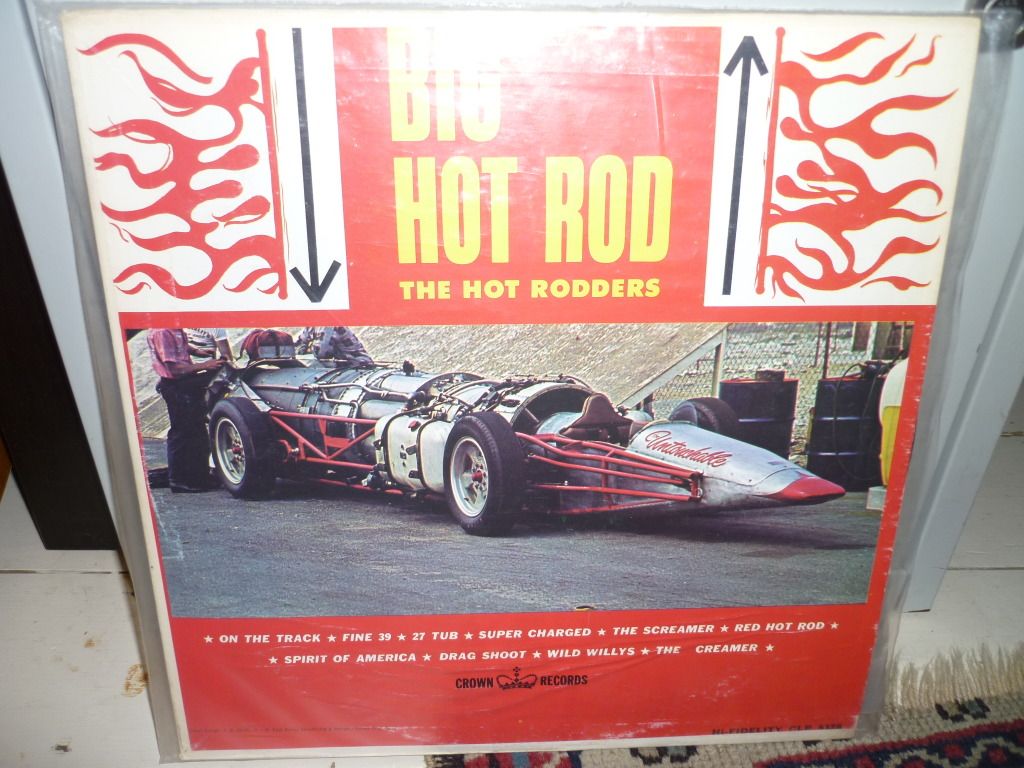
The Hot Rodders - Big Hot Rod


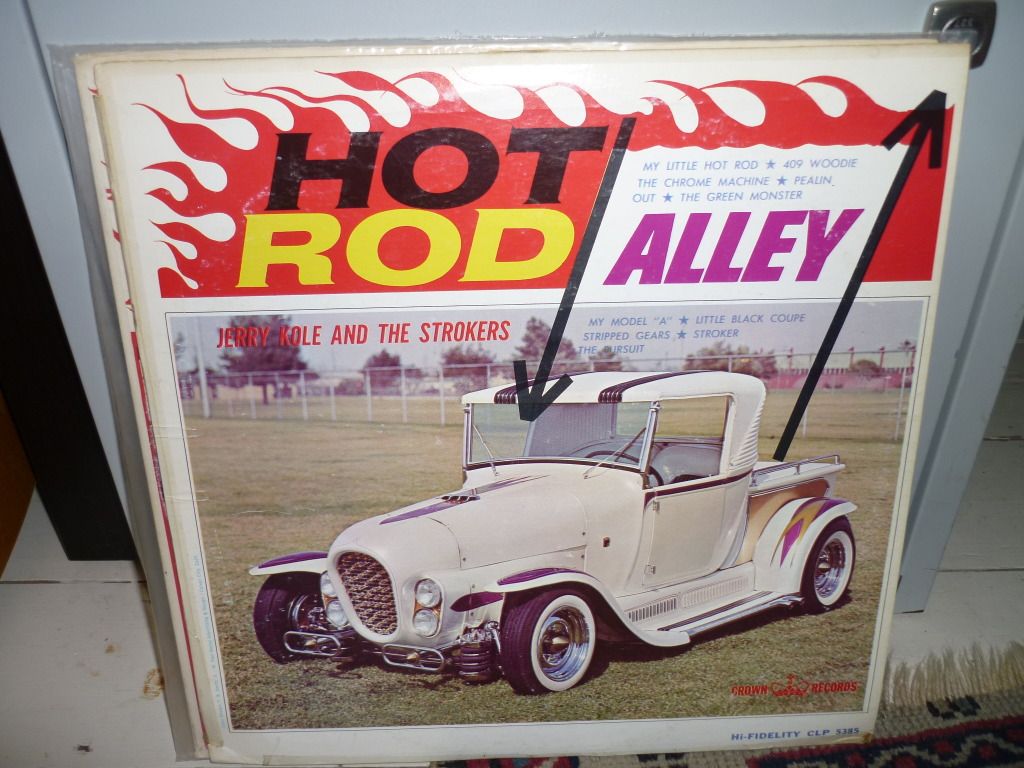
Jerry Kole and the Stokers - Hot Rod Alley (not a very good attempt at hiding his identity)


The Deuce Coupes - The Shut Downs


The Winners - Checkered Flag
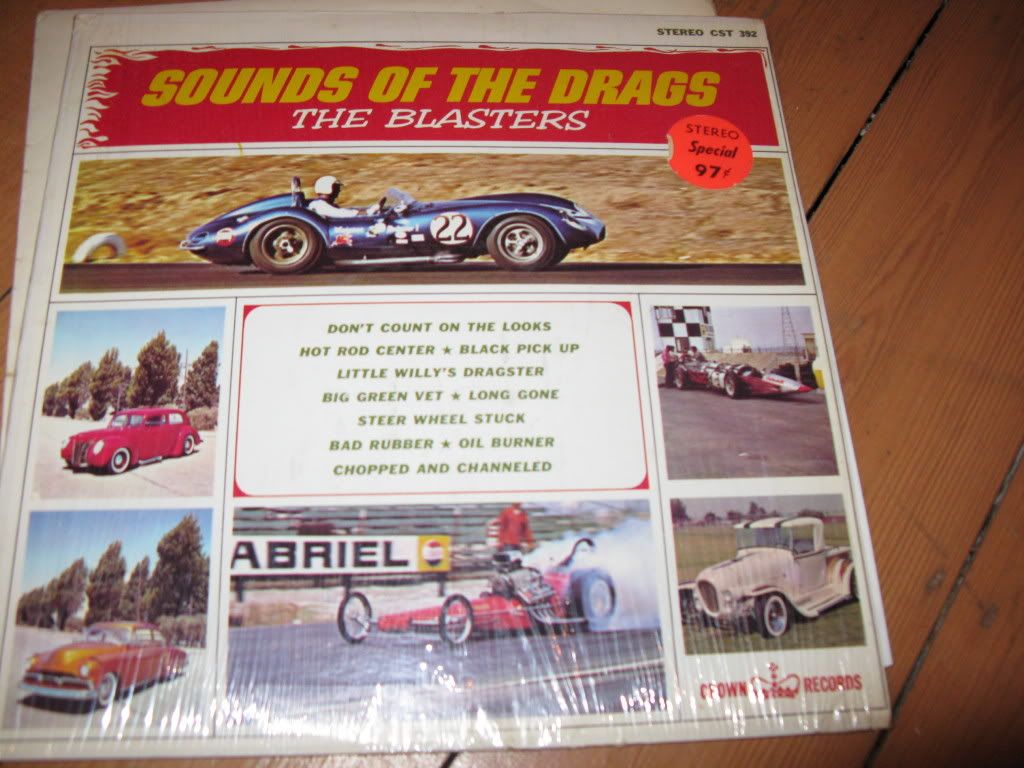
The Blasters - Sounds of the Drags (notice that all of the images have been used for other records!)

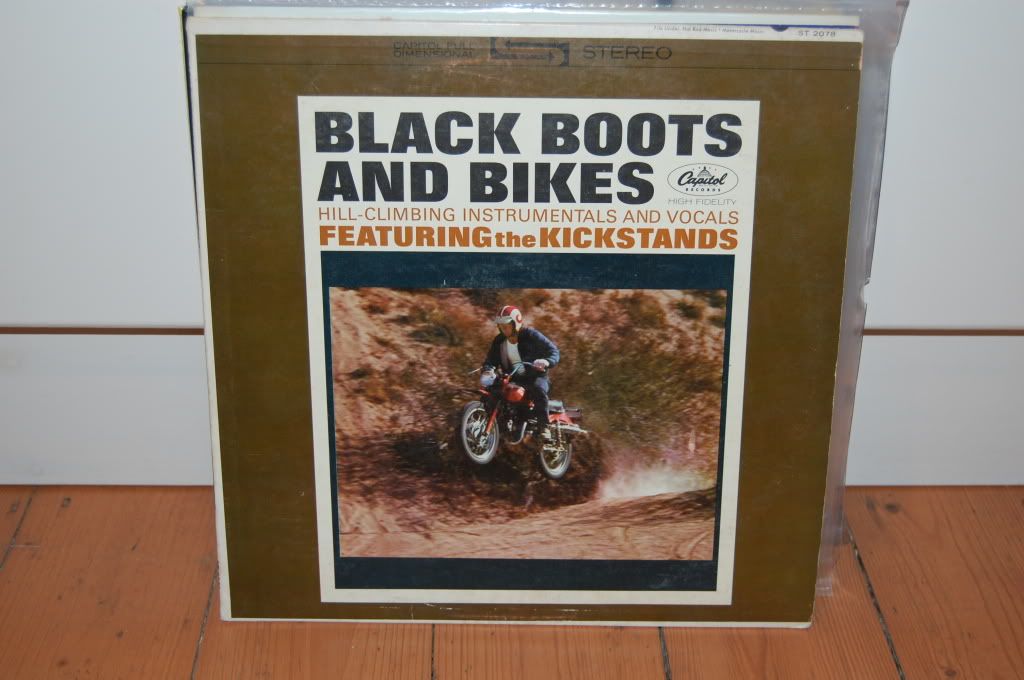
The Kickstands - Black Books and Bikes

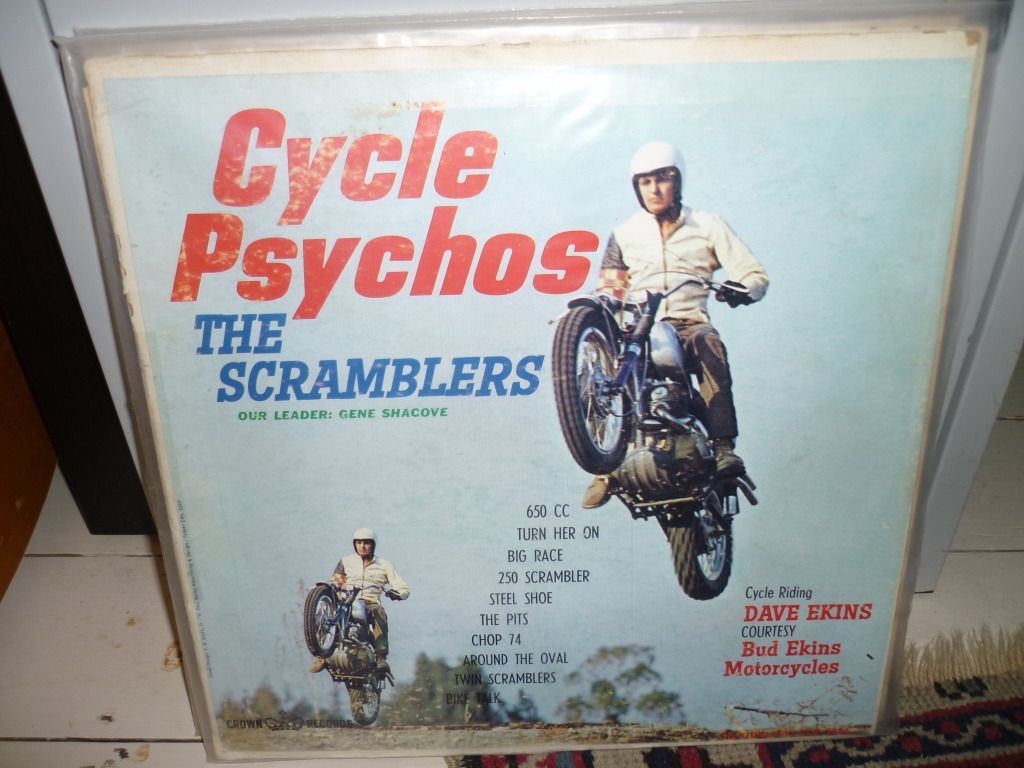
The Scramblers - Cycle Psycho

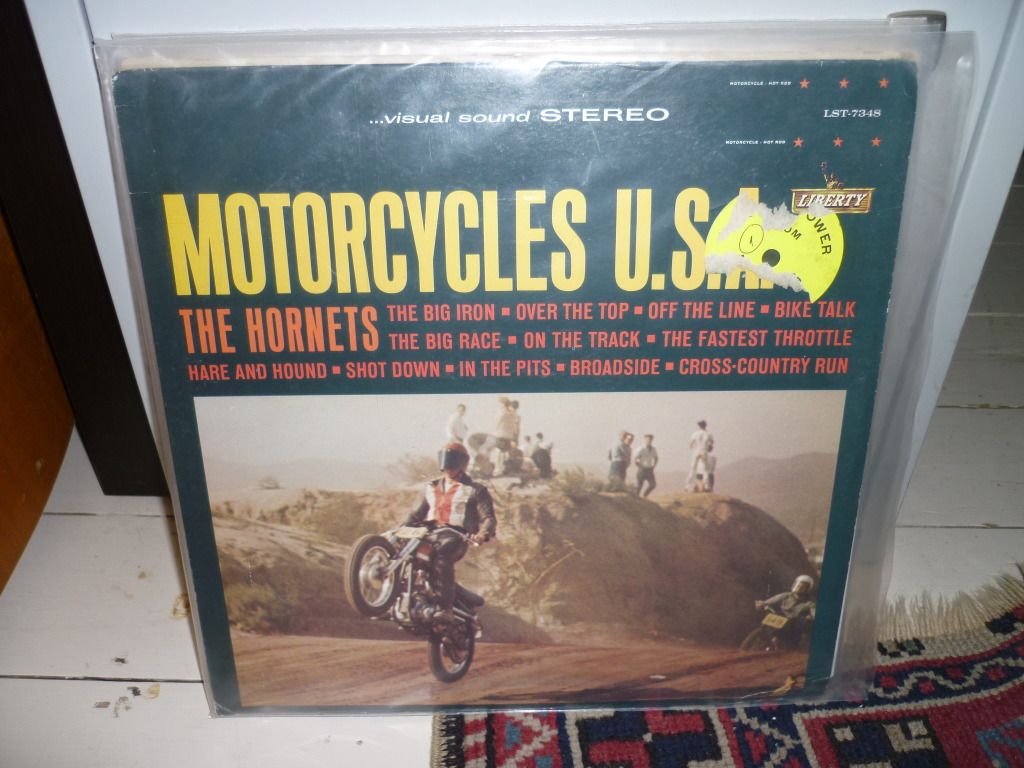
The Hornets - Motorcycles USA

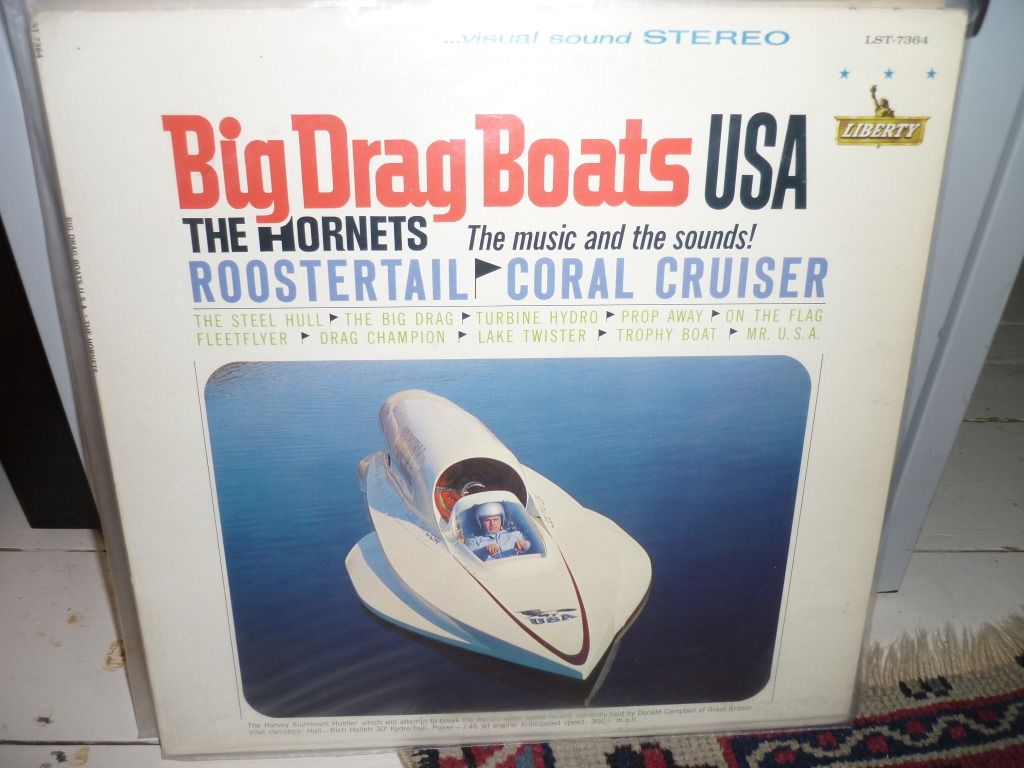
The Hornets - Big Drag Boats USA (this boat apparently was trying to break the water speed record)


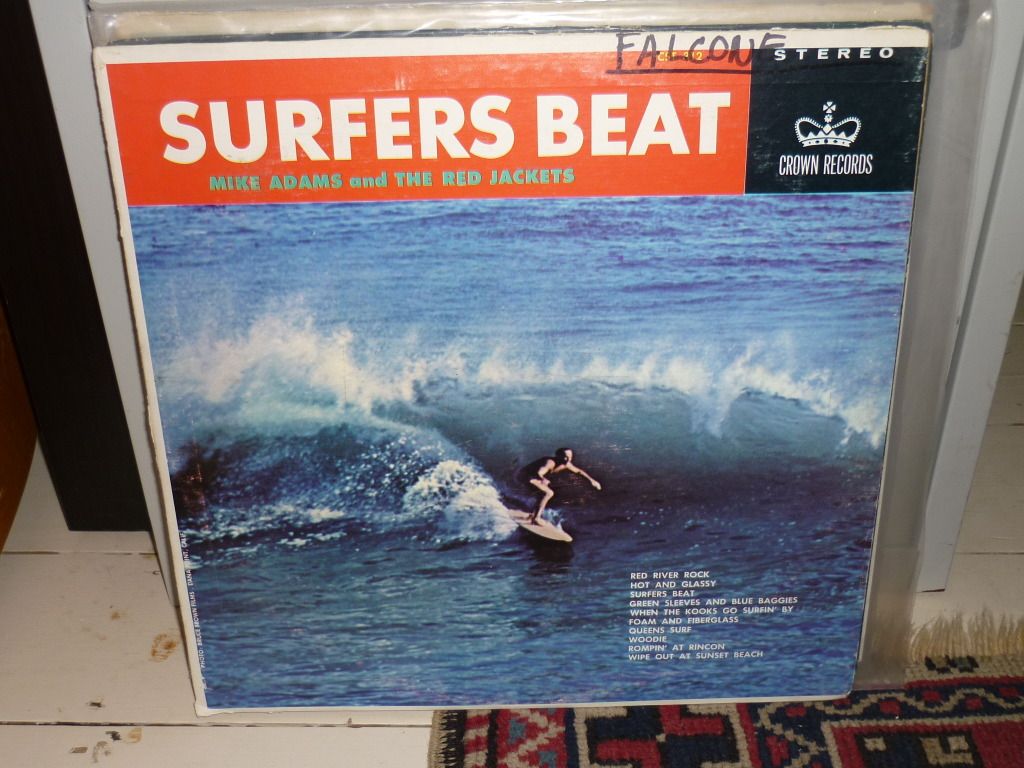
Mike Adams and the Red Jackets - Surfers Beat
Jerry of course, had his own band Jerry Cole and the Spacemen as well as playing in a lot of the Gary Usher studio bands, such as the Super Stocks and The Risers.

Any more that I've missed off?