Writing about music is like dancing about architecture

Sunday, 23 January 2011

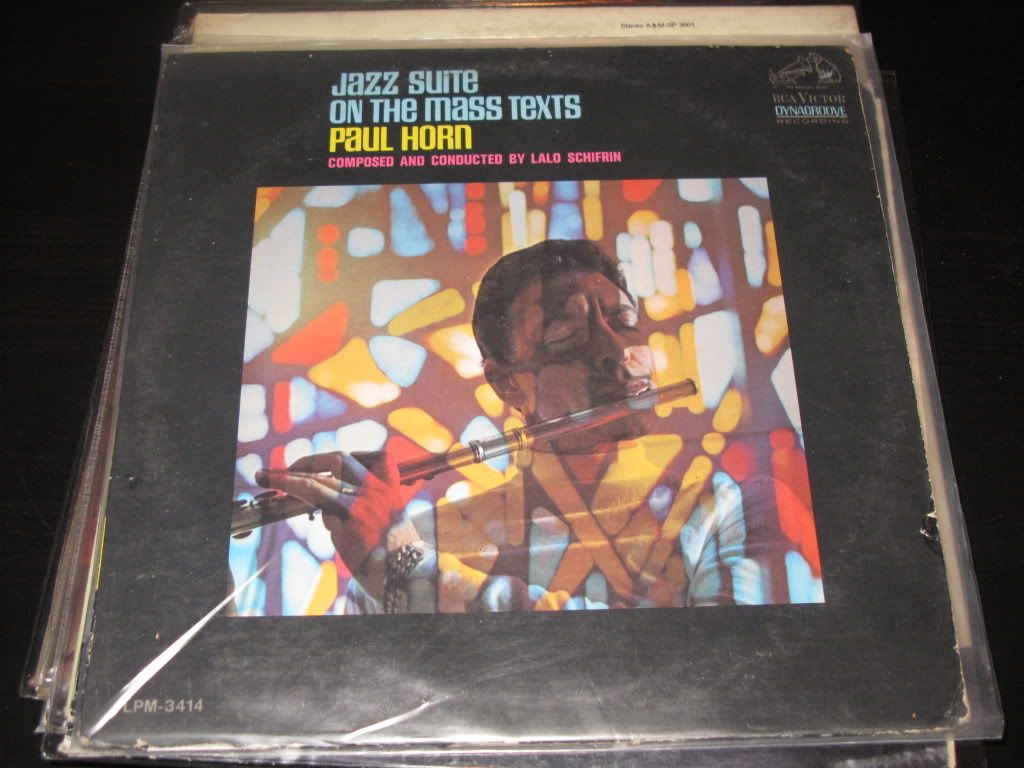
PAUL HORN - JAZZ SUITE ON THE MASS TEXTS


It's Sunday so I thought I'd pull out some Christian jazz.
Apparently this is the first jazz mass, recorded in 1964 by Paul Horn under the direction of Lalo Schifrin. In fact Schifrin arranged the traditional ecclesiastical music, conducted the orchestra and produced the record- so in many ways its more of a Schifrin record than a Horn one!
Schifrin and Horn were trying something that initially when I bought this record, seemed pretty strange but, on reflection, is perhaps is not so strange.
My initial thoughts were that religion and jazz just don't mix. After all, isn't jazz the product of music played in bordellos and gambling dens? Likes the blues, isn't it music for a Saturday night rather than for a  Sunday service? Like pop music there is something deliciously bad about jazz, the music that the cool kids listened to, the music that went with late nights, lots of alcohol, maybe lots of drugs, maybe sex, maybe all of the things that your pastor would disapprove of in church.
Charlie Parker didn't start jazz musicians taking drugs but his musical ability and inventiveness made a lot of people wonder if, by adopting his lifestyle, they could capture a part of what he had. The answer was invariably, a big fat no. But the number of successful jazz musicians who battled drugs is legion.
So jazz is often aligned with some pretty unconventional and frankly non-religious behaviour.
But then again in the early 60s what was happening in jazz, and lots of other music, was lending itself to a great deal of spirituality. Listen to Coltrane's early 60s records and then his wife Alice and Pharaoh Sanders. Listen to as slew of 60s musicians in many genres who were looking to the east, to spirituality, to transcendence, to belief.
So maybe in the early 60s Christianity wasn't that cool - but thinking that there was something else out there was not so weird.
I'm not sure if its at all relevant to a record that mixes jazz with Christian music but, in 1963 a man of the cloth called Martin Luther King Jr went to Washington and gave a small speech about racial equality. The civil rights movement was intrinsically linked to the Afro-American Baptist church.
Also, in 1964 the idea of merging jazz with classical music, the so-called Third Stream, was very current.
Miles Davis had recorded Sketches of Spain in 1960, the Modern Jazz Quartet were at the height of their popularity with their chamber jazz and jazz groups containing all manner of classical instruments, cellos, french horns or oboes were springing up everywhere, particularly on the West Coast. Both Horn and Schifrin were connected to some of the composers and musicians involved with the Third Stream.
So one might expect the music on this record to be polite and perhaps slightly staid.
It is in fact nothing of the sort.
To be honest, its a record that I don't put on the turntable that often. There is something very serious about this music. Serious because it is religious music but also serious because it is music that is exploring and probing and questioning.
One can, I think, hear elements of Schifrin's future cinema work, and Horn's future new age stuff. And at times I can't help but think about Gerry Goldsmith's score for the Omen.
Schifrin's arrangements are pleasingly beat heavy and very full and 'wall of sound'.
Horn's playing - albeit it brought to the front of the mix - is only one element of the music. Names you might recognise who are on the record are Bill Plummer, Larry Bunker, Red Callender and Emil Richards.
Does it urge me to go into a church? Frankly no.
But at times the music is very beautiful and moving. Schifrin manages to bring some of the emotion of the church to the record while not straying too far from recognisable jazz; and at time, particularly on Credo, the music goes into some very experimental territory.
Not something to put on if you are feeling a bit fragile on a Sunday morning. But if you want something to blow the cobwebs away before a relaxed Sunday, this could be the one for you.

Friday, 21 January 2011

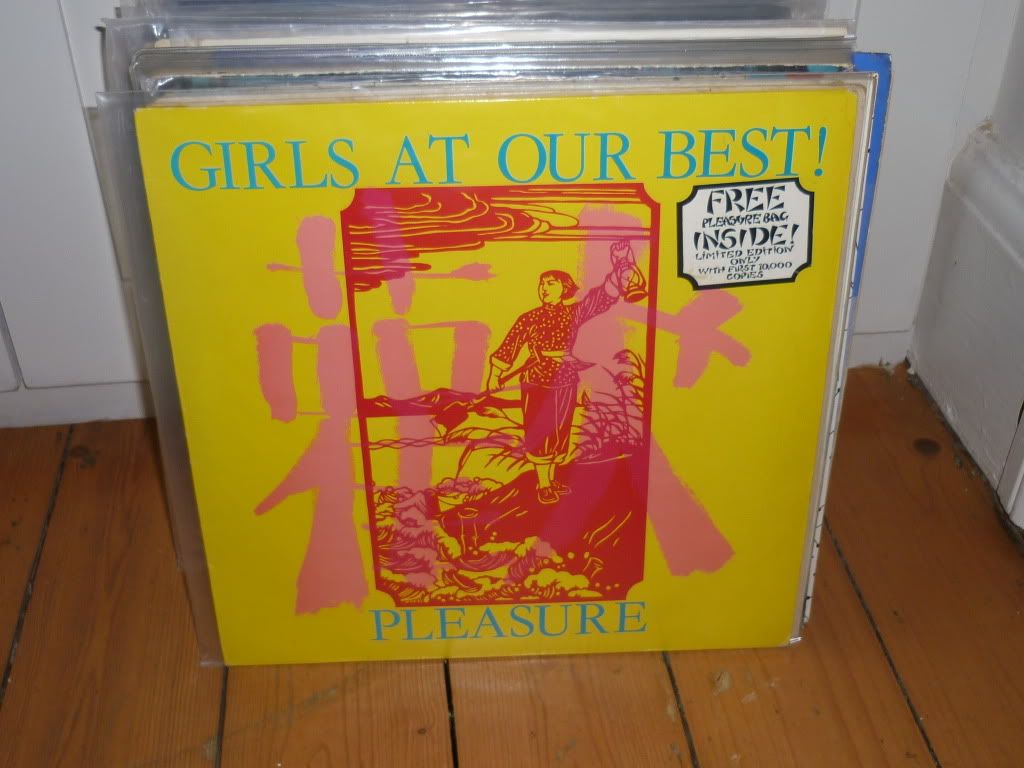
GIRLS AT OUR BEST! - PLEASURE

There are some records that are just fun. The music is upbeat, simple, catchy, the vocals are cool and perfectly delivered, the lyrics are amusing with the right mixture of real-world observation and political intent. This is one of those records.
Girls at Our Best! also have one of the best names in British rock. Which makes it rather a shame that only one band member, the lead vocalist Judy Evans, was a woman.
Unfortunately Pleasure is their only LP, but like so many groups in the post-punk era they left an enduring, if small legacy.If you are so inclined I would very much recommend you track down their earlier singles, Going Nowhere Fast (later covered by the Wedding Present) which also has one of the most amusing single picture sleeves, Going for Gold and Politics. Strangely the lyrics for all these song can be found on the lyric sheet that comes with the LP.
I love bands with a female lead vocalist, from the Slits, to Prag Vac, to the Au Pairs, to Girls at Our Best! to the Shop Assistants,to the Primitives, to the Sundays. Its partly the challenge to male rock values, partly the great lyrics and partly the pleasure of hearing a beautiful voice rather than a gruff growl, wedded to great rock songs.
Pleasure - the title of this record. The music is a pleasure. Buoyant and upbeat it is music for dancing around to like a loon. Perhaps in a dark room with your friends. Perhaps after a few drinks. Perhaps with someone you fancy. I don't think it takes anything away from the music to say that its very straight forward and simple. There's no post-punk stuttering drums or disco bass-lines or choppy guitars. Instead we get music that reminds me of the Mekons at their best. Even the clarinet solo on Fun City Teenagers is charming. Thomas Dolby also makes an early appearance on synthesisers. And for all you beat hunters out there the runout groove one side 1 has a repeated drum break.
The  lyrics also deal with Pleasure in one form or another, not in a simple hedonistic way, but in a questioning, ironic and slightly wry manner. The main theme of the lyrics is that although the modern world is full of ways to get your pleasure we should be careful as many of these seemingly pleasurable pursuits are in reality ways to dull us, to silence us and prevent us from questioning the world around us. Everyone becomes nothing more than pawns in the system if you only take the pleasures that are offered to you. How much better would it be for us to get our kicks by being different and not conforming? Maybe I'm reading too much into it - what do you think?
Unlike a lot of female fronted C86 bands Girls At Our Best's Judy Evans seems to me to meeting attitude to women head on. There is a political aspect to the lyrics that, while not party political, challenges the status quo.
I was just about to select some songs as highlights but then I realised that I can't - each song is wonderful. A beautiful gem of a record and worth tracking down.
If you want to find out more about them the I reckon this is the place: http://www.girlsatourbest.com/

Thursday, 20 January 2011

GARY BURTON - THE TIME MACHINE

One of the purposes of starting this blog was to make me pull out records I haven't listened to in a while.
You probably have records like that yourself. The ones that lurk in the back of the collection, sitting unlistened to for years and years.
As each new record is added to the collection, those that have not had an airing for a while see their chances of being put on the turntable slowly diminish until they must be weeping with frustration.
So it has been with Gary Burton's Time Machine. I bought it on  whim because of the cover (apologies for the dreadful photo). I guess I liked the time-delayed image of Burton playing away at his vibes, his distinctive four mallet technique clearly visible but always wonderfully blurred and confused. If you can see it, at one stage in the photo he has his eyes closed in concentration. I also like his thick glasses with no bottom rim. Cool daddio!
So its a record I got for the cover (not the only one in my collection I can tell you!) but why have I held on to it?
Its on the turntable now and, if you've only hear Burton in his fusion heyday, you would be very surprised to hear how organic it sounds. Of course, as the sleeve notes never tire of telling you, it is not organic. In true sleeve note hyperbole this record is described as "one of the most adventurous recording projects ever attempted". Like WOW! But all the instruments are acoustic - nothing electric just yet.
Recorded in 1966 this record slightly predates what is often referred to as the first fusion record, Duster which he recorded with Larry Coryell as well as Steve Swallow (who plays bass on this record) and the wonderful Roy Haynes in 1967.
But Burton's fascination with taking jazz to its outermost regions is evident here but mostly by his use of the studio to create music that is impossible to create live. The 'fusion' elements of his music that he is perhaps most well known for - the inclusion of rock and country influences-  are nowhere to be heard. Unless one includes his cover of Norwegian Wood!
Burton was a teacher at Berklee during the sixties and seventies and it was at Berklee that he met Mike Gibbs. Gibbs is from Rhodesia (now Zimbabwe) and has produced some amazing music in his own right - I am sure we will get round to one of his records soon. He has also composed some pretty amazing stuff for Burton down the years.
This record has two compositions from Gibbs, the very short Childhood - which is very uncomfortable and I hope not at all like either Gibb's or Burton's childhood. However, Deluge is a different kettle of fish. Also slightly off-kilter but in a much more interesting way. Burton's vibes are very evocative of running and bubbling water. The sleeve notes go into great lengths to describe the studio wizardry that went into making the track - I won't bore you here, suffice to say the finished product could not be reproduced live!
The final track, My Funny Valentine is one of the highlights of the record. It truly sounds nothing like any of the versions you've ever heard before.
And in many ways this track sums up what this record is about. Burton had just come from playing with Stan Getz and was about as deep into the West Coast jazz scene as it was possible to be. You can hear that in his playing sometimes - and surely his choice of Jobim's Chega De Saudade owes something to Getz's dalliance with bossa? And My Funny Valentine has impeccable West Coast credentials having been recorded by Chet Baker, Gerry Mulligan and of course Miles Davis.
But overall there is so much more going on with this record. It's ethereal slightly other-worldly sounds, its  overdubbing and technical wizardry, its jerky rhythms and lack of melody take it far away from any cool West Coast sounds and into some very pleasing experimental regions.
Its not a record I would play often. There's something just too unformed and searching about it, something that is not quite fully formed, its a record that is not quite comfortable in its own skin. As clever as it is, as experimental and deliberately difficult, its not quite there. 
Should it be sent back to the wilds of the back of the record collection? Or worse, should it be ejected entirely?
What do you think?


Sunday, 16 January 2011

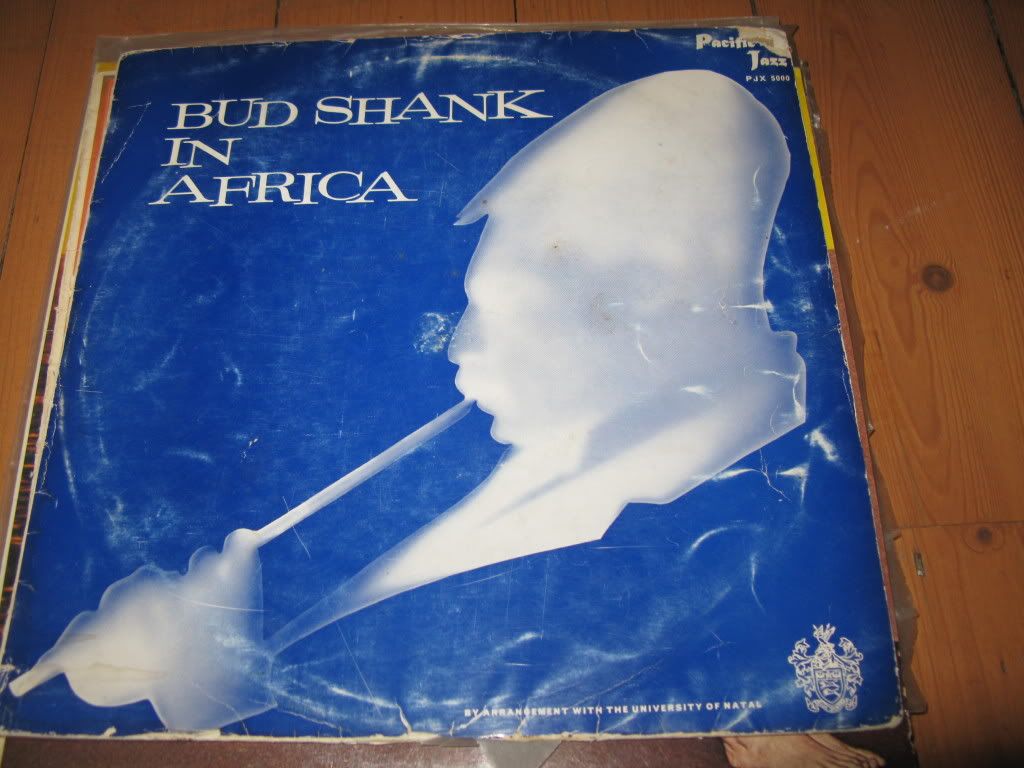
BUD SHANK - IN AFRICA

So I'm in Kalk Bay in the Cape. And I peel off from my wife and kids and look in an antique shop.

On the top of a rather tired looking chest of drawers are some records. Only 40 Rand each the tired looking lady at the counter tells me. I smile and after flicking through some 80s chuff I chance upon this.

At first I think about leaving it. I mean, its by Bud Shank! But then I notice that the cover says that its 'By Arrangement With the University of Natal'. Now that's interesting.

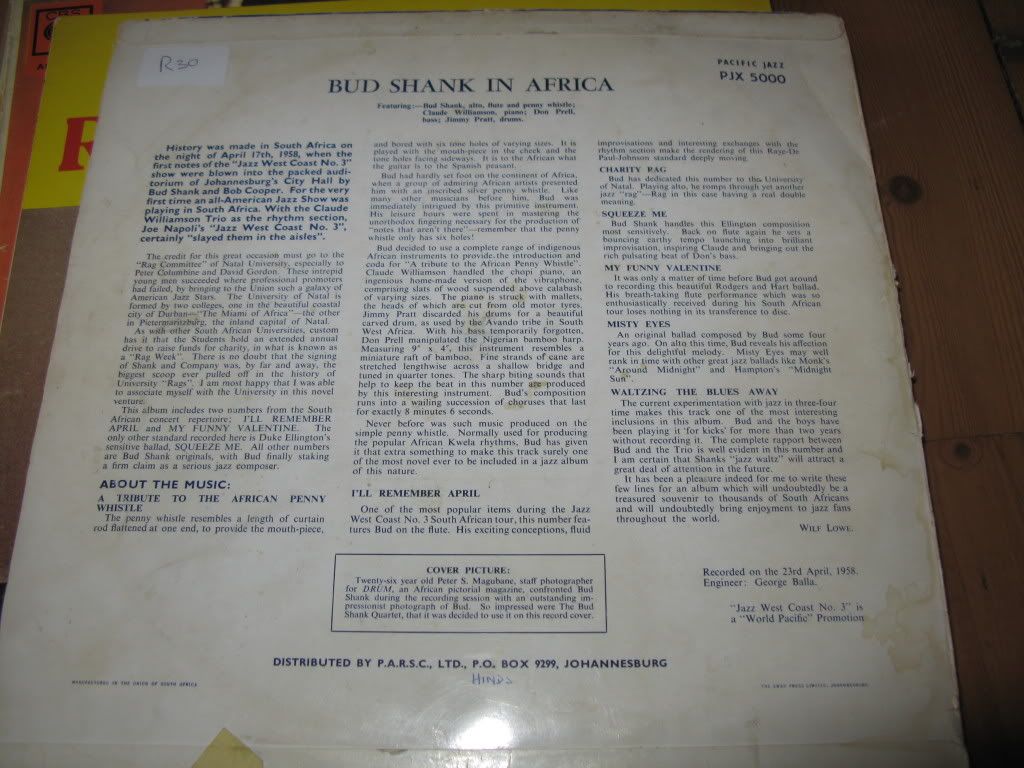
So I look at the back cover and what does it say? Well for once the back cover is very informative. It would appear that the Rag Committee of the University of Natal was somehow able to get Shank, who in 1958, the year of the tour and this recording, was already something of a star on the West Coast of America.to play a series of gigs in Johannesburg.

Shank played in Johannesburg alongside a number of other US musicians. Interestingly one of them was Claude Williamson who later recorded with Spokes Mashiyane.

Shank was a central figure of the West Coast cool jazz scene but prior to that had played in a number of big bands, most notably that of Stan Kenton. In many ways it was the big band sound that was still influential on the South African jazz scene - particularly bands such as the Harlem Swingsters and the Jazz Maniacs and the kwela sound - perhaps explaining Williamson and Mashiyane.

For the most part this record is very pleasant cool jazz. Shank is a fine player, equally at home on sax as flute. But of most interest is 'A Tribute to the African Penny Whistle'. As the sleeve notes explain:

"The penny whistle resembles a length of curtain rod flattened at one end to provide the mouth-piece, and bored with six tome holes of varying sizes. It is played with the mouth-piece in the cheek and the tone holes facing sideways. It is to the African what the guitar is to the Spanish peasant.
Bud had hardly set foot on the continent of Africa, when a group of admiring African artists presented him with an inscribed silver penny whistle. like many other musicians before him Bud was immediately intrigued by this primitive instrument. his leisure hours were spent in mastering the unorthodox fingering necessary for the production of 'notes that aren't there' - remember that the penny whistle only has six holes!
Bud decided to use a complete range of indigenous African instruments to provide the introduction and coda for 'A tribute to the African Penny Whistle'. Claude Williamson handled the chopi piano, and ingenious home-made version of the vibraphone, comprising slats of wood suspended above calabash of varying sizes. The piano is struck with mallets the heads of which are cut from old tyres. Jimmy Pratt discarded his drums for a beautiful carved drum as used by the Avando tribe in South West Africa. With his bass temporarily forgotten, Don Prell manipulated the Nigerian bamboo harp. Measuring 9" x 4",this instrument resembles a miniature raft of bamboo. Fine strands of cane are stretched lengthwise across a shallow bridge and tuned in quarter tones. The sharp biting sounds that help to keep the beat in this number are produced by this interesting instrument. Bud's composition runs into a wailing succession of choruses that last for exactly 8 minutes 6 seconds.
Never before was such music produced on the simple penny whistle. Normally used for producing the popular African Kwela rhythms, Bud has given it that extra something to make this track surely one of the most novel ever to be included in a jazz album of this nature."

Lets ignore the racist and disdainful treatment of South African musician when compared to white American ones. I don't think we can be surprised by the tone of the sleeve notes.

In the hands of a West Coast jazz musician kwela takes on a distinctly exotic air. To my ears it sits in the realm of Martin Denny and Les Baxter rather than in the world of jazz. Interestingly Shank would go on to record albums of bossa nova and Williamson would take a Latin jazz turn. Obviously both men were open to music from other parts of the world. In the case of kwela and bossa these were musics that had been influenced by the sounds of big bands such as that of Stan Kenton, with whom both me played. I like that kind of circularity.

In my view, this is a small example of what might had happened with South African jazz. On the back of the popularity of kwela in the UK, of the appropriation of South African songs by American and British jazz musicians (Tom Hark, Wimoweh/Mbube, Skokiaan etc) it is not inconceivable that South African jazz could have been brought into the pop mainstream of Europe and America in the way that bossa nova was to be. Whether this would have changed the lives of many South African musicians is debatable - but it might have meant that exile was not the only way to reach audiences outside of the country.

However, as the apharteid juggernaut  continued, this version of events proved impossible. Musicians such as Shank would refuse to play in South Africa and kwela, and South African jazz would remain a minority interest outside of the country.

An intriguing and unusual recording.

Friday, 14 January 2011

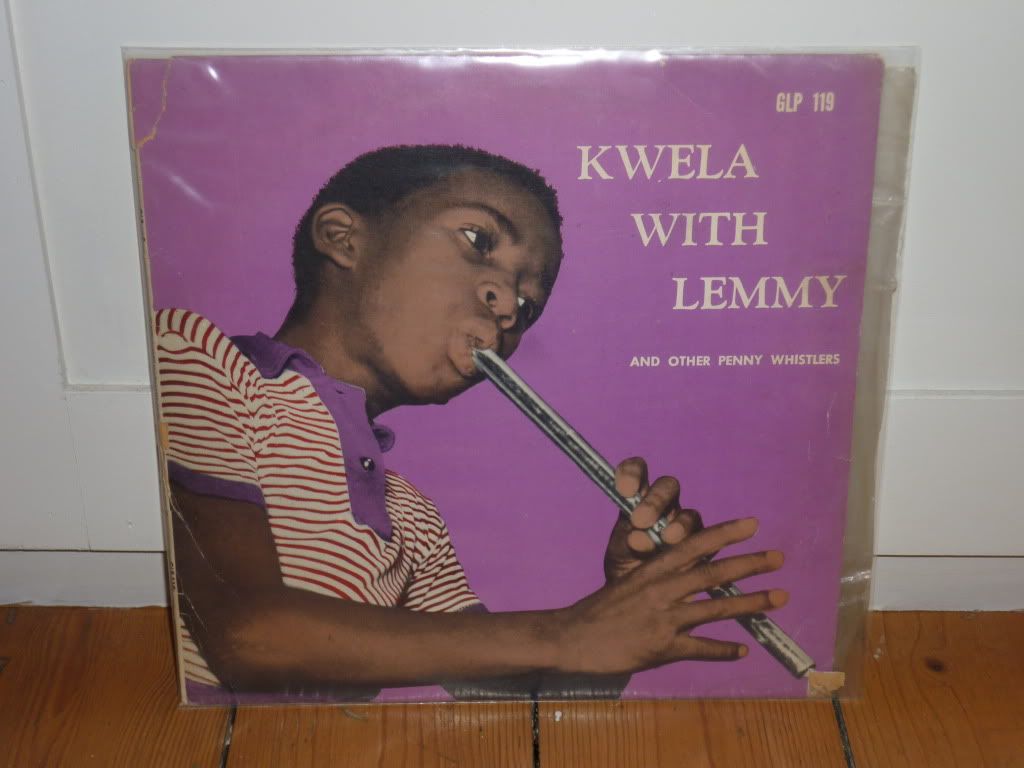
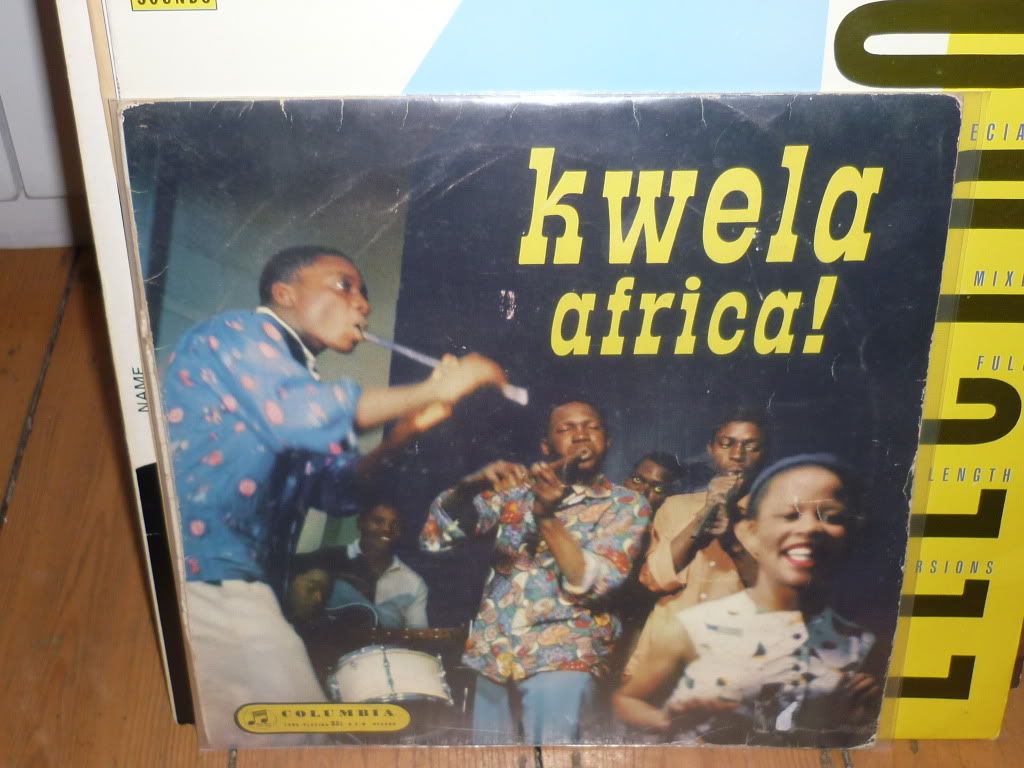
KWELA - SOUTH AFRICAN PENNYWHISTLE JIVE

In 1958 a slightly unlikely single reached No 2 in the UK pop charts.

It was called Tom Hark and was by the wonderfully named Elias and his Zig Zag Jive Flutes.

The theme tune to a TV show called The Killing Stones it proved to be amazingly popular and was, undoubtedly, the first UK chart topper from Africa.

Tom Hark was kwela, a potent mix of jazz, highlife and rhythm and blues.

The pennywhistle was a very cheap instrument produced in Germany and similar to flutes played across Africa. The flute had traditionally been one of the first instruments aspiring musicians learnt to play. It was also associated with young boys in rural areas who would play the flute when herding cattle.

As South Africa became more urbanized kids did less cattle herding and needed another way to make money. Some of them, enterprisingly, started to busk using the cheapest instrument that came to hand. They copied the popular music of the day - often big band jazz by people such as Benny Goodman. The little pennywhistle proved to be very good at copying the sounds of the clarinet or sax and the music became popular.

The origin of the name kwela is a little unclear. It is a Zulu word that means climb up or get on. Policemen would often use the word when trying to get people into their vans and so the vans became known as kwela-kwela. But kwela was also a shout of encouragement during the pata pata dance - the subject of the famous song by Miriam Makeba. Finally Tom Hark starts, as do many kwela songs, with a spoken introduction. It exhorts gamblers to react quickly to the arrival of the police - they put away their cards and pick up pennywhistles instead!

Pop music in Britain and the US in the fifties was becoming very aware of the music produced by the rest of the world. In fact in many ways audiences were more receptive to music from non-European countries in the fifties then they would be until the advent of the so-called World Music movement in the eighties. Exotica was very popular in America, musicians from Cuba, Argentina and Mexico were carving out successful careers across Europe and America. People were listening to the music of Hawaii and South East Asia. Soon bossa nova would break out of Brazil and take off amongst jazz aficionados. Calypso was already a successful genre.

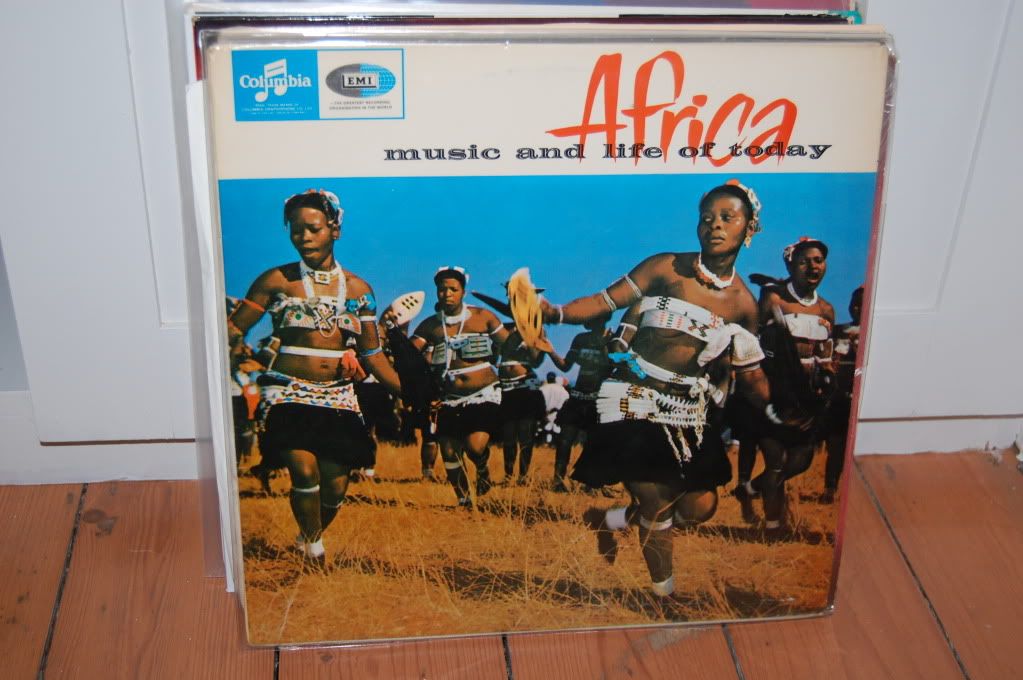
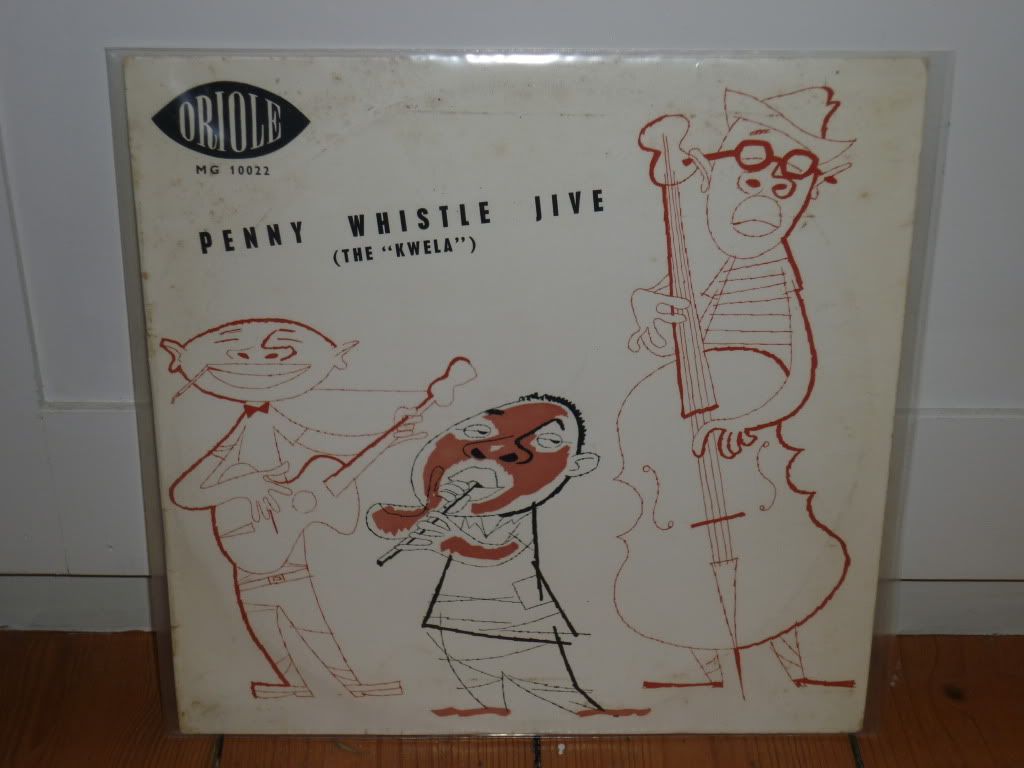
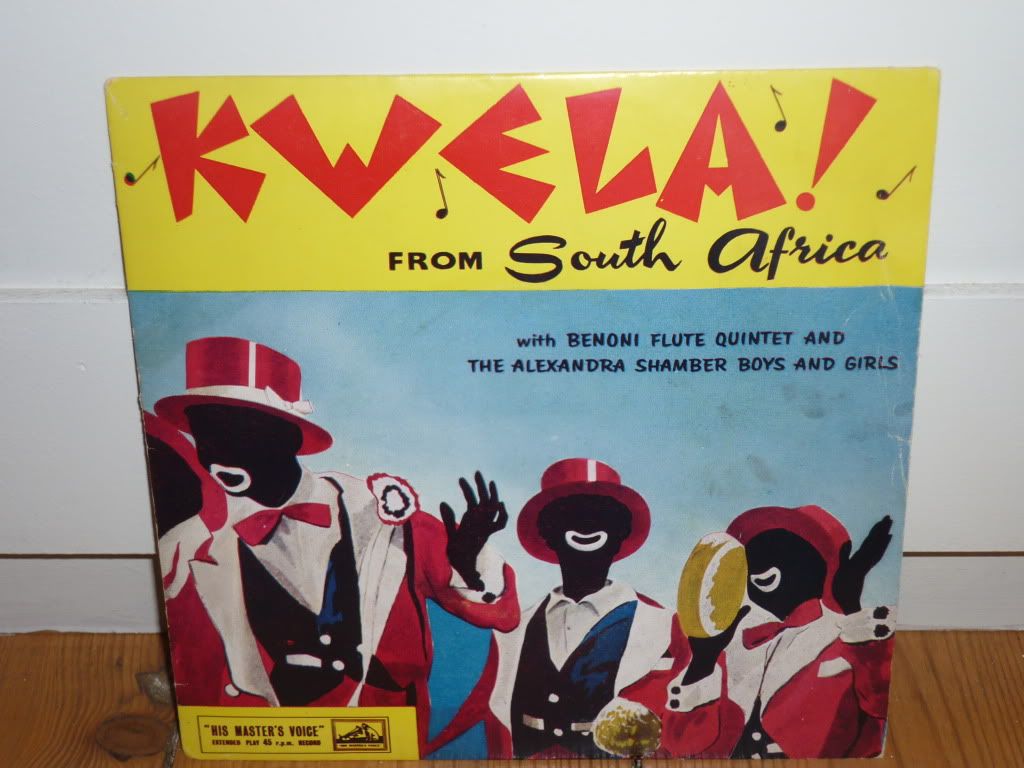
Of course this was all shot through with colonialism and usually overt racism. Look at the sleeve to the left. The music on the record is produced by urbanized black South Africans but the cover shows a traditional dance performed by women. It could not be accepted that the musicians on the record are at all like the white record buying public. The music can have jazz influences but those who produce it cannot be 'Westernized'. The sleeve notes start with the sentence - "Gone are the days when an African could produce elementary musical sounds only by beating a crude drum." Of course, Britain and the rest of Europe and America, were very racist places in the late fifties, especially when compared to today's standards. That is to understand but not condone.

I love kwela. There is something so unrelentingly happy about it, so upbeat and cheery that you can't help but tap your foot and smile. Most kwela is the product of one or more pennywhistles, a bass and a guitar. In that regard it is rather like skiffle - another fifties craze. It's music to dance to, music to throw away your inhibitions and have a good time. And, to my ears at least, like US soul, it is music that is infused with emotion and meaning.

Of course, like most seemingly happy music, there is a great deal of unhappiness going on underneath; its very name referring to police brutality and it is undeniably the music of slums and townships. Most South African jazz musicians were rather disdainful of this 'pop music'. It was too simple and too derivative - after all it was music from street corner buskers. But economic factors forced musicians to make compromises and even the erasable Kippie Moeketsi recorded a kwela track.

Kwela was also packaged as music for export. Amazingly my copy of the record to the left has a sticker showing that at one stage it was in the British Army Gibraltar radio station library. In the late fifties South Africa saw an amazing explosion of wonderful music - so called Township Jazz and Jive. Musicians such as Miriam Makeba, the Manhattan Brothers, Dolly Rathebe, the Harlem Swingsters and other were making wonderful, sophisticated and catchy music that blended Africa with America. But this was not music that often found its way to Europe or America. Instead kwela, a far rawer and less sophisticated form, was sent over. I'm not really sure why. It may have had something to do with the instrumental nature of the music - no strange accents or, heaven forbid foreign languages, to contend with. But I also think that it was more deep rooted than that. Jazz came from America. European musicians aspired to be like Americans. Jazz did not come from Africa. It would take a long struggle by exiled musicians to convince the record buying public that a blend of America and Africa could work.


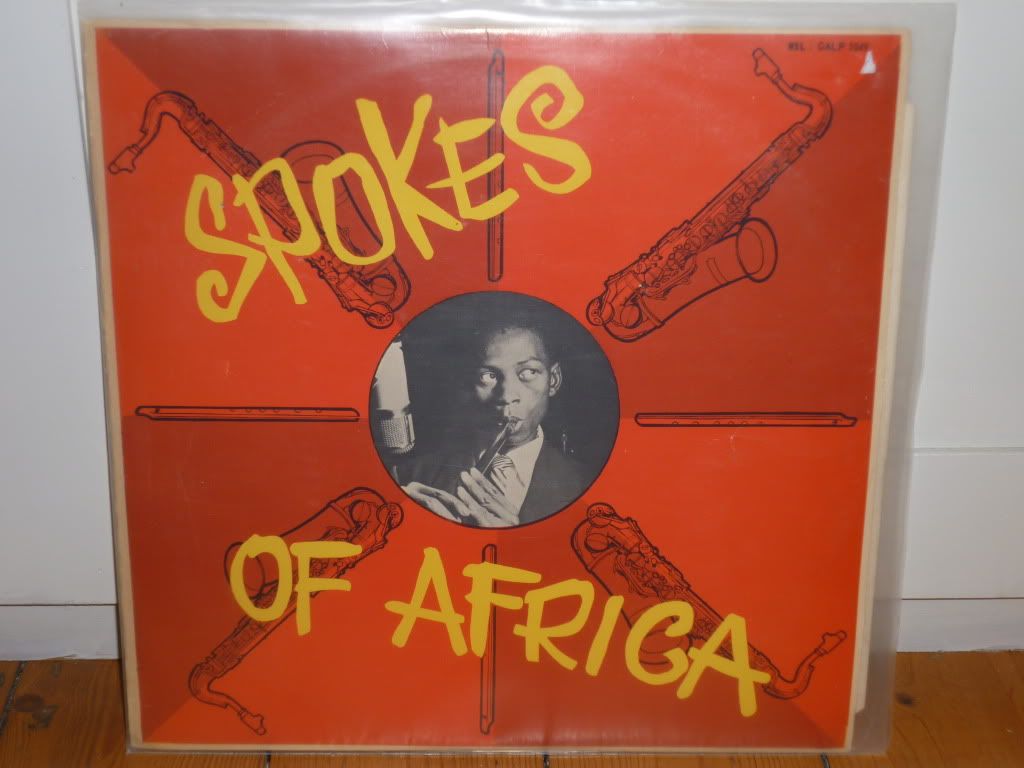
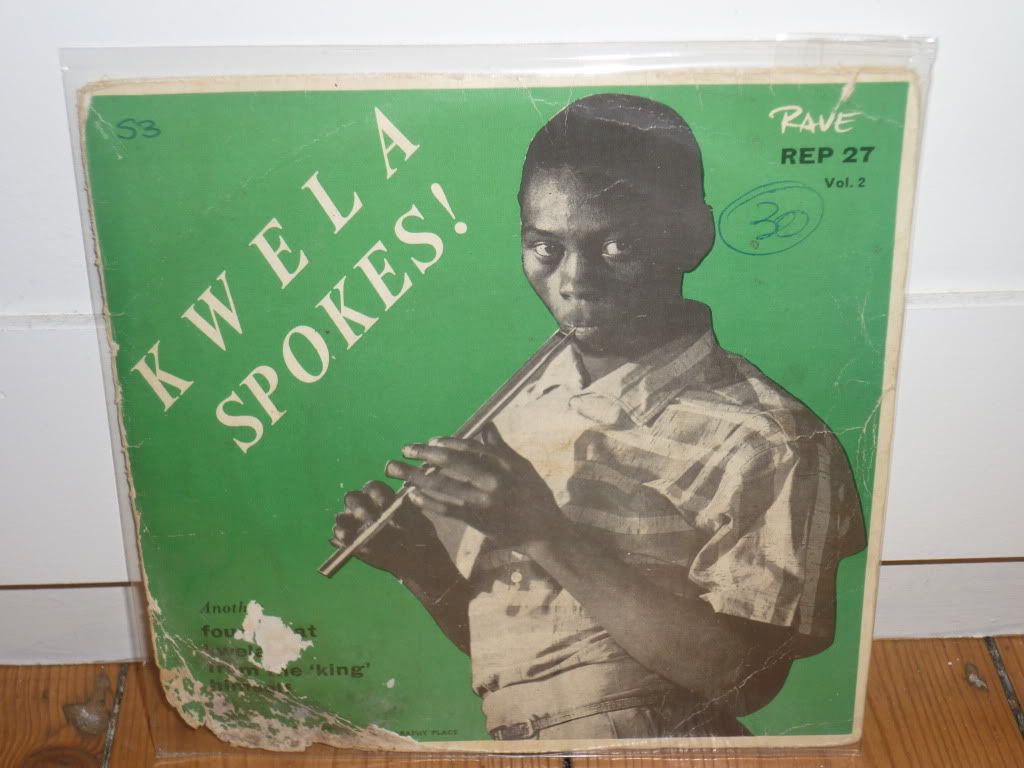
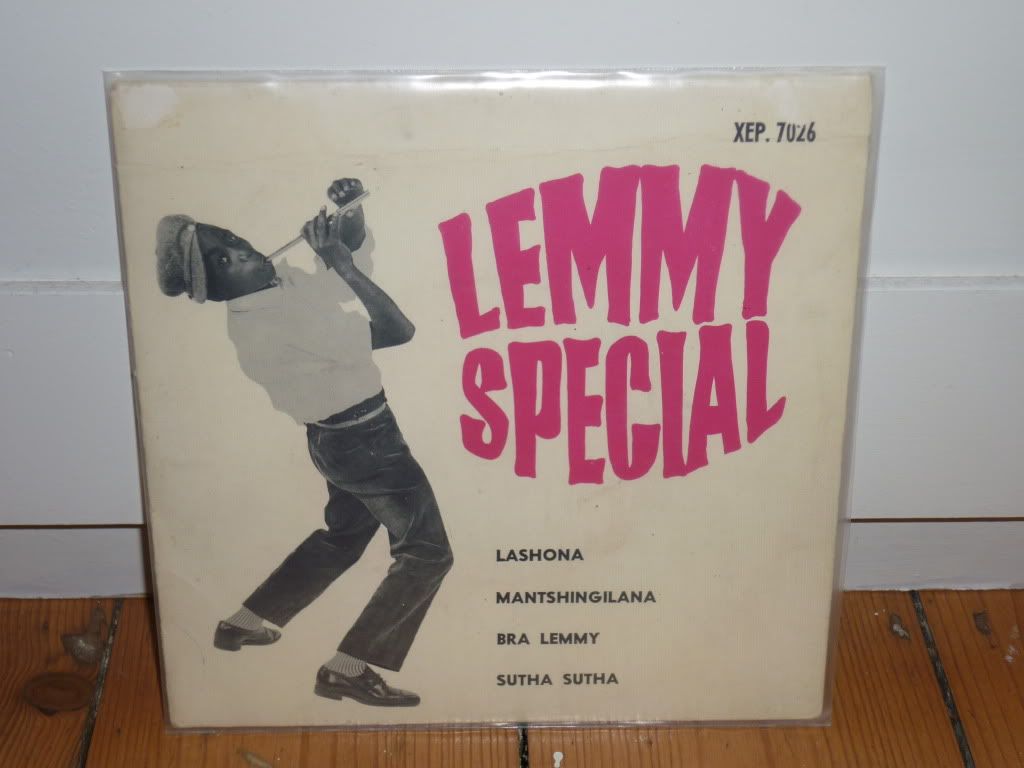
The 'superstar' of kwela was undoubtedly Spokes Mashiyane although he had some stiff competition from Lemmy 'Special' Mabaso and 'Big Voice' Jack Lerole. Lerole would form Black Mambazo (Black Axe - apparently so called because they 'cut' their opposition) which would, much later develop into the completely differently styled Ladysmith Black Mambazo. However, Spokes Mashiyanepennywhistler.

Eventually kwela proved to be too simple a musical form to exist for very long. Rather like punk, it was simply impossible to keep making music that adhered to its original form. And like punk its influence was felt long after its heyday.

Initially many pennywhistlers upgraded to saxophones. Spokes became more sophisticated and he and his songwriting partner Alan Kwela began to really push the boundaries of the form. However, the partnerships was not to last and Kwela became one of South Africa's leading jazz guitarists.

I really believe that, had it not been for the insane apharteid policies of South Africa, kwela, and much other South African jazz could have 'crossed over' in the same way that bossa nova did. However, in a racist South Africa music made by black musicians could only be sold to black people. It was not a possibility for black South Africans to have an international career - unless they left the country.
So we have a form of music, initially born from imitation and using its limitations as strengths. It was a popular form of music that gained great mass support and found itself exported and some would say exploited - few pennywhistlers saw much money from their recordings. For a style of music that was not revered by musicians at the time it has cast a long shadow over South African music.

Try and get your hands on some of this great  music. And if you can find some Township Jazz and Jive I recommend that too.
It will be easier to find kwela in the UK because it was sent overseas. Surprisingly, since I have become interested in it, I have see prices for kwela sore to some pretty insane levels. Maybe I'm not the only one who has started to appreciate the sound of a cheap flute.

HARRY THE HIPSTER GIBSON - BOOGIE WOOGIE IN BLUE

Harry the Hipster Gibson is one of those slightly marginal figures of 20th Century American music who plowed his own furrow and, in the way of many great musicians was both of his time and completely ahead of it.

Harry Raab was born in New York in 1914 and came from a family of musicians. Apparently his father was keen for him to study law but Harry had other ideas and from the young age of 13 he was playing barrel house piano in Harlem clubs. Before long he was embracing ever aspect of 1940's New York music - which at that time included hanging out with Charlie Parker and talking his way out of drug busts. I am sure that he and Charlie had a high old time!

He not only hung out with Parker but was also instrumental in getting Parker and Dizzy Gillespie to Billy Berg's club in California where they played in 1945. Parker famously stayed behind when Dizzy returned East.

But Gibson is not just a white footnote in the story of bop. He was a wonderful musician himself who graduated from Juillard. His playing is not straight ahead jazz, and certainly not bop. It owes a debt to Fats Waller and other boogie woogie pianists. But he was very much his own man. He played standing up, used his elbows and feet while playing and ad libbed to the audience.

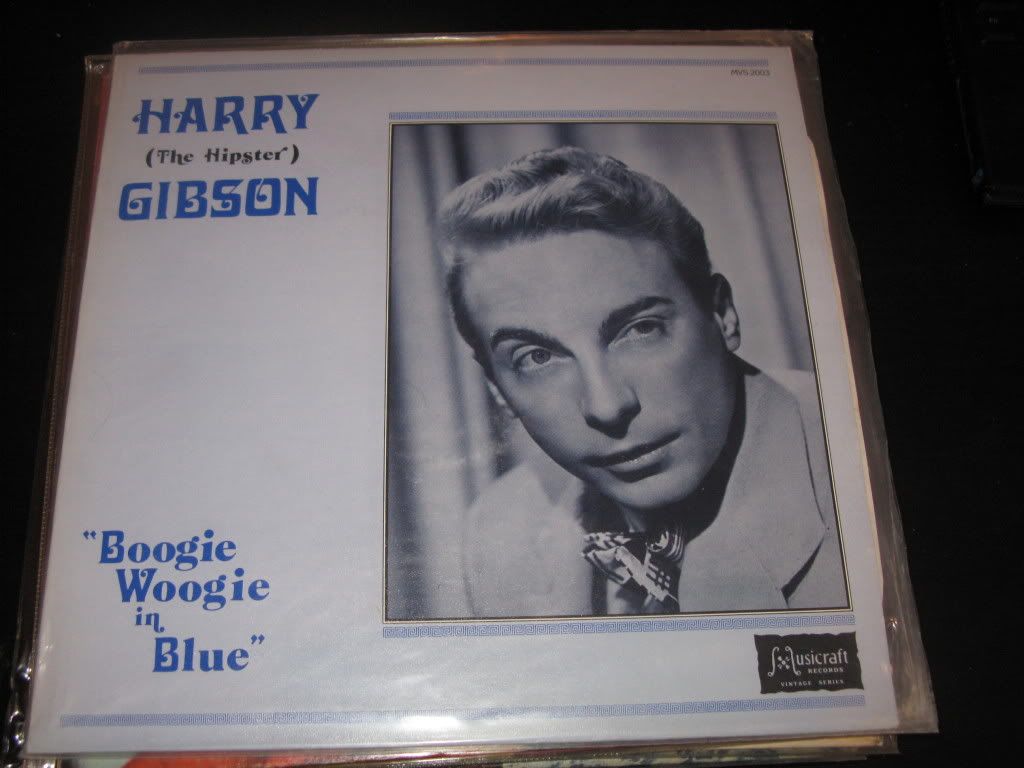
Does that sound familiar? Could it be a description of Jerry Lee Lewis? Look again at his picture on the record sleeve. Is that a quiff he's sporting?

In my view Harry should have featured in Nick Tosches' Unsung Heroes of Rock and Roll. His mix of blues, stride, pop and jazz was rock and roll just ten years too early. By the time that Elvis made rock and roll famous Harry had already done it all. Just listen to the two driving instrumentals on this record and tell me that they are not proto rock and roll!


But Harry was not just a piano player. He was a very funny comic lyricist too. His Hipster name was not just a persona but was really how he lived his life. His use of hip words and phrases was not an attempt the make himself seem cool - or indeed an attempt to ridicule the cool jazz world he was part of. In the fifties he became friends with both Lord Buckley and Lenny Bruce - tellingly both comedians rather than musicians - both men who took hipster slang and used it for square audiences.

Listen to his signature song, Handsome Harry The Hipster. Add electric bass, drums and guitar and you have Jerry Lee Lewis - albeit singing some very funny lyrics.


They call him Handsome Harry, the Hipster
He's the ball with all the chicks
He plays piano like mad, his singing is sad
He digs those mellow kicks

They call him Handsome Harry the Clipster
'Cause he'll hype you for your gold,
He's frantic and fanatic
With jive he's as addict
I don't know, I was only told

And every night you'll find him around the club
Playing and singing so wild
And if you want to get straight with a solid stud
He comes on like a motherless child

They call him Handsome Harry the Drifter
He won't ever marry you, sister
He got a shape in a drape, his story is great
I'm talking about Harry the Hipster
(piano)

They call her Careless Carrie the Clipster
She's the chick with all the tricks
She plays piano like mad, her singing is sad
She digs those mellow kicks

They call her Careless Carrie the Clipster
'Cause she'll hype you for your gold,
She's frantic and fanatic
With dope she's as addict
I don't know I was only told

And every night you'll find her around the club
Playing and singing so wild
And if you want to get straight with a solid stud
She comes on like a motherless child

They call her Careless Carrie the Clipster
She won't ever marry you, mister
She's got a shape in a drape, her story is great
I'm talking about Carrie the Clipster
She's the sister of Harry the Hipster
Yeah, that's right

The main reason I got this record was that I had heard Who Put the Benzedrine In Mrs Murphy's Ovaltine. How it got recorded in 1944 I will never know. There is no attempt to hide the drug references behind any kind of slang or double entendre. They are in your face and at the same time very funny. The lyrics are below:


Mrs Murphy couldn't sleep
Her nerves were slightly off the bean
Until she solved her problem
With a can of Ovaltine
She drank a cupful most every night
And ooh how she would dream
Until something rough got in her stuff
And made her neighbors screa. OW!
Who put the Benzedrine in Mrs Murphy's Ovaltine?
Sure was a shame, don't know who's to blame
Coz the old lady didn't even get his name
Where did she get that stuff?
Now she just can't get enough
It might have been the man who wasn't there
No Jack, that guy's a square
She never wants to go to sleep
She says that everything is sold all reet
Now Mr Murphy don't know what its all about
Cause she went and threw the old man out - Clout
Who put the Benzedrine in Mrs Murphy's Ovaltine?
Now she wants to do the Highland Fling
She says that Benzedrine'e the thing that makes her spring


This is the second chorus you know
The name of this chorus is called "Who put the Nembutals in Mr Murphy's overalls
I don't know


She bought a can of Ovaltine most every week or so
And she always kept and extra can on hnad
Just in case that she'd run low
She never never been so happy, since she left Old Ireland
'Til someone prowled her pantry and tampered with her can - Wham!
Who put the Benzedrine in Mrs Murphy's Ovaltine?
Sure is a shame don't know who's to blame
Cause the old lady didn't even get his name
Where did she get that stuff
Now she just can't get enough
It might have been the man who wasn't there
No Jack, that cat's a square
She stays up nights making all the rounds
They say she's lost about 69 pounds
Now Mr Murphy claims she' s getting awful thin
And all she says is "Give me some skin. Mop!"
Who put the Benzedrine in Mrs Murphy's Ovaltine?
Now she wants to swing the Highland Fling
She says that Benzedrine's the thing that makes her spring


Spring it now Gibson


Some incredible stories about his life that may or may not be true:
He owned a club but was forced to close it because he couldn't pay the cops and the Mafia
Playing with Charlie Parker in LA the two men played a game of draughts, each one moving his piece while the other soloed
He used to play in small towns under the name of Knuckles O'Leary
He was involved in a car accident in a Native-American reservation and while convalescing he fell in love with the chief's daughter. They got married and moved to New York but he had to divorce her when he found out she was a compulsive shoplifter
While serving time for drugs he became the conductor of the choir of the female prisoners' wing
He wrote a hymn that was accepted by the Vatican for the Marian Year


I would have liked to have met Harry. Somehow I think an evening in his company in the clubs of New York would have been a riotous laugh. In place of that I will have to listen to his wonderful music.

Here is a short video made by Harry's daughter and grand daughter -  flip your wig man!


Thursday, 13 January 2011

Exploito psych #3 The Projection Company - Give Me Some Lovin'

 So what do we have here?

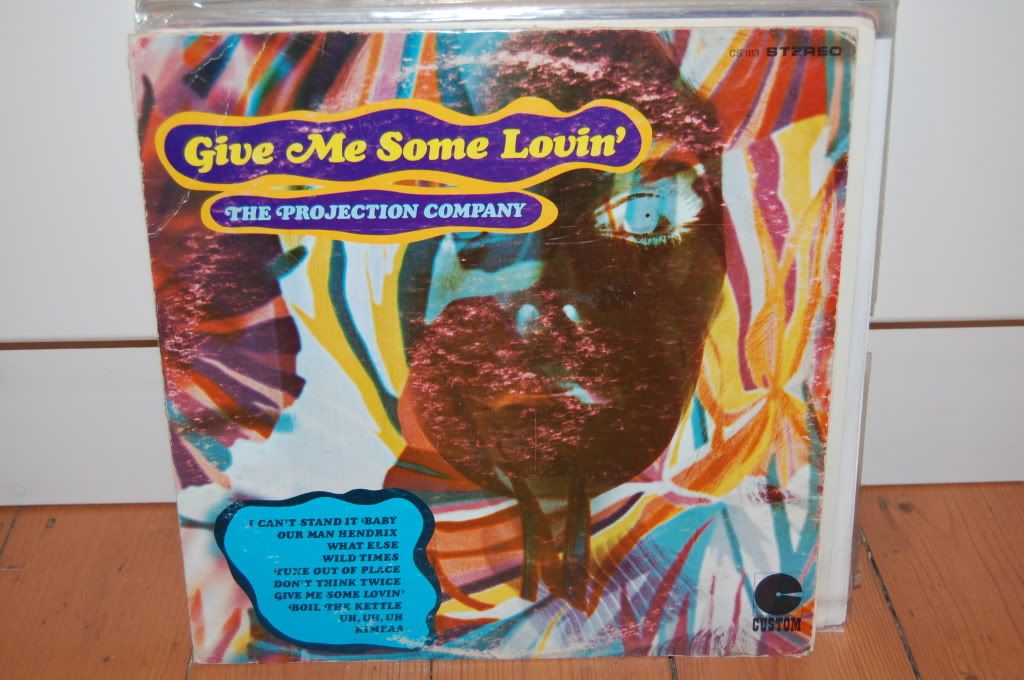
What a moody cover. I'm glad I never saw her what I was tripping!!!!

But its still kinda cool - don't you think?

And it sounds just like that Animated Egg record. Is that because some of the tracks are from the Id sessions?

No, its because ALL of the tracks are Jerry Cole Id/ Animated Egg songs. Some of them you know from the earlier records. But Kimeaa is a true stoned cold freaked out classic. Unless of course you've heard any 60s psych in which case it sounds like just what it is - a pastiche of psychedelic sounds.

But that's ok with me because I love the fake sounds.

The instrumental verion of Boil the Kettle Mother is the highlight - shorn of all the cod-Freudian babble its a fuzz monster of a track.