Writing about music is like dancing about architecture

Thursday, 13 January 2011

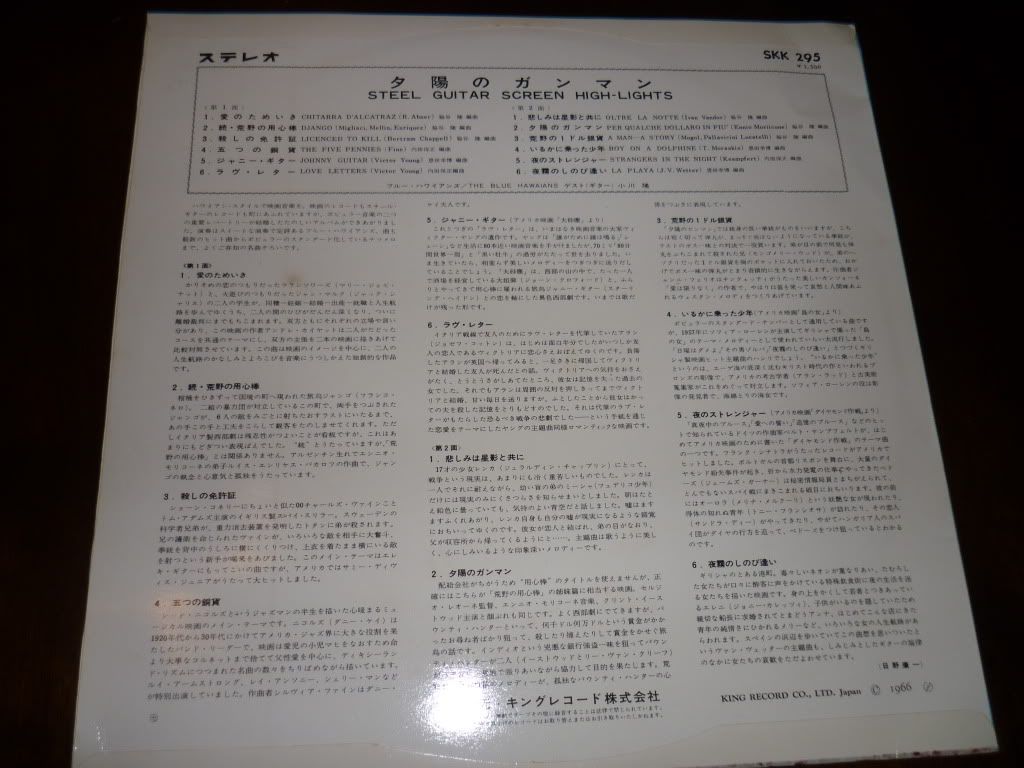
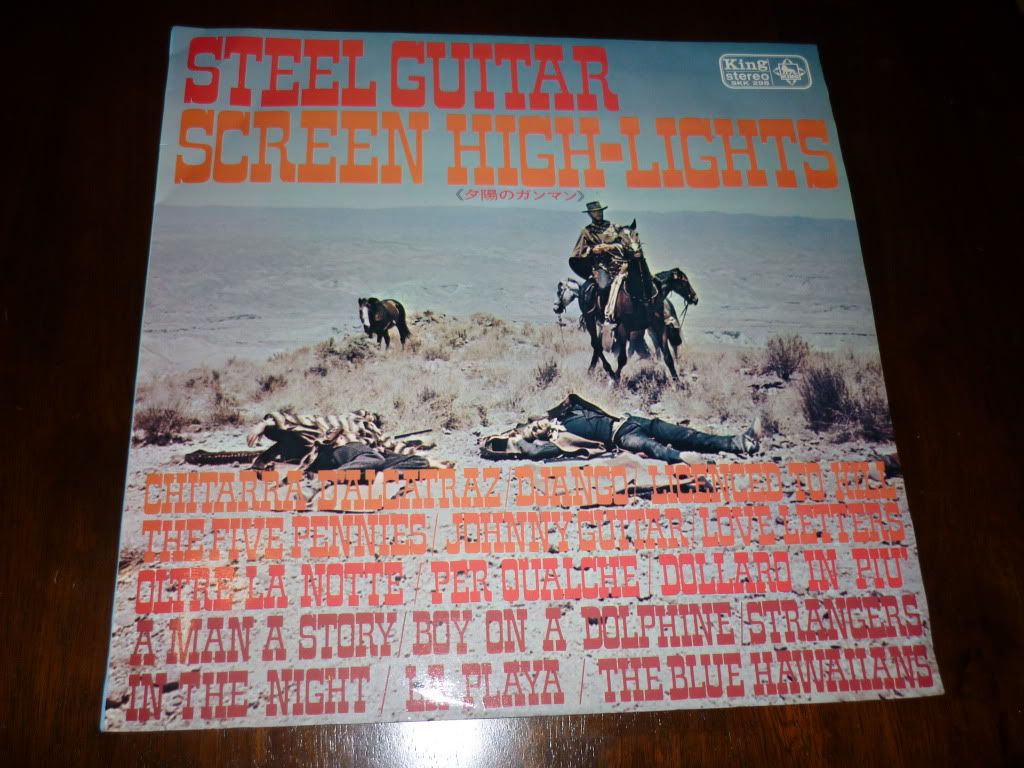
THE BLUE HAWAIANS - STEEL GUITAR SCREEN HIGH-LIGHTS

So, as usual, I'm browsing through some pretty dire records in a charity shop. This time I'm in North London, not very far from where I used to live.
At the back of the box I see this little baby.

Spaghetti Western soundtracks done in a steel guitar style by a Japanese band called the Blue Hawaiians.

Wow, what an amazing car crash of influences - music written in Italy for films influenced by America, played by a Japanese band on an instrument that has become synonymous with country and western music. The influence of America filtered through Italy being played by a Japanese band using instruments that again were filtered from Hawaii through America. Wow!
So a pound changes hands and the interesting record is mine.

I take it home with little expectation. I mean, after all, what can the music be like after my post-modern, cross cultural, multi-layered expectations?

The answer is it can be quite good!

Of course not all the tracks on here are from Westerns. Most are from other movies of the time but that's not a problem.


I guess that this record comes from the eleki period of Japanese music - slightly before the Group Sounds era. There is something slightly like the Ventures In Space - probably the eerie sounds of the steel guitar.
Yes its cheesy - particularly when the Blue Hawaiians tackle Strangers in the Night. But the steel guitar seems to fit perfectly with the windswept, hard man with no name, devil take the hindmost atmosphere of the best Westerns.

So when they get into the Western tunes - Django from the wonderful film of the same name, Johnny Guitar, from the film of the same name that was a huge influence on Lione's Westerns, Per Qualche Dollaro In Piu - For a Few Dollars More and A Man ..A Story from the rather obscure Blood For A Silver Dollar the music takes off into another space. The kind of space that you doesn't make any sense on paper but when you listen to it, seems to make the kind of sense that you know is right.

Try it for yourselves:


Sunday, 9 January 2011

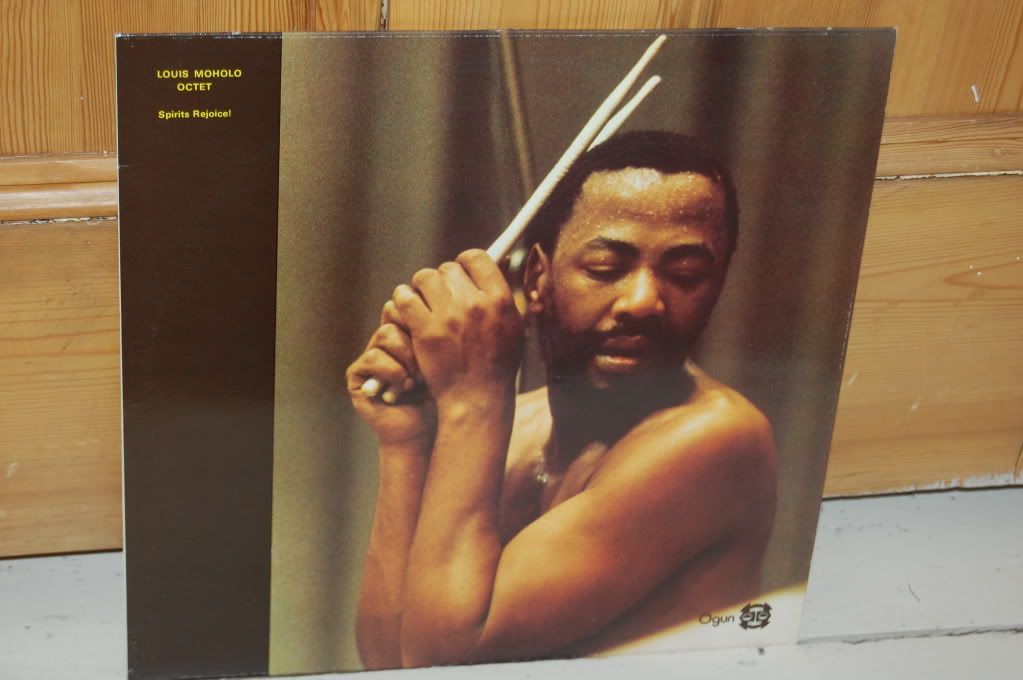
LOUIS MOHOLO OCTET - SPIRITS REJOICE!

I seem to be on a bit of roll with drummers at the moment - no pun intended!
So I've been inspired to pull this record out. 
This is the kind of record that my wife hates - too free, too wild, too unconventional.
Louis Moholo is a South African drummer who, together with Chris McGregor, Johnny Dyani, Dudu Pukwana and Mongezi Feza comprised the Blue Notes. Hounded by apharteid they left South Africa in 1968 ostensibly to play at a music festival in the south of France. They never went back.
After France, they made their way to London where they were to have a profound influence on the jazz scene. Their style of playing, their influences and their radical stance encouraged and nurtured other British jazz musicians who were looking for more experimental approaches. 
The Blue Notes soon split up as a band but the members continued to play together in many different iterations most famously the Brotherhood of Breath.
In interviews Moholo has said that he enjoyed playing with his countrymen Pukwana, Dyani and Feza above all else. Not only were they wonderful musicians but they shared the bond of being exiles, of being black South Africans in Europe, separated from their families, from their homes and cultures. They would often play with other South African exiles but they knew that they could never go back to an apharteid South Africa. All of the Blue Notes, with the exception of Moholo died young and in exile.

Moholo himself once said: "To leave South Africa and to go to Europe, that was my mistake. I did suffer. I even had a heart attack. And people like Mongezi Feza died from depression. Johnny Dyani also died from a kind of depression. We were not happy overseas, but we were free. We were free. I thank Europe for a lot of things, but for other things, we really missed in Europe: it was very, very hard!"
Political freedom and musical freedom, the two are often equated by Moholo. When one listens to the music the Blue Notes played in South Africa and compares it to the music they created when they came to Europe you can hear that their playing was becoming increasingly freer. Perhaps they felt that they could express themselves in ways that were not possible in South Africa. They were undoubtedly exposed to musicians and recordings that would have been impossible to hear at home.
But I like to think that the rage and anger of being exiles coupled with the sheer joy of being free (musically and politically) came together to make challenging and avante garde music. 
If you have trouble with free jazz - then don't listen to this record. However, what lifts it above and beyond most European free jazz in my opinion are the South African elements. I'm no musicologist so I'm not about the go on about marabi, mbaqanga, kwela or other South African styles of music. Suffice it to say that this is music that could only be composed by South Africans. 
The Octet comprises Moholo, Evan Parker, Kenny Wheeler, Nick Evans, Radu Malfatti, Keith Tippett, Johnny Dyani and Harry Miller - a mix of Englishmen and South Africans.
For me the highlight is Mongezi Feza's You Ain't Gonna Know Me 'Cos You Think You Know Me. It has a wonderful repeated theme that you will find sticks in the memory and refuses to become dislodged. Kenny Wheeler's trumpet is masterful, but I can't help but wonder what Feza himself would have made of if. By the way is you get the chance, listen to Zim Ngqawana's recent cover of this track. 

I also find the last track Wedding Hymn, to be very moving. Composed by Pat Matshikiza for the jazz opera King Kong it is a haunting and beautiful piece of music. King Kong played in London which gave many of the musicians in the orchestra the chance to escape apharteid. Musicians such as Miriam Makeba, Hugh Masakela, Jonas Gwangwa and the Manhattan Brothers went into voluntary exile. I am sure that Moholo is commenting on his own exile and that of his countrymen by choosing to cover a song from King Kong. By slowing it down he turns a wedding hymn into something that sounds like a funeral march. Surely a comment on the double edged nature of finding your freedom but losing your country. Kenny Wheelers trumpet is again wonderful but Keith Tippett's piano solo is also commanding and Dyani's bass playing is as imaginative and creative as ever.
Throughout the record Moholo's drumming is exemplary - as you would expect. However, this is a recording of a band rather than a soloist and his backing group.

Thursday, 6 January 2011

PHIL SEAMEN MEETS EDDIE GOMEZ

With a blog that cribs its name from a zombie movie you'd expect a few horrors!
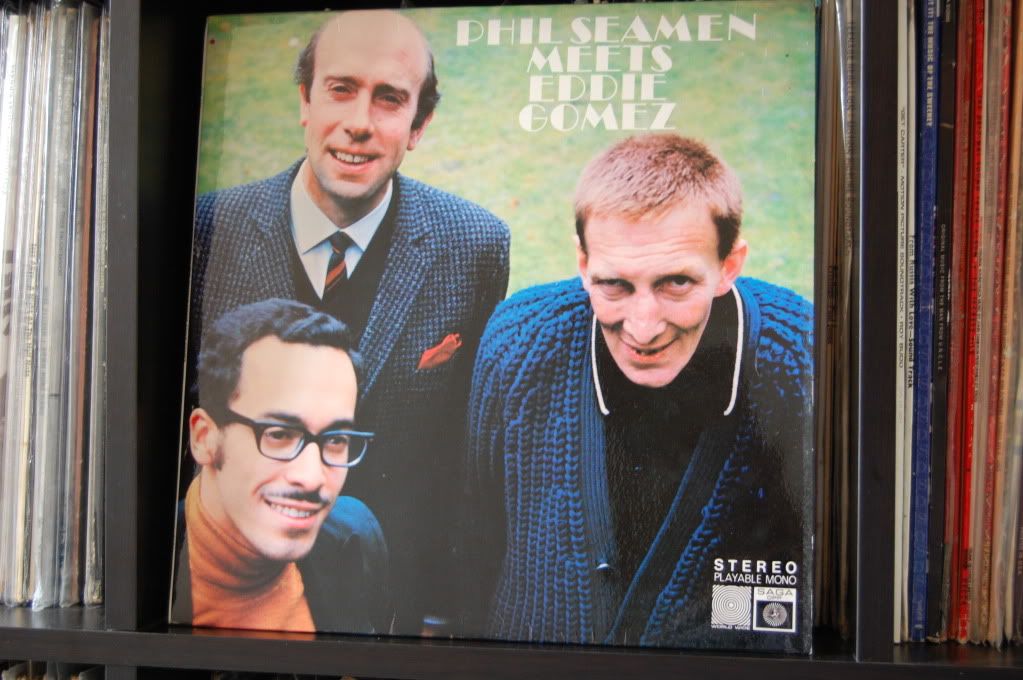
Blimey, the design department at Saga Records obviously had something more important to do than create an interesting cover for this record.
You can imagine someone taking the trio out of the studio once they'd finished recording, walking them to a park, standing on a box and taking exactly one photo.
Poor old Eddie, who is clearly the best looking and best dressed of the bunch, is squeezed into the bottom left hand corner and is actually a little out of focus. The dapper chap in the top left is pianist Tony Lee, who looks like he's just about to go to the golf club for a couple of sherries.
And then there's Phil. How old do you think he was when this photo was taken? He was only 42 but years of drink and drug abuse are clearly shown on his face.The dark bags under his eyes, the sunken cheeks, the jagged teeth glimpsed through the wane smile. I don't like his heavy knit cardigan either, but that's another matter. He looks a like he's in a bad way. And its entirely possible that he was.
Here is Coleridge Goode, another bassist, describing Seamen during the session for Joe Harriott's Swings High album which was recorded in 1967.
"Phil's health worried me a lot that day. He was in a bad way and I thought he didn't have long to live (in fact he died in 1972). But as always he sounded good: he was incapable of playing badly..."
That seems to be the consensus about Seamen. His heroin addiction made him difficult and unreliable off stage but once he was behind the drums he was a wizard. He played with most of the great British jazz players such as Joe Harriott, Tubby Hayes, Ronnie Scott as well as Alexis Korner's Blues Incorporated and many visiting  US players such as Stan Getz, Roland Kirk and Freddie Hubbard.
He was resident drummer at Ronnie Scott's in 1968 when the Bill Evans trio played there and, according to the sleeve notes, he met Eddie Gomez at a party afterwards and they ended up recording this record the very next day. I guess it was a nice little earner for all concerned.
Seamen's playing is amazing throughout. His solos are captivating, exhilarating and always interesting. He really propels the music not simply through rock steady time keeping, although that is there too, but through interpreting the music and giving it depth.
Gomez, as you would expect, is also imaginative and creative in his playing and, although the two men didn't know each other, you can hear that they were musically on the same wavelength.
Poor Tony Lee, his piano is way down in the mix and he rarely gets a chance to shine. Having said that his playing is solid throughout.
What does let the proceedings down somewhat is the unimaginative choice of tracks. But I guess you have to stick to well known standards if you have never played together before!
Seamen gets the best of it on the opening track, Nigh Train, while Gomez plays at a furious rate through Salt Peanut, despite some powerful, almost overwhelming solos from Seamen.
If ever there was a drummer less suited to the soft brush work of bossa it was Phil Seamen and on Corcovado the trio start well but the track drifts off about half way through. How did A Foggy Day become a jazz standard? Anyway they give it their best and it really swings.
On side 2 they kick off with Toots Thielman's Bluesette and Tony Lee finally gets some space for his playing to show through. Gomez is particularly good on this track. Fish This Week also swings with Seamen really having a go at his (swinging) cymbal.
Autumn Leaves is Gomez's track and his playing is amazing. With the solid drum and piano backing he is just all over the place and really taking it as far as he can go.
And the record finished with another ode to rain, Here's That Rainy Day and Seamen, again on brushes, makes it sounds as though the rain is coming into the studio. Melancholy at its best.
He might look like a mod who's seen better days but as Coleridge Goode points out, he couldn't play badly. 
Wednesday, 5 January 2011

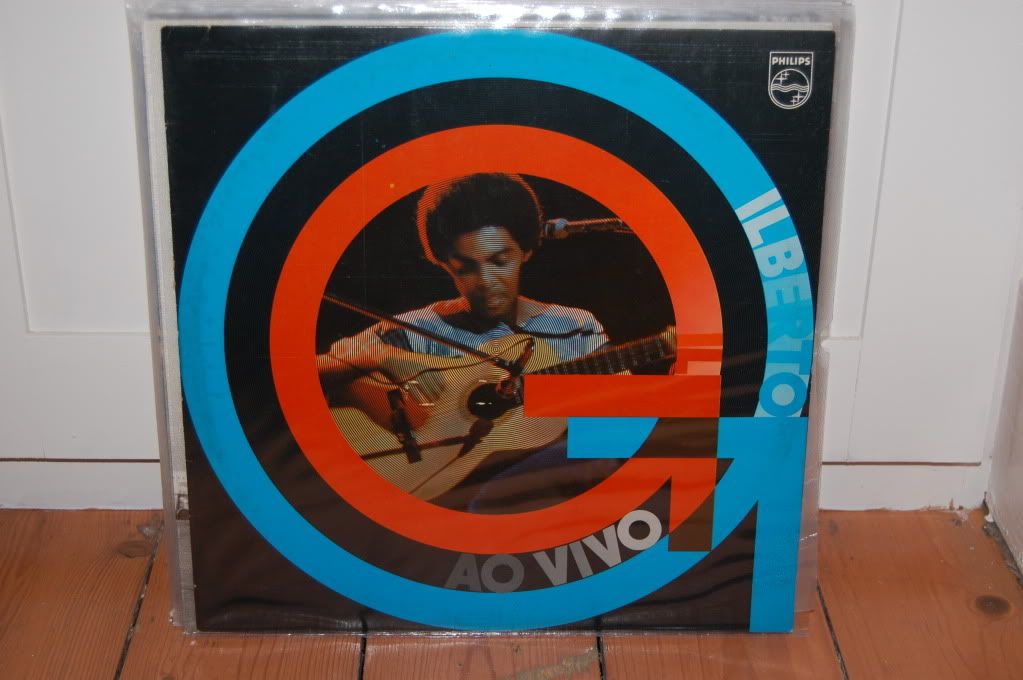
GILBERTO GIL - AO VIVO

Chance, fate, luck - strange and wonderful things.
Like many of his compatriots Gilberto Gil has put out a lot of records which are self titled and this can sometimes make it tricky to know which one is which unless you can see the covers.
So I bought on line what I though, was a copy of the record he made while in London in exile.
Imagine my surprise which this turned up! I hadn't even heard of it before. So I contacted the seller and he just said that I was lucky and that was that!
And he was right because this is an increadibly record.
Recorded during a concert in Sao Paulo in 1974, if it wasn't for the crowd noises you could be forgiven for thinking that it was a studio album - the musicianship is that good.
As far as I can tell none of the tracks here appear elsewhere - but do correct me if I'm wrong.
Backed by a small band Gil is at the very height of his musical abilities. It must have been a wonderful concert.
His band is soft and subtle but electric - electric organ, guitar and bass. Gil's voice and acoustic guitar together with some imaginative percussion keep proceedings from getting too rocky. Indeed throughout the record there are elements of bossa, samba, xate and jazz which fuse together to make a truely unique music.
The main focus however, is Gil's warm, assured voice. It is the central element in every song, the musicians really just providing backing for the voice with few solos and little improvisation. His scatting and falsetto keep each song alive with unexpected twists and turns.
One can see why so many Brazlian musicians became part of the US jazz-fusion scene. They were already used to taking different musical styles and mixing them up and the level of their musical ability was such that they could play jazz as easily as any other style.
Favourites are  Abra O Olho where he accompanies himself on acoustic guitar and manages to be completely spellbinding, and the funky Menina Goiaba which starts slowly but ends at a furious pace that is perfect for dancing. The set closes with the very funky and cool Heroi Das Estrelas. It sounds as though the band were at last waking up after having provided polite backing for the earlier songs and were suddenly in the mood to get down.
Its just a shame that more of the concert wasn't captured - unless of course he only played for about half an hour!

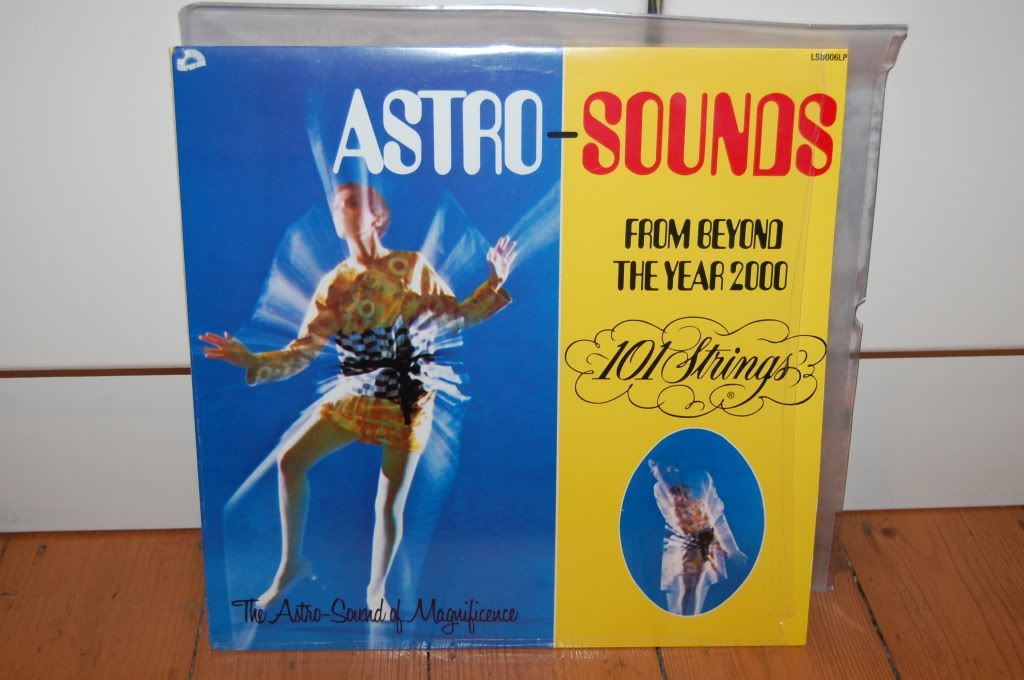
Exploito psych #2 - 101 Strings - Astro Sounds Beyond the Year 2000

I've never been clear why this record seemed like a good idea at the time.
I mean, here you are running Crown and later Alshire, both cheap exploitation record companies and you get your hands of the original masters on some great west coast psych by Jerry Cole, intended for the Id album but never released.
So you do the obvious thing and put it out on record and give it a stupid 'hippy' name - the Animated Egg.
But what weird chain of thought do you go through that leads you to think that you can add strings, give it a space age feel and sell it to middle American 101 Strings buyers? Maybe they thought that times had moved on and people were ready for something different.
Well, something different was exactly what they got.
All of the Animated Egg tracks appear here - just with different names. Overdubbed on each one are some, frankly, freaky string arrangements. Amazingly it works!
In my opinion Astro Sounds is a better record than either the Inner Sounds of the Id or the Animated Egg.
Maybe those wacky guys in charge of Alshire Records did know what they were doing!


The spirit of the age was obviously catching, because in the same year Alshire released 101 Strings - Sounds of Today.
Although it has nothing to do with the Animated Egg it does have some great covers and some very good originals (Stone Baroque, Karma Sitar, Blues for the Guru and Strings for Ravi) by Monty Kelly who would arrange most of the best 101 Strings records in the sixties. These tracks would reappear on a number of other records - some of which we will meet in later posts!
I love this record. I love the wildly over the top covers of MOR standards. The imaginative mix of strings and small 'pop' group sounds. It a great record all the way through.

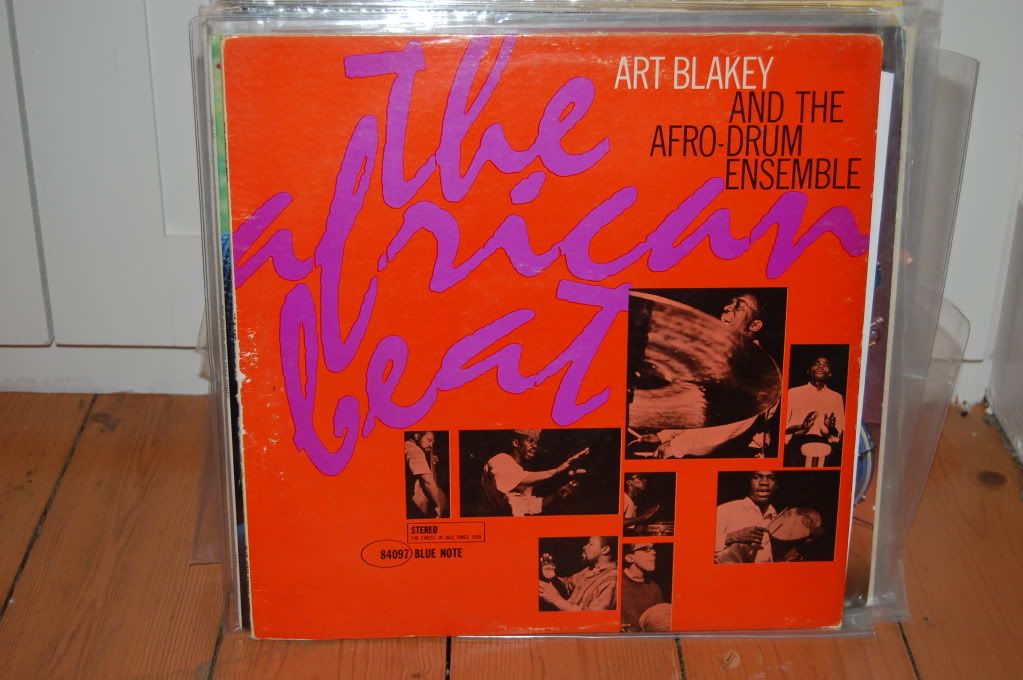
ART BLAKEY AND THE AFRO-DRUM ENSEMBLE - THE AFRICAN BEAT

You all know about Art Blakey, right? The Jazz Messengers, Moanin', The Big Beat, Holiday for Skins, Orgy in Rhythm?
Blakey is the kind of drummer who makes you think he hates his drums. That's the only reason he could have for hitting them repeatedly and so hard. He must have been one hell of a drum-phobe. Have you seen the way he looks on the cover of Orgy in Rhythm?
Apart from his fierce attacking method, Blakey also knew a thing or two about musicians. Just look at the people who came through his Jazz Messangers!
By the late fifties and early sixties people in the US jazz world had become very interested in the music of Africa. Initially conflating African music with that of Latin American, in particular Cuba and Argentina, the jazz world began to incorporate increasing elements of 'exotic' musics.
It's no coincidence that this coincided with many jazz musicians finding Islam. Many black jazz musicians, as well as writers, poets, academics and others, began to turn their backs on Western modes of thinking and look to Africa for inspiration. As the civil rights movement in America became more prominent and, in some cases, more violent, many black Americans wondered what they owed to the modes of thinking and behaving that had come to them from white America. People wanted to shed their names, names given to them by slave owners. People wanted to shed their relgions, forced on their ancestors by slave owners, and return to religions that they might have had before slavery. People wanted to move even further away from Western approaches to music and adopt musical styles from Africa.
Blakey himself went to Nigeria as a merchant seaman in 1948 and is supposed to have converted to Islam and taken the name of Abdullah Ibn Buhaina. He later denied that he had gone to Nigeria to study drums and indeed said that jazz was emphatically American and owed nothing to Africa.
How then is one to take this record?
Blakey surrounded himself with some of the best musician's from Africa he could find in New York in 1962. Solomon Ilori and James Ola. Folami from Nigeria and Chief Bey from Senegal. From Jamaica came Montego Joe( read about his solo records here). From the US came Yusef Lateef (Read some Yusef Lateef stuff here) and Ahmed Abdul-Malik (Read about him here) both converts to Islam and both already investigating music from Africa,Garvin Maseaux who was studying the Yoruba in Nigeria and finally Robert Crowder and Curtis Fuller.
For me the stand-out track is Love, The Mystery of by Guy Warren (have I mentioned I'm kind of obsessed by him?). (You can read about Warren's original recording here) What a shame he doesn't play on the record itself. The track opens with a snaking sax line by Lateef that is followed by chanting. Underpinning the sax and the chanting are Blakey on the drums and others on various percussion. Lateef moves on to oboe and then Blakey is given the space he needs for a thundering drum attack. Abdul-Malik keeps the whole proceedings together with a rock steady bass-line and Blakey drops one drum bombshell after the other with Lateef adding scrapper in the background. Then Lateef comes back in on oboe with a long sustained note that rises above Blakey's furious drums until the entire track gains an unstainable intensity and the chanting begins again until it is faded out at the end. Altogether beautiful stuff.

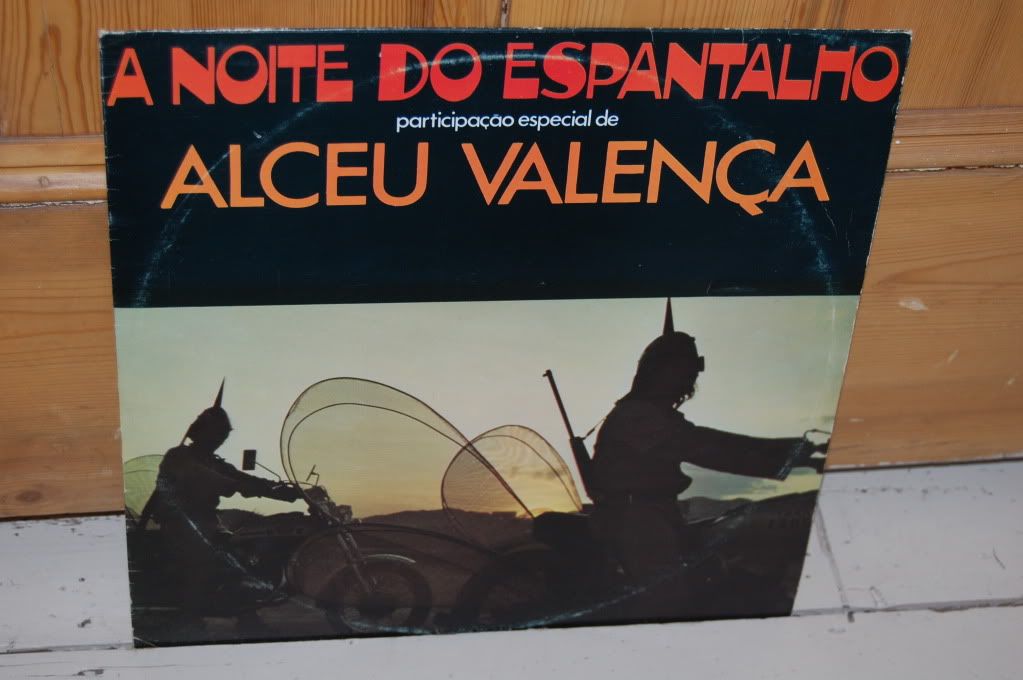
SERGIO RICARDO - A NOITE DO ESPANTALHO

I am always amazed at how many wonderfully talented people Brazil has produced.
One of thos is Sergio Ricardo. Not a name I was at all familiar with until I read about this record in Increadibly Strange Music Vol 2. Jello Biaffra calls it psych-sploitation Brazilian style. That alone was enought to pique my interest.
However, it is much more than an exploitation record and Sergio Ricardo is much more than a Brazlian Davie Allan.
Ricardo was one of the earliest members of the bossa nova movement in the mid 50s, taking one of Jobim's nightclub gigs and letting Joao Gilberto sleep on his floor. He was a classically trained pianist but had also been an actor in TV shows. He toured in the US and Europe but by the mid 60s, as the momentum was going out of bossa nova, he started to make films. He proved to be just as adept a film-maker as he was a musician and his films began to recieve international recognition, particularly in France.
For A Noite do Espantalho, Ricardo not only directed, he produced, co-wrote the script and the soundtrack. The film tells the story of a peasant uprising in northeast Brazil and is increadibly stylised and dramatic - as you might guess from the cover shot of two bikers wearing spiked helmets and riding bikes with fairy wings!
I am not sure why Ricardo asked singer Alceu Valenca to sing on the soundtrack. It may well be that as the film is set in the northeast of Brazil, Ricardo wanted someone from that region. Valenca is well known for using the traditional music of the region but giving it a modern twist.
It is, I think, an inspired pairing. The music, as one might expect, has a dramatic, cinematic quality and Valenca's strong voice brings this out.
There are also very strong folk elements to many of the songs, perhaps not surprising in a film about a peasent uprising. These songs have a, largely, acoustic backing using flutes, accordians and the inevitable guitar. However, there is a constant unsettling, dream-like quality to the music. Something is bubbling underneath that is not pleasent and sometime it comes to the surface. A track such as Briga De Faca is quite scary in its way.
The two tracks which feature the beautiful voice of Ana Lucia de Castro are also worth mentioning.  
A quick word about the cover. My copy of this is from the early 80s and for some reason it reverses the front and the back covers. On my copy the back cover is a painting by Sami Mattar, a well known Brazilian artist and illustrator. If I get the time I'll post a pic of the back cover.